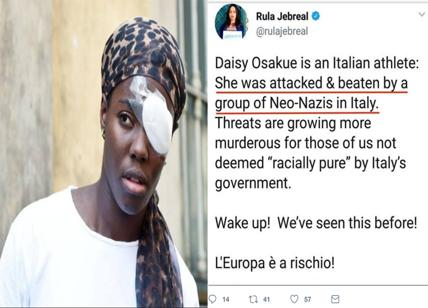
La fake su Daisy Osakue. Ecco chi l'ha alimentata
Written and reported by Antonio Amorosi
La fake su Daisy Osakue. That's who fueled it. Even in foreign newspapers..


Written and reported by Antonio Amorosi
La fake su Daisy Osakue. That's who fueled it. Even in foreign newspapers..
 by Carlo Freccero
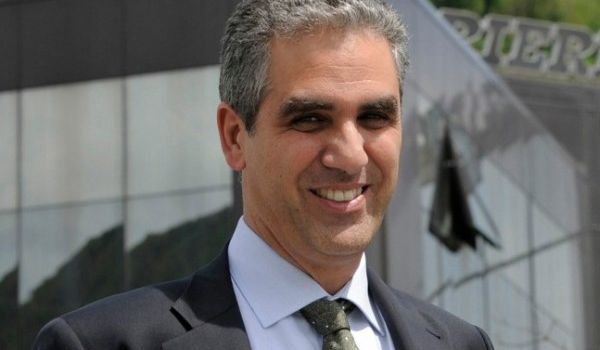
It's from 2006, a year that in terms of the fight against fake news is prehistoric, that Foa analyzes the problem of truth in politics. His book The sorcerers of the news, of which among other things the update has been released, critically analyzes the phenomenon of spin doctors and its implications in terms of democracy. The figure of the spin doctor is not a figment of the imagination of conspiracy theorists, but an official figure, well paid, which has long been involved in organizing the electoral campaigns of Democratic and Republican candidates in America and which, more recently, it was also introduced in Italy. I remember the spin doctor who followed the Monti government and the complete Americanization of the Renzian electoral campaign. The spin doctor is not bound by the truth. Read More
 Of Marcello Veneziani
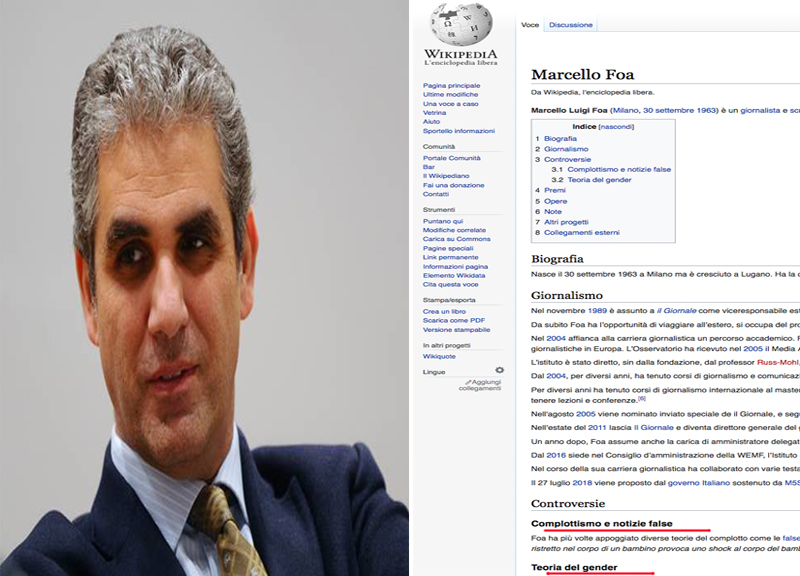
But don't be ashamed to accuse the government in office and Salvini in particular, Of divide up the appointments as you have practiced all your life? Don't be ashamed – you leftists, you left-wing intellectual clergy, you left-wing newspapers and news, you seasoned Rai trade unionists and you more hypocritical and pompous right-thinking crypto-leftists – to cry scandal and be indignant just because the Grillini and the Northern League members, in modo naive, they follow the ways of subdivision that you have been practicing with servile professionalism for decades? On the contrary, in Renzi's time we even had to regret the usual division, because he took everything, on Rai and beyond. This time the rock of the scandal was Marcello Foa, came from the Giornale di Montanelli and then remained at the Giornale di Feltri until he moved to the Canton of Ticino to teach communication science and manage a Ticino publishing group. Never been involved in politics, no blemish on his criminal record or reputation, no suspicious connection. Nothing scandalous. But for the valiant Italian Information Collective plus Pd, starting with the Corazzata Repubblika, Foa says he is a student of Montanelli (a boaster, so), teaches manipulation of news i.e. fake news and not communication science, he is even a guest on Russia Today and therefore is a hired servant in Putin's service, he even retweeted something by one Francesca Totolo, “patriot financed by Casa Pound” (which notoriously has billions, other than poor Renzi with his little paper plane, at our expense, which cost a few hundred million). Read More
 If we want, It's curious but not new, read how the expressions of the Grand Master of Freemasonry coincide with those of Bergoglio and his predecessors and conciliar friends, as well as the left-wing and liberal political galaxy. Not to mention the centrist world, which seems to feed precisely on the GOI…(N.d.R.)
Stefano Bisi, Grand Master of the Grande Oriente d'Italia: “This is what it means to be a Freemason today”
Of Daily Blitz editorial team
ROME – What it means to be a Freemason today? The answer is Stefano Bisi, Grand Master of the Grande Oriente d'Italia, Italian journalist and writer, in an interview with Salerno News 24. [Blitzquotidiano app, free, Click here,- Ladyblitz click here –News Today, App on Google Play] Bisi explains that nowadays we live in an era of "great tensions and divisions", but being a Freemason means being part of an initiative that stands in defense of "free thought" and has the aim of “uniting men building meeting bridges”.
Interviewed by Claudia Izzo, which underlines how harmony and perfection are elements longed for in the obedience of the Grand Orient of Italy, Bisi explains the meaning of Freemasonry today:
“Being part of an extraordinary initiatory school that aims at the improvement of Man and which defends great universal values such as the Freedom, the Brotherhood, l’Equality, the Tolerance, the dialogue, il respect for man and rights. We live in a time of great tension and division on a global level and Freemasons today have a difficult but exhilarating task: that of being defenders of free thought and of uniting men by building meeting bridges and not impassable walls which lead to the disaster of humanity".
Speaking about the seizure of the lists of Calabrian and Sicilian freemasons by the Anti-Mafia Commission in 2017, Bisi explains that he believes the filings are a danger to democracy and what a national filing would imply: Read More
Of Alberto Cossu
Source: Vita
False polarizations
Prestigious national and international newspapers present themselves to the public as the guardians of democracy and freedom of the press. They attack the producers of fake news in both print and digital media and assert that their behavior is execrable because it destroys the essence of democracy. They represent the reality of the mass media as divided between those who are intent on fabricating false stories, and those who, Instead, they are moved only by strong moral principles and immune from this vice. Their editorialists and journalists report political facts with extraordinary objectivity and woe to anyone who tries to question this fact. The media lynching follows, which ranges from the accusation of attacking the freedom of the press to the classic one of being a fascist and if the unfortunate person does not resign himself and insists he is addressed as a neo-Nazi. The media tribunal works and is very efficient and does not spare anyone who has the courage to raise their voice above the chorus. But things are not as the masters of communication want us to believe.
The Juncker case
A striking case was offered at the NATO summit in Brussels. In the aftermath of the meeting, various traditional and digital media spread images of President Juncker who, pretty beat up, appears staggering at the closing ceremony of the Summit. He has difficulty climbing the two steps of the main box, when he manages to do so he kisses, staggering, everyone who is within earshot of him and exchanges slightly excessive affectionateness which is certainly not foreseen in the official protocols. Read More
 |
Monstrous lifetime salaries for doing nothing or at most telling lies" scandal in Rai, Milena Gabanelli reveals the crazy prebends of the do-nothings of state TV on Monday 16 July 2018 “Monstrous salaries for life for doing nothing or at most telling lies” scandal in Rai, Milena Gabanelli reveals the crazy prebends of the do-nothings on state TV Milena Gabanelli …
Read all.
Of Enrica Perucchietti

Source: On Earth
the care of Federico Cenci
In political dialectics, for some time now, there is a quick and effective way to delegitimize your opponent: accuse him of spreading fake news. Yet another English term has forcefully entered our vocabulary, taking on the form of a social alarm among public opinion. Such is the sensitivity of some political forces on the topic in various countries – including Italy – laws to combat fake news are taking shape or have already been approved. However several bloggers, journalists, essayists denounce that this battle against false and misleading news is moving towards a dangerous edge: that of violation of freedom of information. The journalist and writer is also convinced of this Enrica Perucchietti, than in his book Fake News (Arianna Publishing, 2018) depicts a dystopian intent behind the campaign against fake news. On Earth interviewed her. Read More
 We already talked about it at the end of June. The law he would have, in all likelihood, gagged us too, it didn't pass. At least for the moment…(n.d.r.)
STRASBOURG – The European Parliament blocks copyright reform. L’Eurocamera, meeting in plenary in Strasbourg, rejected the start of negotiations with the Council (318 no, 278 yes and 31 abstained) on a proposed directive that had split the Assembly in half. Now the discussion of the proposal is postponed to the next plenary, in September, but it is likely that the text on the digital single market is destined to run aground on further amendments between now and the end of the legislature. Also because time is running out: in May 2019 we return to the polls for the European elections and the assembly that is expected to be "quite different".
The unknowns of September
At least to use the euphemism of a European Chamber spokesperson. The topic has never been easier, but the situation became heated after approval, last 20 June, of the amendments of the Legal Affairs Committee. The changes to the articles sparked the controversy 11 e 13, i.e. the obligation of economic recognition of the contents disseminated by the platforms (item 11) and installing a “filter” to prevent copyrighted material from being uploaded online (item 13). Actually, the directive concerns more the relationship between online platforms (come YouTube o Google) and publishers and end users. The intention of the text is to regulate the economic recognition of copyright in the Web era, replacing a regulatory system stuck at 2001. Read More
Written and reported by Antonio Amorosi
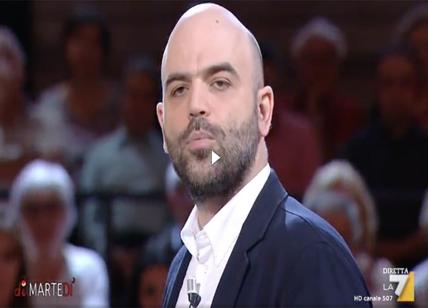
Saviano on immigration on Di Tuesday, Floris. Rhetoric, fake news and errors