Holy Land: water is not the same for everyone

Image results for Holy LandReporting of Federici Studies Center

Thirsty Palestine
Having running water at home in the Palestinian Territories is not at all obvious or normal.
Neither in the West Bank nor in the Gaza Strip. For multiple reasons. Some testimonies from Bethlehem.
Observing the landscape around Beit Sahour, urban center east of Bethlehem, the cisterns on top of the houses allow Palestinian homes to be distinguished from buildings that are part of Jewish settlements. This is explained by the locals who every day deal with the problem of water shortage. The tanks on the houses are useful, Indeed, to conserve water or collect rain, but not all homes need it. In the West Bank, water is distributed differently from house to house, at a distance of a few meters from each other. To overcome the inconveniences of the water emergency, the population does its best, but the problem of resource management remains an open wound that shows no signs of healing, indeed it is "an obstacle to peace", as the BBC defined it.
According to the Palestinian Water Authority, il 95 percent of Palestinian water supplies are found in aquifers (there are three underground basins). Surface water, that could theoretically be available, instead it comes from the floods of the wadis (seasonal streams), from the possible desalination of the waters of the Dead Sea and the Jordan River. None of these resources, However, it is in fact usable by the Palestinians.
Read More

Share

1948 – 2018: the catastrophe of the Palestinian people

Reporting of Federici Studies Center

Life as refugees, the story of Hejar and his family
These days in the Holy Land, the Israelis celebrated their independence and the Palestinians their national tragedy, which we reread through the eyes of Hejar Zghari, refugee in Bethlehem.
A dumpster burns, filling the air with a sour smell. It's a Thursday morning and in the narrow streets of the Dheisha refugee camp, at the gates of Bethlehem, there is almost no one there. Hejar Zghari opens the doors of his home to us, surrounded by other concrete buildings in the camp, populated by 15 thousand Palestinian refugees.
Cheers ha 67 years («I am the first born in my family in the camp»), born in diaspora and raised as a refugee. She graduated here, she got married and became a nurse, mother and grandmother. She appears dressed in traditional clothes and a plate of fruit: Tells: «I am originally from Zakaria, between Ramle and Hebron: ours was a peasant village, there were olive trees, fields cultivated with cereals and orchards. My five brothers were born there. My mother and father had a beautiful house, many animals, rabbits, sheep, goats. When the Zionists arrived they were chased out of the village. Adolescents and young people up to 30-35 years they were taken prisoner. Many of them were killed, a pregnant woman was also murdered. The rest of the village, little more than 1.500 people, he was terrified: they all ran away".

Read More

Share

The embassy of death

Of Niccolò Inturrisi
The embassy of death
Source: The dissident intellectual
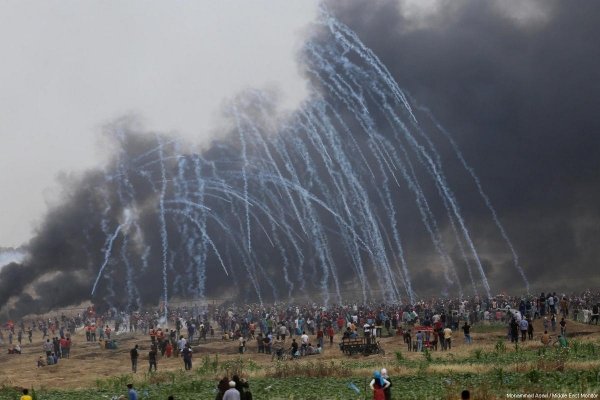
After the months spent amidst controversy and mockery, was held on the day of the seventieth anniversary of the birth of the State of Israel the official inauguration of the new US embassy in Jerusalem. However, what the American president had naively declared as a day dedicated to the hope of a "pace” was resolved, as was predictable, in a massacre by Israeli soldiers against the Palestinian civilian population. We don't just want to dwell on the almosts 2000 injured and beyond 50 dead killed by Israeli bullets – packed, shipped and sold directly from the same country that believes itself to be the bulwark of the survival of democracy in the world - to underline an obscene and deplorable situation that no European country deigns to condemn with due attention. It's precisely this lack of coherence, not just media, but sincerely political, which leaves those astonished (like all of us) has witnessed a real transformation over the last twenty years diktat by the government of Israel: not only political and economic dominance, but above all social and cultural compared to a population that has seen its native land usurped, forced to live on a strip of land and, not humiliated enough, denigrated and left to their own devices by the great world powers. Read More

Share

When Zionism collides with reality

Of Stanley L. Cohen*
When Zionism collides with reality
Source: Comedonchisciotte
“The wrongs we seek to condemn and punish were thus premeditated, so evil and so devastating, that a civilization cannot tolerate them being ignored, because it could not survive their reiteration"
With these authoritative words, Robert H. Jackson, Chief U.S. Attorney, had opened the work of the War Crimes Tribunal in Nuremberg, Germany, immediately after the conclusion of the Second World War.
In charge of ascertaining the guilt of prominent members of the army, of politics and the judicial apparatus for violations of international laws... including war crimes, crimes against humanityand against them laws of war…the court had validated the principle of personal responsibility for the genocide against Jews and other ethnic groups, that had been considered, from the German state, a threat to one's own, declared, racial supremacy, religious and political.
Although these crimes had manifested themselves in different forms, their savagery resulted, actually, from a shared collective thought, who considered all those destined to be suppressed by the state not only (beings) inferior, but unworthy of life itself… men, women and children, young and old, reduced to little more than objects of grotesque derision, whose very existence contaminated the national concept of racial supremacy.
There are no more secrets about the terror campaign unleashed from the Third Reich, as he invaded nations and unleashed international violence never seen before. Nor have its methods of total war ever been subject to serious debate, both towards the military, than against civilians. Even if someone has chosen to dispute the number of victims or to rework the exact instruments of persecution, no serious historian doubts the role played by cattle trucks, from the ghettos and crematoriums in a conscious effort to silence the diversity of life, while most of the world looked elsewhere. Read More

Share

Gaza Cristiana


Reporting of Federici Studies Center

Gaza, the oldest monastery in the Holy Land will be saved
Thanks to international funds, A two-year plan to restore St. Hilarion Monastery and Jabaliya Church has been initiated, monuments from the Byzantine era. With positive repercussions for Palestinian civil society.
The Palestinian enclave of Gaza hides a priceless cultural treasure, especially Christian, too little known and protected, often threatened by time, climatic events, sand, negligence, uncontrolled urbanization and recurring conflicts (three in the last decade alone). It took little for one of the most important early Christian testimonies of the Holy Land to disappear. A Nuseirat, about ten kilometers south of the city of Gaza, near the coastal dunes, the oldest monastery in the Holy Land is located, dedicated to Saint Hilarion and dating back to the 4th century.
Excavations in the monastery began in the 1990s and since 2012 it is included in the World Monuments Fund's list of the most threatened sites in the world. Also the Byzantine church of Jabaliya, discovered in 1996 a few kilometers north of the city of Gaza, risks the same fate. Resting place for pilgrims, it is known for a rich mosaic, damaged during the war 2012. (…)

Read More

Share