

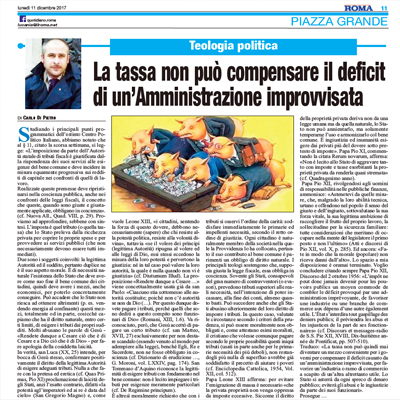
Studying the main programmatic points of the extinct Italian Political Center, we noticed that in § 11, mentioned last week, it reads: «The imposition by the State Authority of fiscal taxes is justified by the correspondence of its services to the needs of the common good and must have an equally progressive impact on capital income compared to labor income. Once these premises have been achieved, it must reinstate itself in the public consciousness, also with respect to tax laws, the concept that these, when they are right and rightly applied, oblige in conscience". (cf. New All., Quad. VIII, p. 29).
Let's try to delve deeper, albeit with summary. The tax is that tribute (or that tax) that the State withdraws from private wealth to cover its expenses and to provide public services (which do not necessarily all have to be immediate). There are two subjects involved: the legitimate Authority and the subject, therefore its moral aspect is twofold. The existence of the State is of natural necessity and must have the common good of its citizens as its aim, therefore he must have the means, also cheap, to be able to actually achieve it. It may happen that the State is unable to obtain otherwise (p. es. selling energy to the neighbor) these means, totally or partially, so that we understand that he has natural right, within certain limits, to demand taxes from their subjects
Let's try to delve deeper, albeit with summary. The tax is that tribute (or that tax) that the State withdraws from private wealth to cover its expenses and to provide public services (which do not necessarily all have to be immediate). There are two subjects involved: the legitimate Authority and the subject, therefore its moral aspect is twofold. The existence of the State is of natural necessity and must have the common good of its citizens as its aim, therefore he must have the means, also cheap, to be able to actually achieve it. It may happen that the State is unable to obtain otherwise (p. es. selling energy to the neighbor) these means, totally or partially, so that we understand that he has natural right, within certain limits, to demand taxes from their subjects
read everything
source – https://www.sursumcorda.cloud/articoli/teologia-politica/1367-teologia-politica-n-83-la-tassazione-non-puo-compensare-il-deficit-causato-da-un-amministrazione-improvvisata.html
