

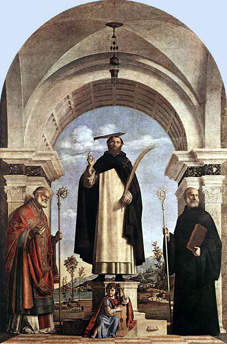
SAINT PETER THE MARTYR, INQUISITOR KILLED BY HERETICS
SEVESO 1252, DEATH OF AN INQUISITOR
(Article by Massimo Trifirò, from La Padania del 29 August 2004)
The dramatic story of the ambush of the Venetian Dominican friar Pietro Rosini
carried out in Brianza by some Lombard heretics
1. THE DOMINICAN
Pietro Rosini, the Dominican who would later be martyred and quickly elevated to the honors of the altars, came into the world in Verona on an unspecified day in 1206.
His family, like others of some influence in the northern territories of the Peninsula, belonged, even if he didn't show blatant evidence of it, to the Cathar sect, a Manichean, specifically indicated by the name of Patarini, or to one of the most widespread Christian heretical forms in those years.
It therefore appears paradoxical, or perhaps determined by a superior will, that the subsequent unraveling of his existence then took place in the name of the most rigid Catholic orthodoxy, and that even Pietro later became a champion, a staunch defender, someone who paid for his firm religious beliefs with his life.
It is told anyway, in this regard, that his line of thought was already well structured from a young age, to the point that once, and perhaps the boy was not even seven years old, finding himself arguing with an uncle, he even contradicted him on a fundamental principle of doctrine, regarding the Cathar error on the governing Entity of Creation, which was unique and identifiable with God, and not dualistic as the heretics professed, that is, divided between the concept of Good and that of Evil, between spirit and matter.
The predisposition to study that Pietro had demonstrated from a very young age, they encouraged the father to convince himself to support her, therefore sending his son to the University of Bologna to complete his cultural education.
That was the opportunity to make a definitive change in his life, at the moment, in that city of studies under the protection of Pope Innocent III, the young student had the opportunity to come into contact with the environment inflamed by the zeal of Master Reginaldo and his Preaching Friars, and above all to personally know the founder of the Dominican Order himself who had just been approved by the Holy See, that is, precisely that Domenico di Guzman who at that time, In the 1221, he was a guest of the convent of San Nicolò, in view of the preparation of the second General Chapter of its followers.
I due, which fate then united in the glory of sanctity, so they met, and at that point the older one picked up from the new follower the now very convinced desire to dedicate his existence to the same ideals, and to the same struggle, which animated the fighting spirit of the Order.
The dutiful attempts of the Castilian Domenico to prudently cool a vocation that could also prove immature were of no avail, through the precise description given to the Veronese of the waivers, of pains, of hardships, that the role of preacher entailed. Pietro, more and more fascinated by that disruptive personality, ultimately he replied that he was aware of it and ready to face them, and then he was hugged, and definitively accepted.
The novitiate then lasted nine years, and it was conducted in an exemplary manner, and even rigid, showing day by day, hour by hour, under the guidance of Prior Ventura, the new lay brother's love for intense and uninterrupted study, and for prayer and contemplation, which every night stole several hours from his well-deserved rest.
Before setting out on the roads of the world, Pietro Rosini was therefore given the chance to capitalize on the extreme teachings of Domenico di Guzman, and to be a direct witness to his death, when, returning from Venice, at the end of one of the many visits to the sixty houses of the Confraternity spread across eight provinces, the Founder succumbed to consumption and illness, then dying out in the unadorned room of the disciple Frate Moneta, having never wanted it himself, out of humility, own your own cell.
When he had already been ordained a priest, wearing the characteristic white habit with the black cloak, the new religious then had to be subjected to a difficult test, to a mocking challenge from the Tempter. Being in Como, and having had a concrete nocturnal apparition of the holy martyrs Agnes, Cecilia and Catherine of Alexandria, just as it had already happened to him in Bologna during his novitiate, Pietro was in fact accused by narrow-minded spirits of secretly receiving women in the convent, and then shipped, for punishment and penance, in the distant convent of Jesi in the Marche region.
But it was there, after his upright behavior convinced his superiors to re-examine his case, ultimately recognizing his complete innocence, that in 1229 the decree of full reinstatement in the role of itinerant preacher reached him.
Gregorio IX, the pope who had meanwhile succeeded Innocent, he therefore decided to send it to Milan, city which then represented the beating heart of the Cathar heresy.
Pietro arrived there in 1232, and he immediately realized what strength and organization the Manichaeans possessed, attested especially within the powerful local aristocratic and bourgeois families, such as that of Pacta da Giussano, which the priest will then find on his way in the role of attackers on his own life. It therefore did not appear incomprehensible, given such roots, that the Milanese municipal authorities themselves were, at least tacitly, in favor of allowing heresy to continue to thrive, and therefore particularly inclined to try to dissuade any attempt at a complete restoration of Catholic orthodoxy.
Pietro, finding themselves faced with such a complicated and hostile situation, However, he did not lose heart at all. The direct investiture of San Domenico was his strength, and therefore intended to put it to good use. Placed its headquarters in the convent of Sant'Eustorgio, the Dominican, as first action, he then founded an association of militants, a "school", that is, a real “Christ's war” anti heretic, which he gave the name of “Society of Faith”.
Not only that, because the 17 September of 1233, now certain of the consistency of these followers and of his own indomitable determination, managed to force the municipality to include in the Municipal Statute the papal decree which ordered concrete actions against those who openly professed unshared doctrines.
To the bureaucratic acceptance of these principles of struggle without any compromise, then the concrete facts followed, and the consequent partial containment of the heretical excessive power in force, so much so that the Pontiff himself, in a letter dated 11 December of that same year addressed to the Archbishop, he then had to recognize and be pleased with the results obtained from Peter's energetic intervention. Which by the way, not yet satisfied, gave life, always in 132, to a further brotherhood inspired by the Marian cult, in clear contrast to the Patarine concept which mocked the dogma of virginity in the "natural location" of the mother of Christ, and indeed he supported it, with deep thought and in all seriousness, that if anything the Madonna had been "fertilized" by the Holy Spirit through an ear. This association, which however was of a doctrinal nature rather than devoted to concrete interventions, he then worked on a widespread commitment to preaching and spreading correct doctrine. In this area, then we must remember the episode of the "Virgin with horns", which in any case attests to the aversion, of the place and time, to the work of restoring the orthodoxy of the Marian faithful.
It is therefore said that Pietro Rosini, while celebrating the Holy Mass in Sant'Eustorgio, he realized that the devil had penetrated an icon of Mary placed above the altar, and immediately chased him away, holding a consecrated Host between his fingers.
Legend? Maybe. But it is nevertheless a precise sign of a certain "diabolical" hostility to the cult of the Virgin that persisted among men of flesh and blood, to the point that Vincenzo Foppa then felt it was his duty to immortalize that climate, and the episode itself, painting in the Portinari Chapel a Mary with disturbing Luciferian appendages, which can still be seen today.
However, Brother Pietro's overwhelming desire to do well was not limited only to the combative containment of the Cathars, but he instead obtained important results even compared to the sincere conversions of heretics.
It's proof of it, for example, the substantial disappearance of the Manichean community of Concorezzo, after their bishop Desiderius, In the 1235, had rejected the contents of the unorthodox "sacred text" called "The Secret Supper", and had moved closer to Catholic positions.
Or the retraction of the heretical scholar Raniero Sacconi, which, after recanting in 145, he even dedicated himself to compiling a “Summa heresis”, Cathar doctrinal compendium very useful for refutation by groups who intended to hinder its diffusion.
To Peter's commitment, also enhanced by the appointment as Inquisitor of Lombardy established by the pontiff in 1242, then that of Archbishop Leone da Perego joined, which in fact, this time together with the Milanese rulers, he worked particularly effectively in the fight against Catara.
As Domenico di Guzman had predicted, the life of the friar who spread the Word of Christ had to be characterized by great mobility throughout the territory, and the consequent arduous hardships, to broaden the radius of influence of teaching as widely as possible. During not even half a century of one's earthly existence, Pietro Rosini therefore remained faithful to this provision, visiting and staying in countless locations in the North. Even managing to promote the foundation of two nunnery convents, In the 1240 the Dominican then reached Asti, in whose monastery he was appointed Prior, and the following year the city of Piacenza, in which he worked energetically to guide the friars and novices in the timely and uninterrupted study of the Holy Scriptures. He did not fail to guarantee his presence as a now acclaimed preacher with an overwhelming oratory both in Rome, than in the Marche, that almost everywhere in Romagna, and specifically in Rimini, In the 1249.
However, the stay in Florence was absolutely decisive, cha data dal 1244. In fact, it happened in the Tuscan capital that his fiery sermons, launched from the pulpit of Santa Maria Novella, thrilled the citizens and the authorities to such an extent, appropriately requested by the Society of Faith, it was then forced to enlarge the square in front, to allow a greater number of people to assist you easily.
The popular support obviously galvanized Rosini and his brother Fra Ruggero Calcagno, thus pushing them to intensify the already harsh conflict with the local heretics, particularly with such Barons, accused of granting hospitality to important Manichaean bishops.
Nor did a trial even arise afterwards, a conviction, and the consequent aversion to it, until its revocation, by the prominent Florentine opponents of Pietro and his Society, in particular the mayor Pace da Pesamigola.
Rosini, however, certainly did not give himself up as defeated at that point, in fact, he took steps to include his major opponents in the list of heretics, and then appealing directly to the people who supported him, who then obtained the seizure of the criminals' assets and the demolition of their homes from the foundations. The Dominican had therefore once again won, contributing to the reaffirmation of Catholicism also in those districts.
Ma, about the people, and of the many "black legends" that flourished in various eras around the Catholic reaction to heresy, without prejudice to the just deprecation of the exaggerations of the Inquisition rightly condemned by History, at this point it is worth clarifying what the attitude of ordinary people really was towards these initiatives, giving the floor to the undisputed authority of Vittorio Messori, the famous Catholic essayist.
In a controversy with Jacques Le Goff regarding Pietro da Verona, on which the French historian criticizes in his "The civilization of the medieval West", In fact, Messori states that "the inquisition was born not against the people", but if anything to respond effectively to a specific health request, given that the heretic was considered by the people as one who propagated diseases (ideological) deadly and polluted the environment (spiritual). “For the common man the heretic is the Great Polluter, it is the enemy of the salvation of the soul, he is the one who brings punishment on the community", the writer then concludes.
From the company, Therefore, from such a position derived the legitimate right to defense even with the most intransigent means, even if unfortunately it sometimes happened that some fanatic willingly went beyond the humanly permitted limits.
A civilization structured in a certain way, shared for centuries, that is, they saw themselves forced to preserve their own survival and identity, and therefore he did it with full awareness.
The disturbances at the heart of the Enlightenment, whose influences are still visible today, they were in fact still yet to come, and therefore it seems evident that no one dared to support it at the time, as happens today with respect to a planned invasion of another civilization that intends to erase ours, that the rights of others are always sacrosanct and untouchable. Even if perhaps they explicitly declare themselves mortal enemies, who take advantage of our weakness, of the liberal legislation that we ourselves have conquered at the price of blood, as well as a misunderstood solidarity, to promise to deny us all with violence in the future, for the exclusive benefit of their own archaic traditions which would later inevitably be imposed on us.
Il 13 June 1251, on the wave of Florentine success, the new Pope Innocent IV entrusted Pietro Rosini with the task of countering the influence of the Cathar bishop of Toulouse in Cremona, Bernard Marty, who had taken refuge there to escape the invasion of his land by the Catholic king of France, after, during the vacation period of the pontificate, there had been numerous attacks by heretics on papal strongholds, including the burning of the headquarters of the Inquisition and the assassination, il 28 May of 1242, of ten of its members in Avignon.
So, during the same year 1251, he was appointed prior of the convent of Como and papal inquisitor, both of that same city and of the Milan area. They will be the last positions held by Pietro da Verona.
The life the priest led, since the onset of one's vocation, it had always been characterized by the most extreme rigor. That is, man belonged to that small group of those who, in humanity of all time, they demand much more from themselves every time than what they ask from others. Except for that foreseen by the daily rite of Mass, In fact, Peter abstained from wine, and was limited to feeding only once a day, quickly swallowing a plate of freshly dressed vegetables. During the day, as seen, he dedicated himself to incessant activity, but also at night, I haven't paid yet, very often the friar would get up from his bed and, until dawn, he concentrated on prayer and study. Preaching, as had happened in Florence, it then produced an enthusiastic popular reaction everywhere.
Its advent was always announced by excited word of mouth, and the figure of the severe Dominican was then welcomed upon arrival by songs, sounds of trumpets and drums, and shouts of jubilation. It wasn't that uncommon, just like it happened to the Master, Fra Pietro sometimes found himself forced to approach the stage of his sermons even on a litter, because the faithful, even in a sometimes dangerous way, they always held him close, they wanted to touch him, and often they even almost stripped him completely to grab a piece of the monastic habit to keep as a relic.
These manifestations of recognized sanctity already in life, they then corresponded to actually miraculous events, which after his death were therefore promptly evaluated and included in the documents of the canonical process.
In fact, several cases of otherwise inexplicable healings were noted, the sudden multiplication of the oil of the parish priest of Cesena, and the absolutely incomprehensible persistence of the limited supply of salted meat on which the team of workers involved in the construction of a Dominican convent fed.
Among the many wonders, the news then reports that, not sensational but certainly effective because it was operated in public, of the bet made by Pietro with a Manichaean in the square of Sant'Eustorgio in Milan. The so-called “cloud miracle”, which among other things has its own intrinsic poetic value, it occurred at the moment in which the two were arguing under the torment of a blazing sun that almost made them fret. To the contemptuous challenge of the heretic, which invited the adversary to ask their God to send a cloud into the completely clear sky to shelter them, Peter responded by accepting the provocation, provided, however, that the cathar, if the event had actually occurred, would undertake to recant immediately. The cloud then quickly emerged from the horizon, and placed himself right at the zenith of the crowded square, not moving from there until the end of the doctrinal clash.
Another time, in the same place, Then Peter happened to meet another Manichaean, which, to put the inquisitor in a bad light and "prove" that he was only a skilled mystifier, he pretended to be ill, however, asking Rosini to cure him of what he was not suffering from at all. Which naturally the friar committed himself to doing promptly, after, however, he had miraculously caused the man to be invaded by authentic and atrocious pain, and not before having gathered the repentance and renunciation of the liar, who at that point was quick to recognize his own scam and all the mistakes of his previous life.
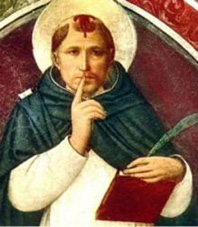
In fact, all this happened punctually, both regarding his death and the invasion of German troops sent by Emperor Frederick II, in support of the Ghibellines against the pro-papal Guelphs.
On another occasion, Rosini clearly glimpsed the future, three years before the events, the collapse of the Gattaedo fortress near Giussano, and the subsequent exhumation of the bodies of two Cathar bishops, whose remains were later set on fire.
Nor for that matter, always about the end of one's existence, the priest failed to explain the precise modalities in advance, the ideological identity of the perpetrators, and even the exact place where his body would later be placed. And this occurred several times, even during the evening before his last day of life.
It is almost superfluous to remember at this point that these phenomena also served the sixteen societies of Lombard heretics to prepare the ground for a violent reaction against the cumbersome Peter, accused of being fanatical, hypocritical, and even a dangerous sorcerer.
Now the time had come for the plot to be carried out against him.
In the middle of the 13th century, the relative independence of the Municipalities compared to large aggregations of power, the Empire and the Papacy, it was already approaching sunset. It was therefore becoming increasingly popular, under such influences, greater doctrinal rigidity, whose function, even if it is not artificially imposed, was to compact the popular conscience into a single and solid bed, regardless of the "tolerance" towards heretics that had hitherto been in force in the municipal sphere, in which what really mattered was only the ideology of goods and profit, by whoever was then supported.
In Lombardy, in the area where the subsequent bloody events will occur, many powerful Cathar families dominated, jealous of both their possessions and their potential, and feared, interference of the inquisitors in their “autonomy”, or in their business.
Among them, the Pacta dynasties certainly stood out, originally from Giussano, and the Confalonieri, of Agliate. In fact, both later had, with the consent and support of the entire Milanese Pataria, a decisive role in the events that led to the death of the Dominican inquisitor Pietro Rosini from Verona, at the age of just forty-six.
The dynamics of what actually happened is then well described in the documents of the trial of the culprits, which, in the presence of the friars Rainerio da Piacenza and Daniele of the Order of Preachers, was held in Milan on 2 September of 1252.
It had therefore happened that Fra Pietro, in How, had ordered a contumacious heretic to appear within two weeks at the Court of the Inquisition in Milan to be judged. The deadline would expire the following day, and therefore the Dominican, after having enunciated those prophecies of death which have already been mentioned, he had therefore set off from the Como area towards the big city. He brought his brother Domenico with him, on a long journey on foot which would have taken at least a whole day. To do your duty, or to meet a destiny that had already been decreed in any case, Furthermore, Rosini had not paid any attention to the cortana fever that was consuming him at that moment. Foreshadowing his departure from the world for the umpteenth time, he had in fact declared that in any case he would soon rest peacefully in the basilica of San Simpliciano, which later turned out to be the place of his first burial.
It was a Saturday, e, with the two travellers, another couple of friars had joined, which, however, was expected to have to abandon them shortly before arriving in Milan, taking the road to a convent in Meda, at the gates of the city. At that time, in that upper part of Lombardy, the long stretches between the few inhabited places were almost deserted, poorly supervised, and covered by thick woods, in whose shadow it was possible, almost with impunity, commit and conceal any crime. Plus, it should not be forgotten that the inquisitor was an enemy in a hostile land, populated by Manichaeans, and that he moved on foot and without the appropriate escort to be able to repel an attack.
Meanwhile, precisely these irreducible adversaries were about to put the finishing touches to their nefarious undertaking. Manfredo, of the da Giussano family had in fact been found, in his town, with Stefano Confalonieri, and together, already well determined to suppress Pietro, they had confided in each other, in Milan, with a certain Guidotto da Sacchella, also belonging to Pataria. The gang subsequently went to a certain Giacomo della Glusa, which, in the conspiracy economy, he had to be the one who supported the role of the treasurer. Money was therefore requested to pay the hitmen, e, the next day, the conspirators had obtained it punctually, in a sealed bag, delivered to a certain Facio da Giussano, which contained a large sum in lira and quintals in large denarii, corresponding more or less to three dozen silver imperials, symbolically precisely the thirty pieces of silver of Judas Iscariot.
At that point, however, the identity of the perpetrators had to be determined. On their precise names, the documents of the trial themselves and the memories of the time diverge a little in truth, even if all the testimonies then narrow the field to a limited number of possible protagonists. Among the potential assassins, probably already known in the Milanese square for their confident professionalism as hardened criminals, Albertino Porro was certainly there, said the Magnificent pompously. Another actor in the story was his brother Pietro, nicknamed the Birdslayer, which, according to the conflicting versions, or he would have acted directly, or he would have intervened at a later time, simply in the guise of the one who, once the crime was accomplished, he calmly went to the powerful to collect cash. The third man, mentioned several times in the documents, instead he was a Carino da Balsamo, That, to further complicate the picture, or was an actually existing person, of which, however, no trace will subsequently be found in any registry document, or it simply corresponded to the nickname of Pietro Porro, o, for other less reliable hypotheses, of the "magnificent" Albertino himself.
Anyway, be alerted, rewarded, determined, these, the morning of 6 April 1252, they set off from Milan towards the Barlassina forest, and especially of the Farga moor, in the then sylvan territory of Seveso, just outside the capital. And arrived there, they then patiently lay in wait, having certainty, for previous spies on certain Larian Cathars, or for the direct control of Carino himself directed by Manfredo da Giussano and Stefano Confalonieri who had previously gone to the lake to verify the situation with their own eyes, that Pietro Rosini had already left Como, and therefore it necessarily had to pass through those specific desert places.
And so it exactly happened. The wait had been long and boring, the midday of a spring day had made the assassins sweat under their chain mail, but the brother, actually two, they were now in sight, and they were proceeding serenely towards their fate as sacrificial animals, while they sang the Sequenza "Victimae paschal laudes", and they were therefore already ready to be offered as a holocaust for the survival of the Manichaean heresy, and the substantial interests that revolved around it.
Cute from Balsamo, anyone who hid under this name, at that point he snapped. It suddenly came out into the open, coming out at full speed from the thick of the woods, and then violently grabbed the inquisitor by the arm, then dragging him by force back into the shade of the branches. There then, with cold determination, he landed two terrible slashes with his hawk on his shoulders and skull, a sort of straight cutlass, wide blade and square tip. At that moment Albertino, which in truth wasn't proving to be all that magnificent, However, he was struck by panic, and began to flee screaming towards Meda, attracting the attention of the surrounding farmers. Carino, however, was certainly not an individual who should abandon a job for which he had been handsomely rewarded. In fact, he shrugged his shoulders at the sight of the other accomplice who had walked away and, with renewed enthusiasm, he then also threw himself on Brother Domenico, Peter's companion, abandoning the inquisitor for the moment to agonize among the vegetation. The fate of the poor little friar's death was then postponed slightly.
The flocking of the country people, attracted by Albertino's screams, for the moment they saved him, putting the assassin to flight, although, for the injuries sustained, the victim equally surrendered his soul to God five days after the ambush. In short, the murderers, now surrounded by those unexpected rescuers, However, they were captured and chained, while a cart covered with flowers was being prepared to transport Peter's remains to the city, died after a brief but excruciating agony. The same ones, with great honor paid by the entire Milanese population, they were later placed in the church of San Simpliciano, as Rosini had foreseen in life, meanwhile a violent reaction against the mayor Pietro Avogadro was breaking out in the city, accused of complicity with criminals, and subsequently barely saved by Archbishop Leone da Perego. The martyr's body was then buried in Sant'Eustorgio, the same location as his office as inquisitor in the capital, in an ark later sculpted, In the 1399, by Balduccio from Pisa, in the middle of the Renaissance Portinari chapel.
The direct murderer of the friar, presumably aided by the powerful sending families, he then managed to escape from prison, but his destiny was no longer to be that of a contract killer in the years to come. Fortunately reached the city of Forlì, the man in fact asked, and he got it, to be admitted as a lay brother into a Dominican convent, to pay for the sin committed with severe penance for the rest of one's existence. As already mentioned, five months later, for the other accomplices, the trial was held, who imposed the sentences precisely in Sant'Eustorgio which had become the victim's final home.
Pietro Rosini from Verona, inquisitor and martyr, he was then elevated to the honors of the altars in March of 1253, less than a year after his death, following the requests that Leone da Perego, numerous Milanese aristocrats, and hundreds of Dominican brothers, brought to His Holiness Innocent IV. Of the new elected, Catherine of Siena also testified in her famous "Dialogues": “he hated heresy so much that he was ready to give up his life for it. And while he lived, his constant concern was to pray, preach, dispute with heretics and confess, announcing the truth and propagating the faith without any fear".
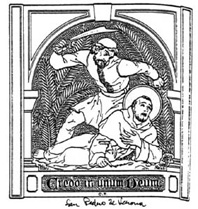
His head was buzzing, and he already felt that the flame of life was rapidly going out inside his very thin body, dug and drained by almost half a century of penance, and from the pain of a job always done without sparing a single moment.
“Into your hands, Sir”.
The criminal had struck on the back of the neck, on the arch of his curved back. Then, uncertain that that wound could prove truly fatal, he had brutally attacked the head, landing a hard blow, ruthless, which would certainly soon prove decisive. Pietro, dragged almost bodily from the path to the shelter of the trunks and nearby branches, she had had the opportunity to stare at his face for a moment. It was certainly a murderer, ma, perhaps not by chance, evil had not imprinted on his features the distinctive signs of an impossible repentance. The Dominican friar, as he had repeatedly prophesied in the months and even in the previous days, he was well aware that his last hour on earth was about to strike. However, he didn't even have time to feel afraid. It was early. He was resigned. He felt strong enough to take the big step, as much as it ever could be, despite being prepared for it, any living thing that stops breathing, to enjoy the light, to love and think, in the imminent prospect of being hurled into the darkness.
He would pray for whoever was killing him, he decided as the other threw him to the ground with a crash.
As long as he was alive, he would have implored God's benevolence upon him. But then, even after passing, in that Paradise in which he had always firmly believed, he would have worked to ensure that the Almighty touched his heart, leading him to a happy destiny of repentance, of penance, of conversion.
“Into your hands, Sir”.
Bloodthirsty. The hot liquid, lumpy, and an intolerable acrid smell, it was slowly sliding down his shattered skull, fouling his ears, the neck, and gradually soaking the greasy soil of the undergrowth right before his eyes, in that collapsed position from which he could no longer get up. The brain, clarity of thought, they were meanwhile evaporating, leaving him intact only the residual energy to mentally recite the final prayers, the formulation of the act of pain for an existence well spent, and the plea for forgiveness which he cared about more than anything else at that moment.
“From’ Domenico, poor innocent”.
Of the criminal by whom he had been attacked, he had tested the strength, the indomitable will for destruction. Then, feeling the torment of the flesh and the bone being torn, that shattered under the cleaver, he had caught the flash on the surface of the blade before it fell, a thin stream of light that had managed to penetrate the vegetation to illuminate the instrument of death for an instant. So, silence had suddenly fallen, and the agitation, sweat, the blasphemies, the hitman's short breath, they had ceased, because probably, while somewhere other screams were heard that the dying man could not decipher, the bandit had moved away to throw himself at the poor brother who had had the misfortune of accompanying him on his journey from Como.
Peter of Verona, gritting his teeth so as not to lose consciousness again, she concentrated and prayed for him too, entrusting the soul of the second one, or maybe third, victim to the clemency of the Almighty. So, barely freeing his arm, who had remained trapped under the fallen body, he stretched it out, after dipping his finger in the tiny pool of blood, towards a flat stone, sunk into the ground, and which barely peeked out among the grasses, in the blanket of pine needles, and in the midst of some struggling flowers that bent to drink the reflections of the distant light.
“I believe in one God”.
He had traced the brief writing with cruel effort, passing his bloody finger over the struggling letters several times, twisted, with an imprecise sign, due to the suffering that had now invaded all his limbs, and for the confusion into which his indomitable spirit was sinking. He had written it roughly, ma, as the last act of one's existence devoted precisely to that holy principle, he had managed to do it anyway, and he was happy about it.
Credo
I believe that Man is a fragile being, despite all his arrogance, arrogance, the pompous security of the wrong principles to which he surrenders, the crime that is too easily voted for.
Credo
I therefore believe he needs God, of a certain compass during his perilous navigation through the waves of his short life, full of pain and dissatisfaction, of disappointments, of terrors and uncertainties, of exhaustion, of crimes and betrayals, and blood spilled in vain.
Credo
And I believe that the task of this poor two-legged being that plows through the earth's crust exhausted is to defend it, this God who defends him. Removing it from the attacks of false doctrine. Fighting those who want to erase him from the world. Proudly fighting for other fallacious faiths, other civilizations hostile to His word, the temptation to settle for the flattery of the world, the weakness of wanting to sell Him off for convenience or cowardice, do not prevail, emptying our being alive of meaning, temporarily existing, but perpetually yearning for a different elsewhere, full, full, of eternal meekness and happiness.
Pietro Rosini gasped. It was now the end, he felt it. He no longer heard a sound, he no longer felt any movement around him. He was bidding farewell to the world in infinite stillness.
With a further surge of will, almost a sort of extreme muscle tear, then he formulated the last prayer of his short life.
“Into your hands, Sir, I commend my spirit”.
Since he was just a nothing returning to the Father, and that he needed help on the journey. It was a lump of flesh that had appeared fleetingly in the flow of History, a being perhaps recently, but that he had at least succeeded, as much as he could in his weakness, to take the side of the sincere beliefs of their people, and to ask yourself, however unworthily, alongside God.
So he prayed, Pietro. E, immediately afterwards, his tired soul found itself immersed in an impenetrable and terrifying darkness, at the limit of which, however, a vivid light could already be glimpsed, unsustainable, flash of light.

beautiful story of a friar who as a patent ignorant about the saints, what are they, I didn't know !
On top of everything, to know having lived in my Lombardy…
Thank you for the story of the life of Saint Peter Rosini,martyr