

Esteemed Associates and kind Supporters, please, this year too, allocate the 5×1000 to our small Association. It is sufficient to indicate in the tax return (or attached to other models) our tax code – 01944030764 – in the appropriate box: «Support for non-profit organizations of social utility, of social promotion associations …». Thank you, God bless you! Let's come to Abbot Ricciotti and his «Life of Jesus Christ», from which we will study the chapter today: «The shrunken woman and the dropsical man. Convivial matters".
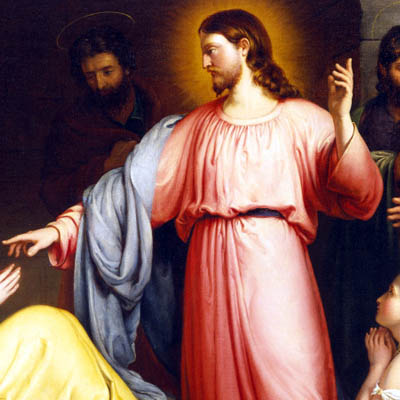
• § 455. These threats had an effect? [«In this last extension granted to the tree, or it will bear fruit, or he will end up under blows with an axe", cf. Up Hearts n° 157]. The fire lit by that fire that Jesus had come to throw on the earth was blazing? In other words, the "change of mind" was taking place which repudiated the old formalistic and sought the new spirit? Saint Luke does not give an explicit answer to these questions, but it seems good that he gives an implicit one through an anecdote that he adds to the previous narratives, and which shows how rabbinic formalism weighed like a leaden pall on the spirits and had not even been scratched by the threats of Jesus. The anecdote is that of the shrunken woman who was healed on a Sabbath (Luca, 13, 10-17); except the Evangelist himself, indulging his predilection for matching checks, shortly after this anecdote is followed by another very similar one about the dropsical man who was also cured on a Saturday (14, 1-6). The two squares logically refer to each other, as a repeated and disheartened response to previous questions on the effectiveness of Jesus' preaching, and it is therefore appropriate to present them side by side; However, similarly from the data of Saint Luke compared with the other Evangelists, it appears that the two facts are chronologically separated, and that the woman was healed shortly before the Feast of the Dedication and in Judea, the man instead shortly after that party and probably in Transjordan. Jesus therefore, during his pilgrimage in Judea, he went to a synagogue on the Sabbath and began to preach. Among those present was a woman who had been ill for eighteen years – perhaps arthritis or even paralysis – and so shrunken that she could in no way raise her head and look up. View it, Jesus called her and told her: «Donna, you are freed from your illness"; the mani does not impose. That, straightened up instantly, he began to thank and glorify God. The arch-synagogue who presided over the meeting (§ 64) He was indignant at the healing that took place on a Saturday; however, not daring to approach Jesus directly, he took it out on the crowd, haranguing them angrily: «There are six days in which you have to work: therefore come and be treated in them, and not on the Sabbath day!». For that zealous synagogue the miraculous healing meant nothing, on Saturdays instead – which, moreover, had not been violated – it meant everything. Jesus then responded to him and to the others of his mentality: «Hypocrites! Doesn't each of you untie his ox or donkey from the manger on the Sabbath?, e (lo) leads to water?». Indeed, untying or tightening a rope knot was included in those 39 groups of actions that were prohibited on the Sabbath (§ 70); but in practice, dealing with domestic animals, their support was provided in one way or another. Having made that clear, Jesus argues a fortiori in conclusion: «And this is the daughter of Abraham, and whom Satan bound eighteen years ago, it was not necessary for her to be released from this bond on the Sabbath day?». Illnesses of all kinds were commonly traced back to Satan (§ 78). So if there was a more opportune day than all to demonstrate God's victory over Satan, that is, of Good over Evil, it was actually Saturday, the day consecrated to God: therefore Jesus, better than any other, he had penetrated the spirit of the Sabbath, operating precisely in it that victory of God over Satan.
• § 456. The crowd cordially agreed to Jesus' reasoning; as for his opponents, St. Luke says they were confused, but this does not mean that they agreed to the reasoning. We already saw that the rabbinical observance of the Sabbath was one of the pillars on which the Pharisees were enthroned and that it should never collapse (§ 431). Even if the miraculous facts denied that observance, that meant nothing: the facts were overlooked and the Holy Spirit was blasphemed (§ § 444, 446), as long as the Pharisaical Sabbath remained. The corresponding picture unfolds, not in the synagogue, but in the house of an eminent Pharisee who invited Jesus to take food from him. It's on Saturday, and the Pharisees are spying. Here a man with dropsy presents himself to Jesus, perhaps attracted by his fame as a miracle worker and hoping to be healed. Jesus then turns to the lawyers and the Pharisees saying: «It is permissible on Saturdays to cure or not?». They remained silent, although in many cases the question had already been treated and decided by the doctors of the Law (§ 71). Continuing silence, Jesus pulls the dropsical man to him by the hand, he heals him and fires him; so he says to the silent ones: «Who among you has a son or an ox that falls into a well?, don't pick it up right away on the Sabbath?» [These are actions that, even today, the Christian can do it lawfully on Sunday, without thereby failing to comply with God's order to sanctify the feast, ndR]. – But this question also remains, according to St. Luke, unanswered. It appears at first reading that the two anecdotes are very similar; only that in that of the dropsy, Jesus' adversaries do not appear acrimonious and simply remain silent. Since this fact seems to have happened in Transjordan, one should conclude that the Pharisees and lawyers of that area, remotest from Jerusalem, were a little less fanatical and narrow-minded than those of Judea, who were under the immediate influence of the capital.
• § 457. The lack of acrimony in these Pharisees from beyond the Jordan is also evident from the fact that the banquet lasted a long time and various issues were discussed without rancor, starting with the first places. Those good Pharisees would not have been Pharisees if they had not come to an argument to occupy the places closest to the host and most honorable at the table: That sofa belongs to me! – Instead it's up to me, that I am more worthy! – You are more worthy? Who do you think you are? – I am older and more learned than you; give me your seat! – And so on. For people who lived above all on exteriors, such questions of etiquette were capital. Jesus intervened by commenting on the argument, and he wanted to confuse the litigants by showing how their vanity was not even sagacious enough in choosing the means to triumph. He said: "When (tu) be invited by anyone to a wedding, don't sit on the first sofa, so that not (happen) by chance that someone more worthy than you is invited to him, and he who invited you has come and he will tell you: “Give room to this man!” and then (tu) you begin to occupy the last place with shame. When instead (tu) be invited, go and sit in the last place, so that when the one who invited you comes, he can tell you: “Amico, climb higher!”. Then you will have glory in the presence of all your guests: for whoever exalts himself will be humbled, and he who humbles himself will be exalted". Thus the vanity of the guests was confused with the consideration of their own incompetence, the attitude of the inviter remained to be sorted out, and in general of all the inviters who too often acted out of vainglory combined with material gain; Furthermore, to guests and invitees, the lesson on material banquet could be useful for a higher sphere, reminding them of the norms and advantages of a certain spiritual banquet. Therefore Jesus, addressing the inviter, he continued: "When (tu) have a lunch or dinner, do not call your friends or your brothers or your relatives or rich neighbors, so that not (happen) by chance they also invite you back, and you have the reciprocation. But when (tu) have a reception, invite the poor, cripples, lame, blind; and blessed you will be, because they have nothing to repay you! In fact, the reward will be given to you in the resurrection of the righteous.". Closely similar to this norm is that contained in the logion unknown to the four Gospels but attributed to Jesus by Saint Paul: "It is more blessed to give than to receive" (§ 98). The common basis for all these norms is always that of the Sermon on the Mount, that is, a sanction that is not earthly but otherworldly (§ 319): here it is called "resurrection of the righteous", elsewhere "kingdom of heaven" or "coming of the son of man", but it is essentially the same base that supports the entire edifice of Jesus' doctrine, while once this base is removed the building collapses and the doctrine no longer makes sense. The ancient pagans mentioned by St. Paul were perfectly logical and consequential, which, since they denied this otherworldly basis to the doctrine of Jesus (cfr. Atti, 17, 32), they found the doctrine itself to be foolishness (The Corinthians, 1, 23). Even today, the dialectical positions have not changed at all, and the doctrine of Jesus is still defined as either foolish or divine, depending on whether you reject or accept that basis.
• § 458. With the idea of the otherworldly reward those guests were relieved – just as Jesus wanted – at the thought of a spiritual banquet. Then one of them exclaimed: «Blessed is he who eats food in the kingdom of God!». Jesus took the opportunity to present the kingdom of God as a banquet using a parable, which is reported both by Luke (14, 16-24) both from Matteo (22, 2-14). The two reviews are different from each other in several accessories, but above all because Matteo's story also has a fairly long development (22, 11-14) which does not find correspondence in Luca's review. Jesus recited the parable in Matthew's broader form only once, which was then shortened by Luca? Or he recited it in Luca's shorter form, which was then expanded by Matthew with a fragment of another similar parable? Or he recited it several times in different forms? There has been much discussion about these questions; the most probable answer seems to be that Jesus used this generic theme of the banquet several times in his parables – as the rabbis also did – albeit with somewhat different aims depending on the circumstances. Matthew's review therefore results from the fusion of two convivial parables of Jesus: at first (22, 2-10) substantially corresponds to that of Luke; the second (22, 11-14) it would only be the final part of another parable, whose background is missing because in today's editorial it was judged that the similar parable of Luke sufficiently replaced it. In the Lucanian recension the parable is as follows.
• § 459. A man had a big dinner and invited many. At the right time he sent his servant to the guests, asking them to come because everything was ready; except that everyone began to give excuses for not coming. One said: «I bought a field, and I have to go look at it; Excuse me!» – Another said: «I bought five yoke of oxen, and I'm going to try them; Excuse me!» – A third made short work of it with a few words: «I got married, and so we don't even talk about it!» – Obtained such answers, the servant brought them back to the master. He then became angry, and gave orders to the servant: «Go through the squares and streets of the city, and let the poor enter the banquet, cripples, blind and lame!» – The order was carried out, and the servant informed the master, adding: «Those unfortunates entered, but there are still empty places." – The master then replied: «You still go out into the countryside, and let in all who you find along the paths and hedges; because my house must be crowded with those unfortunates, while none of the previous guests will enjoy my dinner!». Evidently the banquet symbolizes the kingdom of God, the reluctant guests are the Jews, and the poor who replace them are the Gentiles: what appears even better from Matteo's review. Luke ends here; but in Matteo the scene has the sequel already mentioned. The room was filled with those wretches, the inviting one (who in Matthew is a king who gives a wedding banquet to his son) he comes to the room in person to see the guests. Suddenly he sees among them a man who has not worn the required wedding dress (of which, However, it was not mentioned previously). The king therefore tells him: «Amico, how come you came here without having the wedding garment?» – He is silent in confusion. Then the king orders the attendants: «Tie his hands and feet, and cast him into the outer darkness: there will be weeping and gnashing of teeth!» – Jesus finally concluded by saying: «Many in fact are called, a select few, however". The final part of this singular trait already leaves the symbolic sphere and refers directly to the true object of the parable (“weeping and gnashing of teeth”). Furthermore, it adds a new element to the parable common to Luke and Matthew, and it is that not all new guests are worthy of the banquet, but only those who have the wedding garment: out of allegory, not all the Gentiles who replaced the Jews in the kingdom of the Messiah are worthy of the kingdom, but only those who have the appropriate spiritual dispositions. Jesus, Indeed, Nicodemus had already warned that if anyone is not born of water and (and) Spirit, cannot enter the kingdom of God (§ 288); this internal rebirth was the essential condition for legitimately entering the messianic banquet. The exclamation of Jesus' table companion: «Blessed is he who eats food in the kingdom of God!» it had also been a question, trying in some way to know who would enjoy that bliss. Jesus answered the question by showing who would reject and who would accept the invitation to the messianic banquet, and among those who would have accepted it, some would have shown themselves worthy and some unworthy.
• § 455. These threats had an effect? [«In this last extension granted to the tree, or it will bear fruit, or he will end up under blows with an axe", cf. Up Hearts n° 157]. The fire lit by that fire that Jesus had come to throw on the earth was blazing? In other words, the "change of mind" was taking place which repudiated the old formalistic and sought the new spirit? Saint Luke does not give an explicit answer to these questions, but it seems good that he gives an implicit one through an anecdote that he adds to the previous narratives, and which shows how rabbinic formalism weighed like a leaden pall on the spirits and had not even been scratched by the threats of Jesus. The anecdote is that of the shrunken woman who was healed on a Sabbath (Luca, 13, 10-17); except the Evangelist himself, indulging his predilection for matching checks, shortly after this anecdote is followed by another very similar one about the dropsical man who was also cured on a Saturday (14, 1-6). The two squares logically refer to each other, as a repeated and disheartened response to previous questions on the effectiveness of Jesus' preaching, and it is therefore appropriate to present them side by side; However, similarly from the data of Saint Luke compared with the other Evangelists, it appears that the two facts are chronologically separated, and that the woman was healed shortly before the Feast of the Dedication and in Judea, the man instead shortly after that party and probably in Transjordan. Jesus therefore, during his pilgrimage in Judea, he went to a synagogue on the Sabbath and began to preach. Among those present was a woman who had been ill for eighteen years – perhaps arthritis or even paralysis – and so shrunken that she could in no way raise her head and look up. View it, Jesus called her and told her: «Donna, you are freed from your illness"; the mani does not impose. That, straightened up instantly, he began to thank and glorify God. The arch-synagogue who presided over the meeting (§ 64) He was indignant at the healing that took place on a Saturday; however, not daring to approach Jesus directly, he took it out on the crowd, haranguing them angrily: «There are six days in which you have to work: therefore come and be treated in them, and not on the Sabbath day!». For that zealous synagogue the miraculous healing meant nothing, on Saturdays instead – which, moreover, had not been violated – it meant everything. Jesus then responded to him and to the others of his mentality: «Hypocrites! Doesn't each of you untie his ox or donkey from the manger on the Sabbath?, e (lo) leads to water?». Indeed, untying or tightening a rope knot was included in those 39 groups of actions that were prohibited on the Sabbath (§ 70); but in practice, dealing with domestic animals, their support was provided in one way or another. Having made that clear, Jesus argues a fortiori in conclusion: «And this is the daughter of Abraham, and whom Satan bound eighteen years ago, it was not necessary for her to be released from this bond on the Sabbath day?». Illnesses of all kinds were commonly traced back to Satan (§ 78). So if there was a more opportune day than all to demonstrate God's victory over Satan, that is, of Good over Evil, it was actually Saturday, the day consecrated to God: therefore Jesus, better than any other, he had penetrated the spirit of the Sabbath, operating precisely in it that victory of God over Satan.
• § 456. The crowd cordially agreed to Jesus' reasoning; as for his opponents, St. Luke says they were confused, but this does not mean that they agreed to the reasoning. We already saw that the rabbinical observance of the Sabbath was one of the pillars on which the Pharisees were enthroned and that it should never collapse (§ 431). Even if the miraculous facts denied that observance, that meant nothing: the facts were overlooked and the Holy Spirit was blasphemed (§ § 444, 446), as long as the Pharisaical Sabbath remained. The corresponding picture unfolds, not in the synagogue, but in the house of an eminent Pharisee who invited Jesus to take food from him. It's on Saturday, and the Pharisees are spying. Here a man with dropsy presents himself to Jesus, perhaps attracted by his fame as a miracle worker and hoping to be healed. Jesus then turns to the lawyers and the Pharisees saying: «It is permissible on Saturdays to cure or not?». They remained silent, although in many cases the question had already been treated and decided by the doctors of the Law (§ 71). Continuing silence, Jesus pulls the dropsical man to him by the hand, he heals him and fires him; so he says to the silent ones: «Who among you has a son or an ox that falls into a well?, don't pick it up right away on the Sabbath?» [These are actions that, even today, the Christian can do it lawfully on Sunday, without thereby failing to comply with God's order to sanctify the feast, ndR]. – But this question also remains, according to St. Luke, unanswered. It appears at first reading that the two anecdotes are very similar; only that in that of the dropsy, Jesus' adversaries do not appear acrimonious and simply remain silent. Since this fact seems to have happened in Transjordan, one should conclude that the Pharisees and lawyers of that area, remotest from Jerusalem, were a little less fanatical and narrow-minded than those of Judea, who were under the immediate influence of the capital.
• § 457. The lack of acrimony in these Pharisees from beyond the Jordan is also evident from the fact that the banquet lasted a long time and various issues were discussed without rancor, starting with the first places. Those good Pharisees would not have been Pharisees if they had not come to an argument to occupy the places closest to the host and most honorable at the table: That sofa belongs to me! – Instead it's up to me, that I am more worthy! – You are more worthy? Who do you think you are? – I am older and more learned than you; give me your seat! – And so on. For people who lived above all on exteriors, such questions of etiquette were capital. Jesus intervened by commenting on the argument, and he wanted to confuse the litigants by showing how their vanity was not even sagacious enough in choosing the means to triumph. He said: "When (tu) be invited by anyone to a wedding, don't sit on the first sofa, so that not (happen) by chance that someone more worthy than you is invited to him, and he who invited you has come and he will tell you: “Give room to this man!” and then (tu) you begin to occupy the last place with shame. When instead (tu) be invited, go and sit in the last place, so that when the one who invited you comes, he can tell you: “Amico, climb higher!”. Then you will have glory in the presence of all your guests: for whoever exalts himself will be humbled, and he who humbles himself will be exalted". Thus the vanity of the guests was confused with the consideration of their own incompetence, the attitude of the inviter remained to be sorted out, and in general of all the inviters who too often acted out of vainglory combined with material gain; Furthermore, to guests and invitees, the lesson on material banquet could be useful for a higher sphere, reminding them of the norms and advantages of a certain spiritual banquet. Therefore Jesus, addressing the inviter, he continued: "When (tu) have a lunch or dinner, do not call your friends or your brothers or your relatives or rich neighbors, so that not (happen) by chance they also invite you back, and you have the reciprocation. But when (tu) have a reception, invite the poor, cripples, lame, blind; and blessed you will be, because they have nothing to repay you! In fact, the reward will be given to you in the resurrection of the righteous.". Closely similar to this norm is that contained in the logion unknown to the four Gospels but attributed to Jesus by Saint Paul: "It is more blessed to give than to receive" (§ 98). The common basis for all these norms is always that of the Sermon on the Mount, that is, a sanction that is not earthly but otherworldly (§ 319): here it is called "resurrection of the righteous", elsewhere "kingdom of heaven" or "coming of the son of man", but it is essentially the same base that supports the entire edifice of Jesus' doctrine, while once this base is removed the building collapses and the doctrine no longer makes sense. The ancient pagans mentioned by St. Paul were perfectly logical and consequential, which, since they denied this otherworldly basis to the doctrine of Jesus (cfr. Atti, 17, 32), they found the doctrine itself to be foolishness (The Corinthians, 1, 23). Even today, the dialectical positions have not changed at all, and the doctrine of Jesus is still defined as either foolish or divine, depending on whether you reject or accept that basis.
• § 458. With the idea of the otherworldly reward those guests were relieved – just as Jesus wanted – at the thought of a spiritual banquet. Then one of them exclaimed: «Blessed is he who eats food in the kingdom of God!». Jesus took the opportunity to present the kingdom of God as a banquet using a parable, which is reported both by Luke (14, 16-24) both from Matteo (22, 2-14). The two reviews are different from each other in several accessories, but above all because Matteo's story also has a fairly long development (22, 11-14) which does not find correspondence in Luca's review. Jesus recited the parable in Matthew's broader form only once, which was then shortened by Luca? Or he recited it in Luca's shorter form, which was then expanded by Matthew with a fragment of another similar parable? Or he recited it several times in different forms? There has been much discussion about these questions; the most probable answer seems to be that Jesus used this generic theme of the banquet several times in his parables – as the rabbis also did – albeit with somewhat different aims depending on the circumstances. Matthew's review therefore results from the fusion of two convivial parables of Jesus: at first (22, 2-10) substantially corresponds to that of Luke; the second (22, 11-14) it would only be the final part of another parable, whose background is missing because in today's editorial it was judged that the similar parable of Luke sufficiently replaced it. In the Lucanian recension the parable is as follows.
• § 459. A man had a big dinner and invited many. At the right time he sent his servant to the guests, asking them to come because everything was ready; except that everyone began to give excuses for not coming. One said: «I bought a field, and I have to go look at it; Excuse me!» – Another said: «I bought five yoke of oxen, and I'm going to try them; Excuse me!» – A third made short work of it with a few words: «I got married, and so we don't even talk about it!» – Obtained such answers, the servant brought them back to the master. He then became angry, and gave orders to the servant: «Go through the squares and streets of the city, and let the poor enter the banquet, cripples, blind and lame!» – The order was carried out, and the servant informed the master, adding: «Those unfortunates entered, but there are still empty places." – The master then replied: «You still go out into the countryside, and let in all who you find along the paths and hedges; because my house must be crowded with those unfortunates, while none of the previous guests will enjoy my dinner!». Evidently the banquet symbolizes the kingdom of God, the reluctant guests are the Jews, and the poor who replace them are the Gentiles: what appears even better from Matteo's review. Luke ends here; but in Matteo the scene has the sequel already mentioned. The room was filled with those wretches, the inviting one (who in Matthew is a king who gives a wedding banquet to his son) he comes to the room in person to see the guests. Suddenly he sees among them a man who has not worn the required wedding dress (of which, However, it was not mentioned previously). The king therefore tells him: «Amico, how come you came here without having the wedding garment?» – He is silent in confusion. Then the king orders the attendants: «Tie his hands and feet, and cast him into the outer darkness: there will be weeping and gnashing of teeth!» – Jesus finally concluded by saying: «Many in fact are called, a select few, however". The final part of this singular trait already leaves the symbolic sphere and refers directly to the true object of the parable (“weeping and gnashing of teeth”). Furthermore, it adds a new element to the parable common to Luke and Matthew, and it is that not all new guests are worthy of the banquet, but only those who have the wedding garment: out of allegory, not all the Gentiles who replaced the Jews in the kingdom of the Messiah are worthy of the kingdom, but only those who have the appropriate spiritual dispositions. Jesus, Indeed, Nicodemus had already warned that if anyone is not born of water and (and) Spirit, cannot enter the kingdom of God (§ 288); this internal rebirth was the essential condition for legitimately entering the messianic banquet. The exclamation of Jesus' table companion: «Blessed is he who eats food in the kingdom of God!» it had also been a question, trying in some way to know who would enjoy that bliss. Jesus answered the question by showing who would reject and who would accept the invitation to the messianic banquet, and among those who would have accepted it, some would have shown themselves worthy and some unworthy.
source – https://www.sursumcorda.cloud/comunicati-e-note/2161-comunicato-numero-158-la-donna-rattrappita-e-l-uomo-idropico.html
