RETURN TO THE STUDY OF THE CLASSICS? WE SAY YES

In the face of a progressive impoverishment of the Italian language and its study (to which the abominable amount of time we spend on social media certainly contributes) there are those who propose to reinstate the study of Latin in middle school.
Latin, as a sort of “precursor”, it could strengthen the grammatical and syntactic foundations that are the basis of our language, just as the study of classical culture could strengthen our ability to think and argue. It is not easy to express oneself on an issue such as the reintroduction of Latin in schools: good thing, old thing or simply “thing”?
Reflecting, but, we have recovered an excerpt from Antonio Gramsci, which deserves to be read: “Latin is not studied to learn Latin, we study to get kids used to studying, to analyze a historical body that can be treated like a corpse but which continually recomposes itself into life. Naturally, I don't believe that Latin and Greek have intrinsic thaumaturgical qualities: I say that in a given environment, in a given culture, with a given tradition, the study thus graduated gave those certain effects. Latin and Greek can be substituted and they will be replaced usefully, but it will be necessary to know how to arrange the new subject or the new series of subjects didactically, in order to obtain equivalent results of general human education, starting from a young boy up to the age of professional choice".
(SOURCE: Antonio Gramsci, Notebooks from prison, Einaudi, 1975)

The study of Latin, traditionally, it occurred simultaneously with the study of the classical cultural corpus: from great authors to philosophy. It is precisely this holistic approach that has made Greek and Latin the subjects of choice for the intellectual elite. And that's exactly it holistic approach that we should follow in the choice to restore Latin to middle school or to orient ourselves towards another cultural model. It doesn't matter what the model is, but we must assure them of the solidity that classical studies have built over two millennia.
source – https://portalebambini.it/ritornare-allo-studio-dei-classici/

Share

Fontana: Negrar è struttura d'eccellenza. Vote Andreoli mayor!

Sunday 26 May from 7 all 23 we also vote for the renewal of the Negrar municipal council (VR), than with his 17.000 inhabitants is the fifth largest town in the province of Verona. I have lived there for twenty years and I believe that it is time to make a change with respect to the left-wing councils by voting for my friend Marco Andreoli as mayor.

Fontana: Negrar is a structure of excellence

Almost a thousand beds, beyond 31 thousand hospitalizations, 2.150 collaborators, advanced technologies especially in the fields of radiotherapy and nuclear medicine. Minister Lorenzo Fontana visited this morning, with the Undersecretary of Health Luca Coletto, the deputy Paolo Paternoster and the mayoral candidate Marco Andreoli at the Irccs Sacro Cuore don Calabria hospital in Negrar, accompanied by the managing director Mario Piccinini and the management of the structure.

After a short meeting in the administrative offices, the minister visited some departments, including the one dedicated to vegetative states. In the courtyard of the hospital he spoke with the deputy minister of the Dominican Republic Francisco Neftari Vasquez, arrived in Verona to lay the foundations of a collaboration in the health and social health sector with the Opera Don Calabria.

“The Sacro Cuore Don Calabria hospital in Negrar is a national excellence – said Minister Fontana -, certainly one of the models to look at and to 'export'. My compliments to all the staff”. Minister Fontana underlined how the center is “a great sign of Christian charity that, starting from its founder, San Giovanni Calabria, continues to do its best for the good of the community, with extraordinary results”.

“We also look at these values – the minister underlined – that they produced, and they produce every day, such important works for supporting sick people, to families, to people with fragility”.

source – https://m.tgverona.it/pages/819971//politica/fontana_negrar_e_struttura_d_eccellenza.html

Share

Indications for the European elections 2019

Of Matthew Castagna

As our militants well know, supporters, sympathisers, amici, we are a Catholic Cultural Club faithful to Tradition that operates in society at various levels.
Our motto is “Studio, prayer, action” as Saint Philip Neri said.
We want the restoration of the Social Kingship of Our Lord Jesus Christ. We know well what and how many difficulties there are.
But we stick to the Doctrine of the Church, and with pragmatism and realism, we think it's right to go and vote on Sunday 26 Maggio 2019 for the renewal of the European Parliament and for the administrative elections, in the numerous municipalities where they will go to the polls at the same time.
We do it out of a sense of responsibility, because staying at home would mean delegating every choice to others. The elections, Indeed, non hanno un quorum.
Personally I think that, Today, in the national political landscape, Salvini's League, changed significantly compared to the past, can achieve important results also through friendly candidates, who share our essential ideas in the political sphere or who, elected or not, they have the concrete possibility of bringing what matters to the tables, even our principles because they are first of all theirs.
I'm getting ready, so, to give my instructions to all those who know me, who know what my ideal drive is, my spirit, my intent. In the first place, that of never asking for anything for myself, but for the greater glory of God and for the Common Good which today I believe represented by Sovereignism which cannot exclude traditional Catholic demands, in a Europe of Peoples, of large families, of national dignity, of love of country.

Read More

Share

The concrete plan for Minister Fontana's family: “We work towards this goal…”

Only yesterday the rejection of the plan for families by the Ministry of Economy, that plan that Di Maio had so much flaunted in opposition to his government allies. But there is a concrete and achievable plan that the Ministry of the Family is working on. 300 euros per month per child is the proposal put forward by minister Lorenzo Fontana, which should take the form of a legislative decree. «We work towards this goal», said Fontana a Pro Life and Family. «I hope that everyone cares about their family even after the electoral campaign».
Last Tuesday, the Minister of Economy, Giovanni Tria, had frozen the hopes of the families regarding Luigi Di Maio's project: 150 euros per month per family is a «proposal without any financial coverage», said Tria regarding what the deputy prime minister promised at the Family Associations Forum. Di Maio's idea was to reinvest the money left over from the citizen's income in a new allowance for families.
Read More

Share

Con la scusa dell'odio ci imbavagliano

The Agcom regulation
Be careful what you say and what you write. And maybe even what you think. Not just if you are journalists, also because, thanks to social networks, they are all a little’ journalists and everyone can say what they like.

Yesterday the communications guarantor, Agcom, has drawn an inviolable limit beyond which one sinks into hate speech. Anyone who goes astray is reported and then fined. Up to this point we all agree. The problem is: what are the words of hate? Because at this point personal sensitivity comes into play and therefore, at least to some extent, also subjectivity.
The words of hate – explains Agcom – they target specific targets (like women, homosexuals, immigrants, i rom, people of color). Words that would leverage stereotypes and clichés. But news content that can lead to "dangerous generalizations" also ends up in the guarantor's sights.. And the question becomes more and more complicated. Let's take a practical example: Monday in Mirandola a young Moroccan set fire to the headquarters of the traffic police, killing two people and wounding twenty others. I can say he is Moroccan? Or am I sowing hatred towards the people of North Africa? And if, as unfortunately has happened many times, someone makes a massacre in the name of Allah, we can write it or we must keep it silent so as not to disturb the sensitivity of the people 1,8 billions of Muslims in the world? Because those are not words of hate, they are words that speak of hatred.
Read More

Share

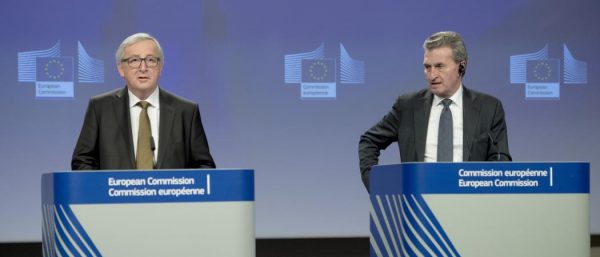
Oettinger reveals: the Junker Kommission also remains in December

Oettinger reveals: the Junker Kommission also remains in December

Oettinger reveals: the Junker Kommission also remains in December

Whatever the voters decide with the vote of 26 maggio, the Commission in office (Junker, Moscovici, Oettinger, Tusk, Mogherini) he is organizing to stay in power beyond the limits. Already the "regulations" provide that the Juncker Committee will only lose its office on 31 October; that is, he remains in command, to do what he wants, still for six months later…

Read all.

source – https://www.maurizioblondet.it/?email_id=2853&user_id=13803&urlpassed=aHR0cHM6Ly93d3cubWF1cml6aW9ibG9uZGV0Lml0L29ldHRpbmdlci1yaXZlbGEtbGEta29tbWlzc2lvbmUtanVua2VyLXJlc3RhLWFuY2hlLWEtZGljZW1icmUv&controller=stats&action=analyse&wysija-page=1&wysijap=subscriptions

Share

Like it or not, Wake the sovereignism Europe

Of Marcello Veneziani
Source: Marcello Veneziani
The allegorical floats of eurocracy parade united against the national-sovereign danger and its true and presumed mythological references. Napolitano, Study Program, Monti, Moscovici, the Newspaper Directors Collective in unison with the local Euro-Constitutional Arch, they mobilized against the Imminent Danger, sovereignism at home and sovereignism abroad. The alarm is not justified by the threat of a coup or an armed revolution - even if the sovereignists are decorated with old Nazi-fascist friezes - but arises from the terror that the European people, in freedom, peaceful and democratic elections, decide on a turning point.
I don't know if the sovereignists will really have the numbers to overturn the power structures of Europe; I don't know if they will be able to find a broad point of convergence, despite their national differences and whether they will find allies along the way or in parliament. And I still don't know if the sovereignists will be able to change - and for the better - this asphyxiated and torn Europe that we find ourselves in.. I don't even know if they will have strategies and not just slogans, whether they will have statesmen or only tribunes of the discontented plebs; in short, whether they will be up to the challenge. I do not know, and maybe we should test them on the road before rejecting them in the living room. Read More

Share

Without sovereignty there is no politics

Of Piotr Zygulski
Source: Appeal to the People
The contrast between so-called "sovereignists" and "Europeanists" is absolutely senseless, according to the political scientist Carlo Galli, spoke in Bologna on 13 maggio 2019 to present his book Sovereignty (The Mill). Which is aimed above all at those who intend to oppose chauvinistic forces by summarily liquidating the concept of sovereignty and above all without proposing an alternative vision. We can only say Europe (without sovereignty?) both good and sovereignty would be a bad thing. It would be trivial, simplistic and even harmful.
Galli then returns to this political category, inviting us to treat the topic more seriously: “We cannot talk about politics without sovereignty”. At most there can be indefinite “multitudes”., theorized Toni Negri, curiously in tune with some liberal individualistic views, which the Bolognese professor does not share at all. “The question is another: who should have sovereignty in Europe?” The concept of sovereignty, for Carlo Galli, it is existential; it can obviously also reach extremes, from non-interventionism to war, which also belongs to its existence. It is therefore not a pure concept, absolute, if not on a theoretical level in books and in a state of exception: it is always conditioned in some way.
Sovereignty coincides with constituent power, which is the basis of established power. It projects an idea of ​​unity - the Law represents unitarily through the "will of the Nation" what in itself would not be unitary - due to the fact that it is a part that becomes the sovereign whole. So sovereignty means "being the owners of decisions that have to do with one's existence"; we need to have the same strategic defense interests. Furthermore, it always arises from a violent act: an armed conflict, a secession, a civil war; “politics is not the dimension of wishing good”, Galli notes.
The European case, however, would be different: in history it has never happened that a state acquired sovereignty through a decision engineered from above. For this reason the European Union - "non-sovereign collection of sovereign states" - lives in an intermediate situation in which only monetary sovereignty would be shared. Think of defense or foreign policy, for which each European state continues to make different decisions; the crises in Libya, Syria and Ukraine would prove it. France does not intend to give up its army; the German constitutional court accepts European measures only from the perspective of subsidiarity: something that Germany simply cannot do alone, can be entrusted to the EU.
For the rest, further limitations of sovereignty are excluded, because for the Germans national sovereignty remains sacred, despite having left Nazism, Galli notes. Similarly Italy, in its republican Constitution, states that “sovereignty belongs to the people”, despite some exceptions allowing sovereignty to be ceded only "on equal terms with other states" if necessary to ensure "peace and justice among nations". They were designed for the UN, not for European construction. Furthermore, it seems clear that the national elites themselves do not want to move towards true European sovereignty.
Yet we arrived at the European Union on the one hand by building a "fortress" to compete in the global market, on the other, extending the German ordoliberal model to all European nations. It could become a textbook case in which what Galli defines as the "neo-enlightenment elite" - through the ideology of the "external constraint" that united us first to the European Monetary Serpentine and then to the Euro - fails miserably, without true sovereignty. Also following austerity measures, Indeed, This whole project, conceived on the drawing board, has entered into crisis. Now it would be right to go back to its profound causes, which cannot be circumvented with wisdom, accusing those who object to European construction of functional illiteracy. Also because this stalemate is what favors those more Eurosceptic feelings.
To say something in a much more proactive way and to do politics seriously, a strong investment of energy in sovereignty is needed. Whether you want it at the level of the European institutions, both to return to the national one; for both there would be non-negligible difficulties. “There will be a reason in the crisis of neoliberalism, or all this is fate?”, Galli finally asks.

Share

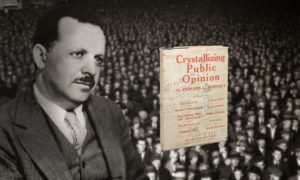
The father of propaganda: Edward Bernays

Of Ilaria Bifarini
Source: EreticaMente
“The individual makes his choices driven by irrational and uncontrolled impulses. It is the task of a minority of chosen people to guide it "as a flock of sheep should be guided"
Listed by the authoritative American magazine Life among the 100 most powerful men of the 20th century, unanimously acclaimed as the creator of consensus engineering, Edward Louis Bernays is a name unfamiliar to European audiences. Perhaps known to some curious people for his relationship with the father of psychoanalysis, of his uncle Freud, the young Louis quickly assimilates and brilliantly reworks the theory of revolutionary knowledge of the unconscious. Of Jewish and bourgeois extraction, he moved at a very young age to New York in the early twentieth century where, abandoned the pre-established path of continuing his father's business, takes his first steps in the world of journalism, to establish himself in a completely new role as a communicator for the times.
After the glories recorded by the manufacturing industry serving the war production of the First World War, the United States finds itself having to face the scariest of market specters: the risk of overproduction. The "brain storming" of illustrious bankers and influential entrepreneurs leads to finding the solution in a decisive and unequivocal way: we need to ferry the American citizen from the culture of needs to that of desires, making people eager to satisfy ever new needs, burdensome as pressing needs. The economic logic, after having enslaved the war industry to increase its own production, he thus approaches the newborn science of psychoanalysis.
Read More

Share

Mary Help of Christians: from Lepanto to Don Bosco

Giuseppe Federici Study Center – For a new onset

Press release no. 41/19 of the 24 maggio 2019, Mary Help of Christians
Mary Help of Christians: from Lepanto to Don Bosco
History of the Basilica of Mary Help of Christians
The façade recalls that of the church of S. Giorgio Maggiore in Venice, of Palladio.
On the bell tower on the right the archangel Gabriel is depicted offering a crown to Mary; on the bell tower on the left the archangel Michael waves a flag with the writing "Lepanto".
On the eardrum, the marble statues are of the Solutor martyrs, Customer, Octavius, killed on this earth (Valdocco = Valley of the Slain). On the attic, you can see the clocks above, on the right the statue of San Massimo, first bishop of Turin, on the left the statue of Saint Francis de Sales, patron of the Salesian Family.
In the central niche, under the rose window, you can see the marble group of Jesus among the children. In the side niches are the statues of St. Joseph and S. Luigi Gonzaga.
Of the two bands of high reliefs between the columns, one represents S. Pius V announcing the Victory of Lepanto (1571), the other represents Pius VII crowning Maria SS. in the Sanctuary of Savona after his liberation from Napoleonic imprisonment (1814).
The Sanctuary of Mary Help of Christians was born from the heart, by the courage of Don Bosco and his great devotion to the Madonna.
It was an undertaking marked by extraordinary events and enormous difficulties: Don Bosco never tired of repeating that it was Our Lady who wanted the church and herself, after having even indicated to him the place where it was to be built, he would also have made him find the necessary means. But we hear from Don Bosco himself the story of a "dream" he had in 1844, when he was still looking for a stable location for his oratory.
The Lady who appeared to him told him: “Observe. – And I looked and saw a small and low church, a bit of courtyard and young people in large numbers. I resumed my work.
But since this church has become narrow, I turned to you again, and She showed me another much larger church with a house nearby. Then, leading me a little closer, in a stretch of cultivated land, almost in front of the façade of the second church, he added:
“In this place where the glorious Martyrs of Turin come, Solutor and Ottavio offered their martyrdom, I want God to be honored in a very special way.".
Share
1 4 5 6 7 8 9 10 293