
 Of Ilaria Bifarini
Source: EreticaMente
“The individual makes his choices driven by irrational and uncontrolled impulses. It is the task of a minority of chosen people to guide it "as a flock of sheep should be guided"
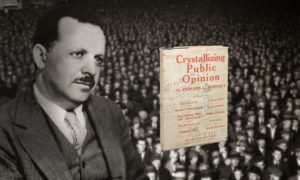
Listed by the authoritative American magazine Life among the 100 most powerful men of the 20th century, unanimously acclaimed as the creator of consensus engineering, Edward Louis Bernays is a name unfamiliar to European audiences. Perhaps known to some curious people for his relationship with the father of psychoanalysis, of his uncle Freud, the young Louis quickly assimilates and brilliantly reworks the theory of revolutionary knowledge of the unconscious. Of Jewish and bourgeois extraction, he moved at a very young age to New York in the early twentieth century where, abandoned the pre-established path of continuing his father's business, takes his first steps in the world of journalism, to establish himself in a completely new role as a communicator for the times.
After the glories recorded by the manufacturing industry serving the war production of the First World War, the United States finds itself having to face the scariest of market specters: the risk of overproduction. The "brain storming" of illustrious bankers and influential entrepreneurs leads to finding the solution in a decisive and unequivocal way: we need to ferry the American citizen from the culture of needs to that of desires, making people eager to satisfy ever new needs, burdensome as pressing needs. The economic logic, after having enslaved the war industry to increase its own production, he thus approaches the newborn science of psychoanalysis.
But how can we convince citizens to consume new products having not exhausted the old ones purchased? Per Bernays, the answer is simple: it is enough to "frame public opinion as an army frames its soldiers". Uncle Sigmund had given light to the dark part that moves desire driven by the unconscious: through the desire compensation mechanism, the individual shifts the horizon of his repressed and inadmissible desire towards the external sphere of materiality in order to be able to satisfy it.
Lesson learned, Bernays offers his invaluable advice in the American Tobacco Company's campaign to break down the taboo in post-war America against women smoking. In the 1929 stages the “torches of freedom” parade: hires a dozen suffragettes who, in the midst of an Easter demonstration, they theatrically light up the then forbidden object of manifest desire, cigarettes, which in the female unconscious represented the penis. The news goes around the world, conveyed as a gesture of female freedom and emancipation, strongly affecting the Puritan taboo.
The individual, so, is willing to engage in irrational behavior, oriented towards the consumption of products that are not only useless for his life, but even harmful, just to feel the satisfaction of some of your unspeakable and unfulfilled longings, just to convey an image to the outside world that gratifies him and makes him feel appreciated by others.
And precisely because human beings are prey to unconscious forces, they must be controlled, “it should be led like a flock of sheep”. To the most intelligent minorities (elite) It is the task of proselytizing and directing the undisciplined and irrational masses. A sort of moral duty of the elected: “only in this way can individual and collective interests be combined to promote the development and well-being of America” (Propaganda, 1928).
Bernays' client list is full of names from the American economic and political elite: Procter & Gamble, l’American General Electric, la General Motors, US President Eisenhawer are just some of the names present in Bernays' endless portfolio, capable of disguising the Guatemalan coup as a coup d'état 1953 to encourage, alongside the CIA, the interests of the United Fruit Company. His fame will reach overseas, winning over the Nazi Propaganda Minister Goebbels with his theories, his declared fan. It is to him that all current "professional" figures owe their fatherhood, like spin doctors, who have made propaganda the weapon of social consensus.

