

THE UPDATED REEDITION OF “MONTINI'S PARTY” IT IS IN CONSTRUCTION?
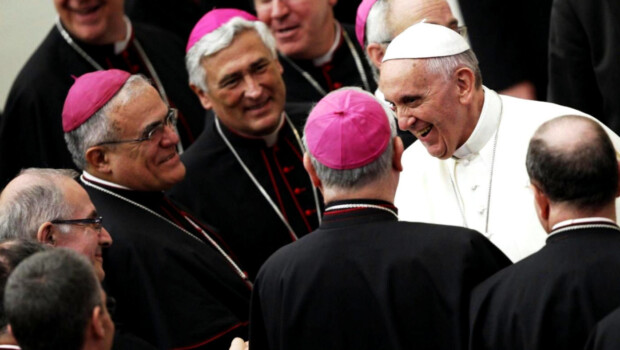
Sooner or later the People's Party will be reborn. Romano Prodi will do it, or his heir, Enrico Letta; Berlusconi will do it, or his Antonio Tajani of the moment, or they will do it together, yesterday's rivals, in the shadow of the EPP which already unites them. But eventually something like this will happen, thinking about Europe and sovereignism, more than to Don Sturzo and the centenary of the Popular Party. But while the tyrannosaurs of popularism move slowly, hesitating and procrastinating, someone is forging ahead. It is the Church of Bergoglio, it is the Church of Cardinal Bassetti, head of the Italian Episcopal Conference, it is the Church of Matteo Zuppi, archbishop of Bologna. If a priest founded the Popular Party, why shouldn't a prelate instead of a politician now think about it?
The news is that a Pope's Party, that is, a Catholic Party under the aegis of Bergoglio would have only one thing in common with Prodi's and/or Berlusconi's Popular Party: would arise against the present majority, to block the way to populism, to nationalisms and sovereignisms. But after this concordance, the Pope's Party would inevitably be the Party of Welcoming, the Pro-Migrant Party, the continuation of Caritas and the Sant'Egidio Community in politics. Limit it, it would be the party of Gino Strada and Mimmo Lucano, to understand each other. Something very different from what the Catholic Party was in our country, the old DC.
So let's leave the contingent controversies and see things in a broader perspective, historical. Italy managed to survive fascism, to the defeat of the war, to the revenge and threats of communism, taking refuge under the breasts of the DC. A party that had its strength in its weakness, in not opposing anything in a radical and resolute way, in reflecting reality in a ductile and malleable way, guaranteeing everyone a little, or not threatening anyone. He organized his escape from history at affordable rates, it was both a salve and a policy against past and present traumas. The DC was the autobiography of the nation in the maternal version, while fascism had been the autobiography of the nation in the paternal version, virile, warlike.
The strength of the DC was to ensure a painless transition from fascism to anti-fascism, from the nation that wanted to become an empire to the country that wanted to crouch under the American Atlantic umbrella and under the pro-European parasol, receiving help in exchange, military support and control plans. His strength was the fear of communism, the desire for tranquility. And the Motherland instead of the Homeland.
It would make sense today a Catholic party in a highly de-Christianized country, radically secularized, with the churches emptied? But above all he would be able to break through a Catholic party projected on Bergoglio's papal line? It would not risk leaving out too many Catholics who recognize themselves in tradition, in Christian civilization, in defense of the family? What position would a papist party take on the issues of abortion and homosexual adoptions?, of gay marriage and euthanasia, of births and the protection of the maternal and paternal figure? The DC held on to a tacit but lasting compromise between this conservative component and the moderate component which considered the protection of the West as a priority, Atlanticism and anti-communism, the defense of the market and the private sector.
But the main opponent for a Catholic party should not be radical secularism, the Jacobin and progressive spirit, atheistic materialism which is today the main sponsor of Bergoglism? And the fear of communism does not translate today into the fear of Islam, towards which Bergoglio's Church is very open? It is clear that the Pope's Party would only be able to represent a small share of Catholics, plus a slice of radical voters, left, not Catholics if not atheists. Today their official organ would not be Avvenire but la Repubblica. And it would be a nice paradox.
After half a century of Christian Democratic leadership, the Catholics managed to carve out a role for themselves in the bipolar system with the ancient strategy of the two ovens, being courted by both poles, because being in the middle and no longer having political representation, despite being in the minority, they could shift the balance in favor of the centre-right or the centre-left. For a few years instead, the irrelevance of Catholics in political choices is clear.
Right, there is no shortage of figures of guarantee for the Catholic world, and Mattarella a Conte. But the influence exerted in the past is unthinkable today, and we are not talking about the distant past or the first republic but also more recent ones. Also because the pressure from Catholics has reduced, of the CEI, of the Curia on bioethical issues and the family, to grow instead on the topic of migrants and reception. A topic that alienates many Catholics, not because they are refractory to charity, but because they are wary of one Church-NGO which does not care about the declining Christian civilization and also opens its doors to Muslims. At present no one is able to represent Catholics in politics. Three Catholic parties can be glimpsed on the horizon, what would be born from the ashes of the Olive Tree, the one that would arise on the remains of Forza Italia and the one that would emerge from the Pope's cassock (and by the CEI). But they are three parties that are difficult to reconcile with each other, all highly minority. It is difficult to imagine that something like a unified Catholic party could be reborn.
Once upon a time it was said, with resignation, we will die Christian Democrats. Today, however, it should be said: we will not be reborn as Christian Democrats.
MV, panorama n. 4 2019
source – http://www.marcelloveneziani.com/articoli/e-se-nascesse-il-partito-del-papa/
Similar Posts
