

As sovereignists we carefully read an article of constructive criticism:
If he sovereignism it is exclusive attention to the national interest, it should come as no surprise that that world, in Europa, has no interest in supporting Italy in its economic policy. He made it clear first Sebastian Kurz, Austrian chancellor, who demonstrated the full support for the European Commission's decision on the correction of the Italian maneuver.
The German ultra-right then made it clear. The leader of the alternative for Germany, Alice Wiedel, he wrote a tweet quite clear when talking about Italy. “Horrendous new debt: These Romans are crazy!” exclaims the AfD leader on her social profile. And again: “The crazy maneuver of the Italians is at the expense of Germany: because we have to pay for the rich Italians?”
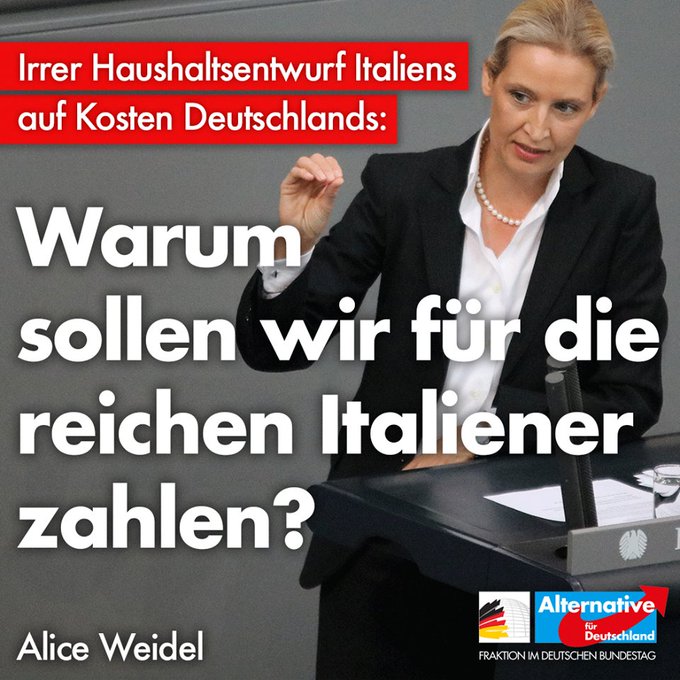
Fiery words, derogatory phrases. In any case, words that do not give any overview of the European panorama. But they give the impression that the sovereignist bloc does not exist in reality. Or better, can exist as a large electoral list: ma it does not seem to have a strategic value in the European sense. Allies against a common enemy, but armed adversaries against each other, sovereignist parties therefore risk finding themselves mired in a swamp for which they themselves are responsible: that of the rise of national interest as the lodestar of the politics of the individual country.
Attention, it's not an accusation: it is a factual reality. And in some ways that's right. Because if a party is born for the sole purpose of protecting the interests of its electorate and its country, it is completely clear that these interests cannot always coexist with those of other states. And therefore of other sovereignist parties.
a short circuit? No, but certainly a reality that we have to deal with and understand that sovereignty comes first and foremost national interest. And the national interest is not, by definition, shareable with everyone. This is why the rise of these new movements, which characterizes the entire European and Western reality, it also serves to understand how the future of our continent can develop.
Because if each party represents a priority national interest, then the strategy of the individual government will no longer be oriented towards helping another country, but only himself. Everyone does it, one might object. And if the alleged champion of Europeanism does it, Emmanuel Macron, who dumps migrants at the border and talks about Europe, imagine if a Kurz or a man can't think so Viktor Orban who have chosen a rhetoric completely devoid of the idea of European solidarity.
The politics of Vienna, in Budapest, of Berlin, it is not that of Rome, Paris, London or Athens. And it is from this premise that we can understand a lot about how sovereignists will orient themselves in the near future. And this block, which represents an ambition of individual electoral bodies rather than a common European project, it could radically change the destinies of Europe. First of all, by orienting the strategies of individual governments differently.
Kurz is the most eloquent last demonstration. Austria has no interest in building an axis with Italy in the absence of a concrete reason that bears fruit in Vienna. It is not ideology that guides the young Austrian leader, but one pragmatic and exclusively national vision. And since he came to power, the head of the Austrian government has never made a secret of considering the Italian government a potential ally on some issues, but a fundamental adversary in a strategic sense.
The controversy over passport for South Tyroleans, the military to Brenner, the clash over the redistribution of migrants e, not least, the harsh condemnation of the Italian economic maneuver, demonstrate that Vienna's strategy is sovereignist: but not a friend of the other sovereignists. It is only and exclusively Austrian and linked to an idea of Core Europe founded by a continent in which the Germanic bloc leads the game.
Hence some consequences. European sovereignists are united? Perhaps in an electoral context. But not in a strategic sense. And the idea of asovereign international, perhaps too easily hoped for, it crashes on the rocks of national interests. And if these are the ones pulling the strings of European politics, then the alliance will be between movements representing states with common interests, and not between movements with common interests. It's so true that Marine Le Pen and Matteo Salvini, representing Italy and France, they know they share common objectives at a European level, while this is not the case between the German ultra-right and our government, despite an ideological link between the League and the AfD.
Therefore, rather than thinking of a sort of great sovereignist alliance, you might think, much more pragmatically, to an alliance with some sovereignists in a strategic key and to a broader alliance in a purely electoral key in view of the European countries 2019. But the alarm bells are clear: Central and Northern Europe are not compatible with the objectives of Mediterranean Europe. And all the problems already demonstrated by the European Union so far, they're just meant to be more noticeable.
Source: http://www.occhidellaguerra.it/sovranisti-europa-punto-debole/
