

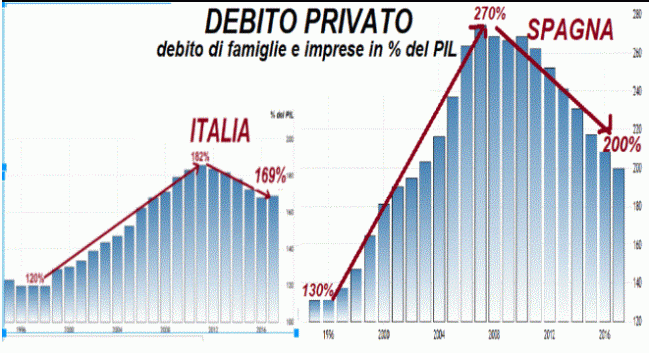
The euro has been a disaster for Southern European countries and in particular for Italy, but not so much - as we often hear - because it did not allow for devaluation as in the days of the Lira. In reality, the euro was and is a mechanism for inflating the credit and debt of families and businesses and then also of states and banks. The proof is that in the years of the common currency the indebtedness of the economy as a whole exploded, to the point that the repayment of the debt and interest (overall, by families, businesses, State) he arrived at 70% of GDP! This is the real reason why the euro system caused economic stagnation in much of Europe and depression in Italy.
The euro, under the smoke screen of the famous limits on public debt, in reality it is a mechanism to increase private debt (of families, businesses and banks) and then in the end also the public one.
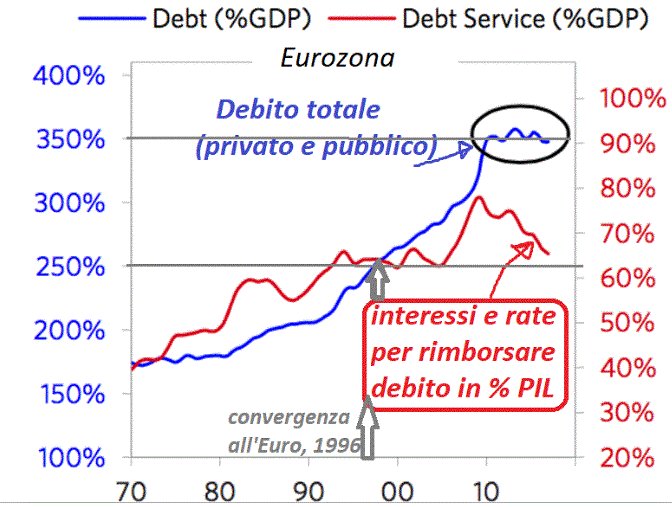
Thanks to the euro, real economic power has passed from states to large banks and finance (and to the Central Bank that protects them). But let's proceed in order.
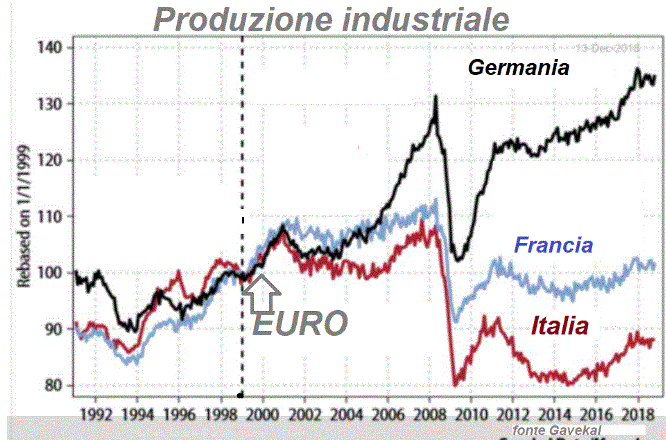
We don't remember it, but before the introduction of the common currency, industrial production grew more in Italy than in Germany and in line with France. After the 2000 both France and Germany first slowed down and then stopped growing. Italy lost until -23% of production since the peak of 2007 up to the minimum caused by Monti's austerity in 2013 and even now he has recovered very little.
France lost less, but it was still distanced from Germany. Starting from 1990 (using it as the same basis for all a 100) we have that Germany is today a 130, France to 100 and Italy a 88. The euro has been a disaster for the Italian economy (and also French). There were obviously also other concomitant factors during the euro years, like the opening to China in 2001, but trade with China even today is a share of GDP around 2% and the Eurozone, so it is difficult to argue that it caused a collapse in industrial production 20%.
THE COLLAPSE
The collapse in production was instead due to two factors. Firstly, taxation which was increased heavily to join the euro and then increased again after 2011 with Monti (always to avoid a default on the euro debt given that it could not be devalued). The burden of taxation on GDP has increased since 1998, when the “convergence” to the euro began, Of 5 percentage points. Before the common currency this was not necessary because the State could, if necessary, also finance deficits by issuing money and not by taxing, as they do in Japan where the public debt is double ours.
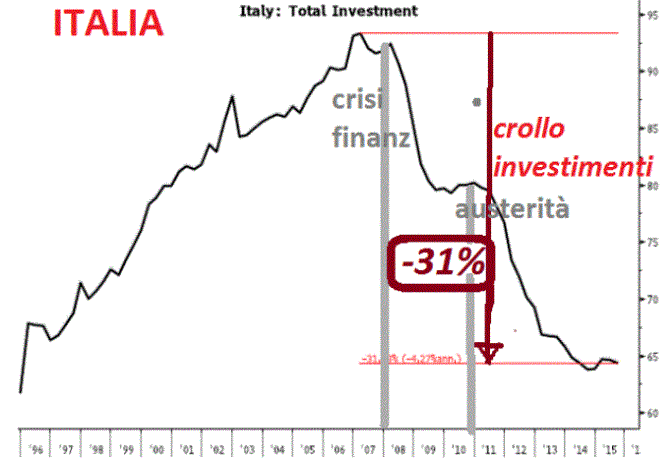
Secondly there was the vertical collapse after the 2008 of business credit that has been cut from 910 a 710 billion, a credit collapse that has never occurred in peacetime. This violent contraction of credit in turn caused the collapse of investment 30%.
Suffocating taxation and drastic credit cuts have led to a collapse in investments which, however, in turn has led to a loss of productivity, given that investments are needed to increase it (in machinery, software, research…).
How come there wasn't a revolt against the euro then, if it was so bad for the industrial economy? Because the euro was instead a big deal for the financial economy. This is the fact that both apologists and critics of the euro almost never notice. With the arrival of the euro there was an explosion of credit (and therefore of the debt), which is doubled from 5 thousand a 10 trillion and poured into real estate, inflating the real estate bubble to 2008 and then on consumer credit and financial investments and speculation (including mergers and acquisitions).
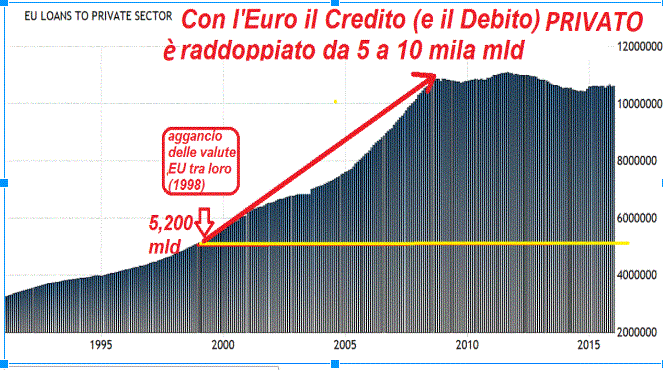
While everyone was always talking about the famous deficit and public debt, in reality private debt was exploding. How come? First of all from the Maastricht Treaty of 1992 onwards governments were formally prevented from issuing money. Consequently, all the increase in money in the economy occurred only through credit and therefore the issuance of debt. If you impose to reduce public deficits and then finance them with debt, the result is that less money arrives in the private economy from the State and that money is all reabsorbed to buy government bonds issued.
THE BANKS
In this way the only creation of money for the economy occurs through banks, whose budgets have doubled in just a few years. However, this accumulation of debt for businesses and families could not continue indefinitely, also because it was largely unproductive, it ended up mainly in real estate. In the eurozone only a quarter of credit goes to businesses, that is, it is productive credit, three-quarters go to finance real estate, consumer credit and various financial investments. Just think that the French banks had almost bought 300 billion BTPs. The real estate bubble has swelled everywhere (except in Germany), particularly in Ireland and Spain, but also in Italy, until there was a crash in 2008 simultaneously in America and Europe.
In the 2008 the global financial crisis that we all remember triggered by Lehman broke out, credit growth has stalled, there were defaults and most of the banks (in America and Europe) they were saved by governments. In Italy, due to the constraints on the public deficit, the State has not intervened to plug the holes of the banks and these, burdened by investments and real estate loans, they indiscriminately cut credit to businesses. Given that there was a lack of liquidity throughout the Western world and the banks were all in crisis, they suddenly liquidated government bonds, creating the "spread crisis".
Foreign banks with the euro had in fact bought the majority of BTPs, making enormous capital gains, because with yields falling from 6-7% al 3-4% obviously the prices of BTPs increased. In the 2008 given that the financial market was paralyzed by losses on mortgage derivatives in America and by losses on properties in Ireland or Spain, the banks all suddenly cut back, causing BTP prices to fall. Given that the Italian State could not intervene through the Bank of Italy to regulate the market as it did before the euro, BTPs lost a 20% around and this was used as a pretext to call for Berlusconi's resignation and install Monti who imposed more austerity, i.e. more taxes. Monti - to save the euro - gave the final blow to the productive economy, causing a collapse in domestic demand 10% approximately and in turn then a further cut in credit to companies in difficulty.
THE POINT
As can be seen in this entire discussion the exchange rate of the Lira or the Euro is not mentioned, because it doesn't actually matter. What really matters is how much money circulates in the economy and whether it is all created as debt and finally whether it is used for productive purposes or to finance real estate, financial investments and speculation.
With the single currency, the banks had the green light first to merge more and more and then to explode unproductive credit, what goes to real estate, consumer credit and financial investments such as buying Greek or Italian or Turkish bonds. It's true that banks have crashed everywhere, even the English ones, Swiss or American because it wasn't just a problem of the Euro, but of the entire Western economy which is today financialised. The difference, however, is that outside the Eurozone the State can finance itself with the Central Bank and intervene to plug the holes in the banks, while in the eurozone the "rules" penalize countries like Italy and prevent them from doing so. As a measure in extremis, to avoid the implosion of the euro in 2012 in the end the European Central Bank also financed public deficits up until this year by buying 2,600 billions of securities on the markets and this stabilized the situation. But the problem has only been postponed because now it stops and Italy cannot use its Central Bank.
With the Euro, behind the smoke screen of public debt limits, a huge private debt was created which then created a bubble and a banking crash and in the end the public debt also increased as a result because all the banks were saved. So in the end the real economic power passed from the states to the big banks (and to the Central Bank which always protects them) and to the mega funds that are now able to blackmail governments.
This is the real problem today, the power of the big banks, of large funds and the central bank (which is made up of characters who come and go from banks and funds) which replaced that of the State. You can vote whatever the fuck you want, meanwhile now the power, thanks to the euro, belongs to finance and no one elects that.
source – https://www.ariannaeditrice.it/articolo.php?item_id=61391
Similar Posts
