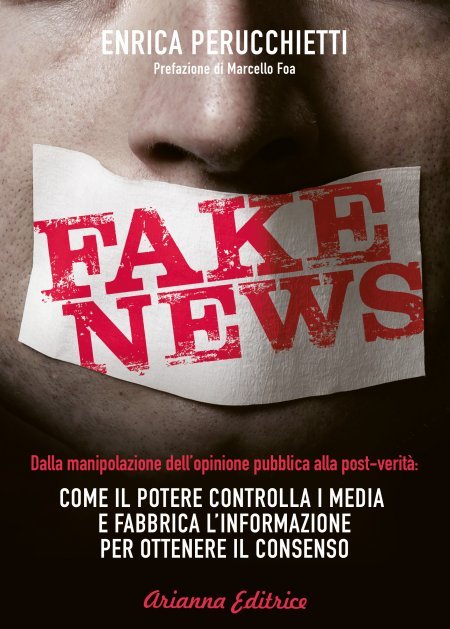
Of Enrica Perucchietti
Source: Web Macro Editorial
The latest book by Enrica Perucchietti can be considered a real cry of alarm. Let's talk about Fake News (Arianna Publishing), which uses the preface by Marcello Foa. The ongoing battle against so-called fake news is, actually, for Perucchietti a further big step towards a modern form of thought crime, desired by government forces that do not accept counter-current thinking.
A super-hot topic especially in these times where the term fake news it has almost become fashionable but behind it there are realities and new risks that are not always easy to interpret. The book intends to be a compass to better understand "who and what is behind it", as evidenced by the interview we did with the author.
Why this book? As an established author, what are the needs that led you to write this new critical essay?
In recent years I have delved more and more into the topic of manipulation and social control. The current global battle against fake news fits into this context: in fact, I believe that it is a form of exploitation to convince public opinion to introduce the crime of opinion and above all to censor alternative information which takes place above all on the web. Power today, like Orwell's Big Brother, subjugates the minds of citizens through "reality control" and nothing must escape the meshes of its all-pervasive domination. The power, that is, it empties the minds of citizens to fill them with its own contents: whoever opposes, anyone who dissents is accused of "psychocrime". In the book, I show how many themes addressed by Orwell in 1984 have or are coming true.
Today those who do not align themselves with single thinking and political correctness are in fact persecuted, risks censorship and in the future, thanks to the political proposals that I talk about extensively in the book, will be punished with fines or even arrest.
What are the social and political dynamics that characterize the current world of communication?
With the advent of modern mass society, power has had to be exercised over an indefinite number of people who are considered a "disoriented herd" that is directed elsewhere.
The art of control ended up becoming the science of Public Relations, Better, a "science of manipulation" that manages to influence behaviors and ways of being, most of the time without having to use physical coercion, if anything, using communication and the media mainstream as a sounding board.
Edward Bernays spoke of "techniques used to frame public opinion" carried out by an "invisible government": power today prefers to remain "in the shadows", showing themselves as little as possible. He is thus able to control citizens by penetrating their imagination, in their minds, in their conscience.
In the book I therefore analyze the major techniques of social control: once the underlying pattern has been identified, it becomes easier to emancipate oneself and return to practicing critical thinking.
Fake news and "post truth" respond to which dominant persuasion logic?
Generate chaos, make reality increasingly virtual and confusing so as to be able to lower the preconceived truth from above to blindly rely on. The virtuality of information convinces us that we can believe what we want because everything is true and everything is relative. Relativism and the resulting sense of precariousness serve power because information has been manipulated so much that today the truth seems like a Noumenonunknowable and unattainable: you might as well not believe anything anymore or believe what you prefer. Or blindly rely on a principle of authority that represents the father figure that is now missing in our society: this is how the Miniver orwelliano. It and its ministers do not lie and cannot lie, they represent Orthodoxy and watch over us, they protect us from thought crime and protect us from external threats and enemies. Indeed, we need new laws to orient ourselves in the world: laws that tell us how to live and die and above all how and what to think.
You outline a historical literary comparison with the theses of the major contemporary dystopias. Fiction has surpassed reality?
Yes. We can say that the dystopian genre was right, especially George Orwell with 1984 e Aldous Huxley con The new world to which I make extensive references in the book.
I believe that we are increasingly moving towards a transparent society in which privacy will be gradually abolished. The electronic gaze of the Government will follow us in every moment of our existence, exactly like the eye of Orwell's Big Brother.
The goal, to better exercise collective control, is to make each of us a "glass man", transparent, under constant technological surveillance but not only, because this control is gradually penetrating our conscience through the introduction of a modern form of "psychoreat". That is, we want the community to conform to the single thought that has been imposed from above; anyone who doesn't do it and dares to criticize the system is persecuted, mocked, censored and perhaps in the near future also criminally persecuted.
The war on fake news therefore hides, as I said before, the attempt to introduce the crime of opinion to censor alternative information.
There are real and viable spaces for credible and independent communication?
The margins of freedom are proportional to our critical conscience and our desire to emancipate ourselves from this hidden yoke. To monitor our collective freedom we must get back to putting ourselves out there and above all to use our heads critically even if this means thinking against the grain of the single thought. Whatever the cost.