

Of Robert Fish
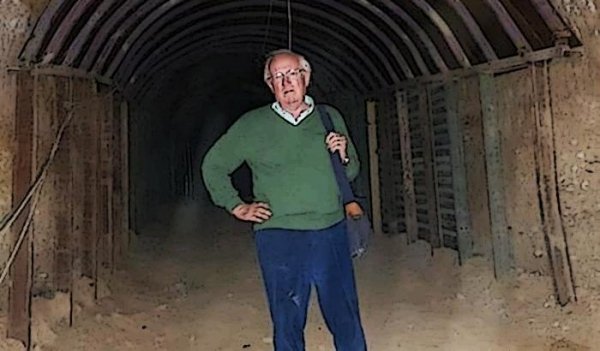
Source: Megachip
From the reportage of the famous and historic war reporter Rober Fisk it is clear that there was no attack with chemical weapons in Douma. Fisk's version may be contested. Vero, but since the governments of USA, France and Britain attacked Syria as they received information dai social network of the use of gas by the Syrian army, why you shouldn't believe an internationally renowned reporter who has more than 40 For years he has been producing reports from the battlefields? Fisk's article acquires greater authority since he cannot be defined as an Assad sympathizer at all. From the article, here in the original, emerge. Full translation follows. [The Anti-Diplomat]
This is the story of a city called Douma, a devastated, smelly place of destroyed apartment blocks – and of an underground clinic whose images of suffering allowed three of the Western world's most powerful nations to bomb Syria last week. There is also a friendly doctor in a green coat who, when I track him down at the same clinic, he cheerfully tells me that the recovery of “gas” which horrified the world – despite all the doubters – it is perfectly genuine.
War stories, However, they have a habit of getting darker. For the same Syrian doctor as 58 there is something deeply uncomfortable about it for years: the patients, dice, they were overwhelmed not by gas but by oxygen starvation in the rubbish-filled tunnels and basements where they lived, on a night of wind and heavy bombing that unleashed a dust storm.
Like Dr. Assim Rahaibani announces in this particular conclusion, it is worth noting that he is by his own admission not an eyewitness and, while speaking in good English, refers twice to the jihadist gunmen of Jaish el-Islam [the army of Islam] a Douma come “terrorists” – the regime's word for their enemies, and a term used by many people throughout Syria. I'm listening to thisWhat version of events should we believe?
Unfortunately, even the doctors who were on duty that night, il 7 April, they were all in Damascus to provide evidence to a chemical weapons investigation, which will attempt to provide a definitive answer to this question in the coming weeks.
The France, in the meantime, declared he had “tried” that chemical weapons were used, and US media cited sources saying blood and urine tests also showed this. The WHO said its partners on the ground have been treating 500 patients “who exhibit signs and symptoms compatible with exposure to toxic chemicals.”
At the same time, inspectors from the Organization for the Prohibition of Chemical Weapons (OPCW) they are currently blocked from coming here to the site of the alleged gas attack, apparently because the right UN permits were missing.
Before we go any further, Readers should be aware that this is not the only story in Douma. There are many people I spoke to in the ruins of the city who said they never believed the gas stories, which were usually carried out by armed Islamic groups. These jihadists, in particular, they survived under a blizzard of bomb fire by living in other people's homes and in vast, wide tunnels with underground streets carved into living rock with axes by prisoners on three levels beneath the city. I went through three of them yesterday, vast corridors of living rock that still contained Russians – Yes, Russians – rockets and burned cars.
So the story of Douma is not just a story of gas – or no gas, depending on the case. These are thousands of people who did not opt to evacuate from Douma on the buses that left last week, along with the armed men with whom they had to live like troglodytes for months to survive. I passed through this city quite freely yesterday without a soldier, policeman or security officer to follow my steps, just two Syrian friends, a camera and a notebook. Sometimes I had to climb two and a half meter high ramparts, up and down the almost earthen walls. Happy to see foreigners among them, even happier that the siege is finally over, they are mostly smiling; the ones whose faces you can see, naturally, because a surprising number of women in Douma wear a black hijab.
I first drove to Douma as part of an escorted convoy of journalists. But once a boring general had announced outside a destroyed house “I have no information” I left. Several other reporters, mostly Syrians, they did the same. Even a group of Russian journalists, all in military clothes, he's gone.
It was a short walk for Dr Rahaibani.
From the door of his underground clinic – “Point 200”, is called, in the strange geology of this partially underground city – there is a corridor that leads downhill where he shows me his humble hospital and the few beds where a little girl cried while nurses treated a cut above her eye.”I was with my family in the basement of my house three hundred meters away that night, but all the doctors know what happened. There was a lot of bombing [by government forces] and the planes were always over Douma during the night – but that night, it was windy and huge clouds of dust began to come into the basements and cellars where people lived. People started arriving here suffering from hypoxia, loss of oxygen. Then someone at the door, and “White helmet”, he shouted “Gas!”, And the panic began. People started throwing water on each other. Yes, the video was shot here, it is authentic, but what you see are people suffering from hypoxia – no gas poisoning.”Strangely, after speaking with more than 20 people, I couldn't find one who showed the slightest interest in Douma's role in provoking Western airstrikes. Two actually told me they didn't know about the connection.
But it's a strange world I've entered. Two men, Hussam e Nazir Abu Aishe, they said they did not know how many people were killed in Douma, even though the latter admitted to having a cousin “executed by Jaish el-Islam [the army of Islam] to be “close to the regime”. They shrugged when I asked about them 43 people said to have died in the infamous Douma attack.
I White Helmets – medical first responders already legendary in the West but with some interesting insights into their own history – they played a familiar role during battles. They are partly funded by the Foreign Ministry and most of the local offices have been run by men from Douma. I found their offices destroyed not far from the doctor's clinic. Rahaibani. A gas mask had been left outside a food container with one eye punctured and a pile of dirty military camouflage uniforms lay inside a room. Planted, I asked myself? No doubt. The place was full of capsules, broken medical equipment and files, sheets and mattresses.
Of course we need to hear their side of the story, but it won't happen here: one woman told us that every member of the White Helmets in Douma abandoned their headquarters and chose to take government-organized, Russian-protected buses to the rebel province of Idlib with the armed groups when the final truce was agreed.
There were open food stalls and a patrol of Russian military police – an optional now optional for every Syrian ceasefire – and no one had even bothered to break into the hostile Islamic prison near Martyrdom Square where the victims were allegedly beheaded in the basements. The city's complement of the Syrian Civil Police of the Interior – who strangely wears military clothes – it is guarded by Russians who may or may not be observed by civilians. Once again, my sincere questions about the gas were met with what seemed like genuine bemusement.
How is it possible that the Douma refugees who had reached the camps in Türkiye were already describing a gas attack that no one in Douma today seemed to remember? It occurred to me that, walking more than a mile through these miserable tunnels cluttered with prisoners, the citizens of Douma lived so isolated from each other for so long that the “news” in the sense of the word they simply had no meaning for them. Syria is not made like a Jeffersonian democracy – as I would cynically say to my Arab colleagues – and it is truly a ruthless dictatorship, but that he could not manipulate these people, happy to see foreigners among them, to react with a few words of truth. So what were they telling me?
They spoke of the Islamists under whom they had lived. They talked about how armed groups stole homes from civilians to avoid the Syrian government and Russian bombing. Jaish el-Islam burned down their offices before they left, but the massive buildings within the safety zones they had created had almost all been destroyed by aerial bombing. A Syrian colonel I met behind one of these buildings asked me if I wanted to see how deep the tunnels were. I stopped after more than a mile when he cryptically remarked that “this tunnel could reach as far as Great Britain”. Ah, Yes, Mrs. May, I remembered, whose airstrikes had been so intimately connected to this place of tunnels and dust. And the gas?
Similar Posts
