

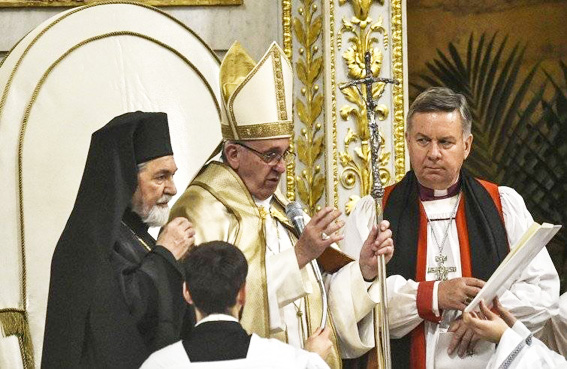
 On the side, the ecumenical vespers of Bergoglio/Badoglio of the Catholic Faith
Reporting of F.F.
Of Francesca de Villasmundo
In the conciliar Church, il 25 January, feast of the conversion of Saint Paul the Apostle, it has become an excuse to celebrate, or rather incense, syncretistic ecumenism, making it coincide with the closing of the week of prayer for Christian unity.
Every year, to this date, the conciliar popes go to sing the "Vespers" of this beautiful feast of the Apostle in the Roman Basilica of San Paolo Fuori le Mura, in the company of representatives of the Protestant and Orthodox churches. On the occasion, they always announce the same message of "unity in diversity", foundation of modernist ecumenism which is only an apostasy in accordance with heretical doctrines.
Pope Francis did not derogate, Obviously, to this ecumenical "tradition".. Indeed, it has taken a new step along the path that has been followed since Vatican II, a journey characterized by the abandonment of Christian doctrine to get in tune with the world and with separated "brothers".!
Representatives of the Patriarchate of Constantinople and the Archbishop of Canterbury were present at Vespers, plus this year a Finnish Evangelical Lutheran delegation, which had been received in the morning by Francis in the Vatican. To these, Francis had spoken words full of meaning for the future…
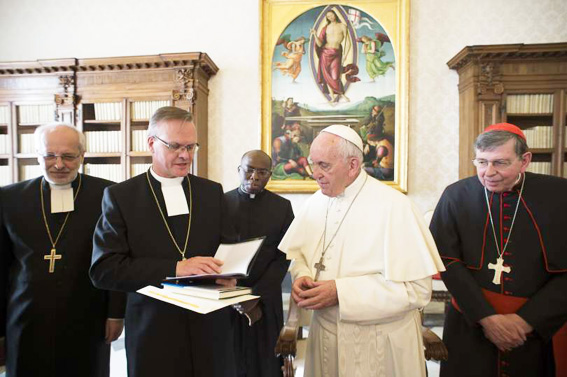 The Finnish Lutherans
The Pope began by praising the common commemoration of 500 years of the Protestant Reformation, allowing a glimpse of a progressive evolution on "the nature of the Church"; which says a lot about the increasingly marked break between the true Catholic Church and the new conciliar Church:
that remains – he added:
«…we understood – explains Jorge Mario Bergoglio – the event of the Reformation as an invitation to face together the loss of credibility of Christianity, an invitation to give renewed strength to the common confession of the Triune God. The year that has just ended reminded us of the time when unity among Christians had not yet been broken. This is why Lutherans and Catholics were able to celebrate the commemoration of 2017 only one way: in ecumenical communion."
So let's find out, in a sprint, from the mouth of Pope Francis, in a message addressed to Protestants, that consensus has been reached "between Lutherans and Catholics on fundamental questions relating to the doctrine of justification"!
Simply put, the Conciliar Church therefore ended up adopting Protestant theology on this question, so long as, let it be known, Lutherans have not changed their doctrine on justification… At this point, all that remains is to put this agreement into practice and, why not, through the official birth of the future ecumenical mass, conciliar fixation circulating in the corridors of the Apostolic Palaces…
The conciliar Church of the Bergoglian era intones the definitive ruin of the few strings of Catholic doctrine that still remain within it...
The neo-Protestant and neo-modernist Conciliar Church from year to year it moves away in an impressive way, both overall and in detail, by the Catholic Church…
Source: http://www.unavox.it/ArtDiversi/DIV2344_De-Villasmundo_Francesco_consenso_coi_luterani.html
