

Of Martin Sieff
Source: Counterinformation
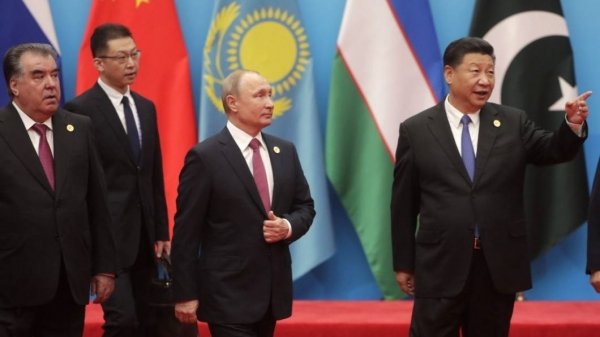
The world has changed and no one in the West has noticed. India and Pakistan joined the Shanghai Cooperation Organization. The Organization, a 17 years since its foundation on 15 June 2001, it has quietly established itself as the major alliance and grouping of nations across Eurasia. It has now expanded from six to eight countries, two of the new members are the giant nuclear-armed regional powers of South Asia, India, with a population of 1.324 billion and Pakistan, con 193,2 millions of people (both in 2016).
In other words, the combined population of the powers that are part of the SCO, which were already beyond 1,5 billions of people, it practically doubled in one fell swoop.
The long-term global consequences of this development are enormous. It is likely to prove the single most important factor in securing peace and removing the threat of nuclear war on South Asia and beyond. 20% of the human race. Now this Organization groups the total population of the world into the eight SCO nations 40% of the total , including one of the two most powerful thermonuclear weapon nations (Russia) and three other nuclear powers (China, India and Pakistan).
This development is a diplomatic triumph especially for Moscow. Russia has sought for decades to facilitate the entry of its longtime close strategic ally, India, under the umbrella of the SCO. This vision was clearly articulated by one of Russia's greatest strategic minds 20 th century, former Prime Minister and Foreign Minister Yevgeny Primakov, died in 2015. China has blocked in the past, but firmly, India's accession, but with Pakistan, ally China joined at the same time, the influence of Beijing and Moscow has harmonized.
The move can only strengthen Russia's already dominant role in diplomacy e in the national security of the Asian continent. Both for Beijing and Delhi, the road to good relations between them and the resolution of issues such as sharing the water resources of the Himalayas and investing in the economic development of Africa now runs through Moscow. President Vladimir Putin is ideally positioned to be the regular interlocutor between the two giant Asian nations.
The move must also be seen as India's most significant reaction to growing volatility and unpredictability of the United States in the global arena. In Washington and Western Europe, It is fashionable and indeed inevitably reflective that this factor is entirely attributed to President Donald Trump.
But in reality this alarming trend dates back at least to the bombing of Kosovo by the United States and its NATO allies in 1998, challenging the lack of sanctions in international law for any such actions at the time, also because other key members of the United Nations Security Council, he had opposed it.
Since then, under four successive presidents, The US appetite for unpredictable military interventions around the world – usually bungled and open-ended – has inflicted suffering and instability on a wide range of nations, mainly in the Middle East (Iraq, Syria, Libya e Yemen) but also in Eurasia (Ukraine) and South Asia (Afghanistan).
 Shanghai Cooperation map
The membership of both India and Pakistan in the SCO also constitutes a stunning repudiation of the United States.
The United States has been Pakistan's main strategic ally and protector over the last few years 70 years since it achieved independence (Dean Acheson, secretary of state through the Truman administration of 1949-53 he was known for his racist contempt for all Indians, as well as for his anti-Semitism and hatred of the Irish).
US-Pakistan relations have also progressively deteriorated since the US took war on Afghanistan in November 2001, but through all of this, US politicians have always taken it for granted that Islamabad at the end of the day would "stay on the reservation" and ultimately dance to their tune.
The United States has courted India for 17 years since President Bill Clinton's state visit in 2000, which he spoke about in his press conference. Current Indian Prime Minister Narendra Modi addressed a joint session of Congress in 2016, the highest accolade of approval from the U.S. political establishment for any foreign leader.
US politicians and pundits have continually pontificated that India, as an English speaking democracy, it would become America's ideological and strategic partner in opposing China's inevitable rise on the world stage. This turned out to be pure fantasy.
During the Cold War era, the “loss” of any nation the size and position of India or Pakistan to a rival or newly independent ideological camp and security group would have sent shock waves, wounds, anger and even fear expressed openly in the US media.
However, what we have seen since this latest momentous development is far more extraordinary. The decisions of Delhi and Islamabad were not praised, condemned or even recognized in the mainstream of US political and strategic debate. They were completely ignored. Seeing the leaders and creators of an opinion of a great superpower who still imagine that their hyper-dominant conduct corresponds to that of the sole superpower, it means that his dealings in this way are potentially troubling and alarming.
The reality is that we live in a multipolar world, and that we have clearly done so at least since 2001.However, this obvious truth will continue to be denied in Washington, London and Paris in an unscrupulous dispute of abundantly clear facts.
Source: Strategic Culture
Translation: Sergei Leonov
Similar Posts
