

 THE REVIEW
Written by Massimo Fulvio Finucci and Clarissa Emilia Bafaro il . Published in Actuality, Media and Publishing.
The Italian challenge to European Nihilism
It happened, at the Press Room of Chamber of Deputies, a Palazzo Montecitorio, an interesting presentation of the book by Matthew Castagna entitled "Catholics between Europeanism and Populism”, published by Solfanelli. Introduce the author, the editor and three competent speakers Vito Comencini, Giacomo Bergamaschi e Andrea Bacciga.
From the choice of the title, the book is already part of a very current dialogue, in view of the next European elections. As the author himself points out: “Reading the book will help to understand which side to take in politics: Sovereignty and Identity (or “Populism”) o Cosmopolitanism and Europeanism (ovtrue conciliatory progressivism?)”.
It is an important tool for understanding what is happening, in an attempt to trace the causes of this profound crisis which, even before economic and political, in fact it proves to be one moral crisis ed identity. Courageous book that brings clarity to some concepts, like that of populism, often used as an accusation towards all those who defend the identity values and Christian roots of Europe.
For the author, Catholics are disoriented in the face of the current problems of globalism and indiscriminate reception. The pope's magisterium has come to be questioned, something that had never happened until Pius XII. With the Vatican Council II a process has begun secularization, this worldliness has distanced the church from its true essence, disorienting the faithful and disarming them in the face of the true enemy of all time: il Nihilism.
BOOK REVIEW
The essay of Matthew Castagna presents itself on the editorial scene as a text from times gone by, where the theme returns Roman question. But the innovative and interesting thing about the operation lies in the fact that what has been said is up to the standards of the Roman observer. This means, said incidentally, allow the reader to feel in the most immediate way possible, current events of the topic discussed. The analysis is illuminating in this regard, against the light, of the concordat phase of regime fascism, where elements worthy of consideration emerge, with a view to future investigations.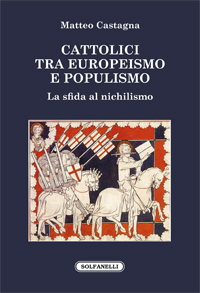
The author has the merit of having brought to the center of our attention a notable aspect taking place within the long-distance confrontation between Father Agostino Gemelli and the philosopher Giovanni Gentile, where the programmatic continuity of the Risorgimento is interrupted, in favor of the neo-Thomist vision.
Thus what the philosopher thought comes true Julius Evola. Both Spiritualism Absolute Gentilian, how much Historicism Absolute Crociano, they are both put aside. Something that was widely expected and feared by the philosophical formations in question. Positivism as expected, but first and foremost idealism, and in particular theCurrentism of the Gentile, will be put up for auction. The future work plan ofEncyclopedia Italian, ultimate end of Gentile Reform, it will inevitably be modified and deviated.
The regime's political project, with the Monarchist Institute at the center of the Armed Forces, that of the Duce of Fascism, it was at a turning point. Where the Italian Way to Modernity met with consensus and applause from Oltre Tevere. In summary it emerges, from a careful examination of what is an exemplary place of twentieth-century historiography, what was perceived at the time as a scientific discovery that had to be dealt with: the capital of Italy, it is not Rome without the Vatican.
This explains the connection inherent in the title, subsisting between Catholicity e Romanity, and the argumentative validity placed in the dichotomy Europeanism/Populism.
The author without failing in the critical intent of his work and with a methodical approach, begins an academic chronicle dedicated to the world of Tradition, that moving from the inside, allows the reader to take stock of what was happening beyond the Tiber: the Advent of the Modern World.
We are thus expertly introduced into a world of tenor passions and tensions, more current than ever. In fact by empire, lo State he is the first to bring his challenge to the nihilism, in an attempt to fill, in a universalistic sense, the regime vacuum left by Church. A very modern drama, so, which still awaits a Secular Song, Romanally at the height of the Present Hour.
The actors of the past return to the forefront from Sovereignists, by virtue of an inexhaustible and continuous reference to those who were their referents Globalists. Soli, are highlighted, like places facing the night of the highest systems, intent on peering into the darkness, in an attempt to identify the characteristics of the modern. Roman Party against Modernist Pact, how to say Piano Kalergi from the Piano Society. The point of view Italo-Vatican it was reported by the Author with seriousness and dedication, but it is also clear that we have been following an interrupted path for some time. Where the synthesis of the present, he makes himself feel more and more absent.
The Italian Way for Modernity. – The turning point still awaits us. A scientific study, important for those who intend to do serious research, a contribution to the attentive reader's library. The Book was finally Written. The Text has met its Reader. His poetics is now locked in a room.
It is up to Us to complete the Work
Now is the turning point
source – https://www.consulpress.eu/il-primato-spirituale-di-roma-capitale-in-un-saggio-di-matteo-castagna-presentato-a-palazzo-montecitorio/
