

 Reporting of www.unavox.it
in don Curzio Nitoglia
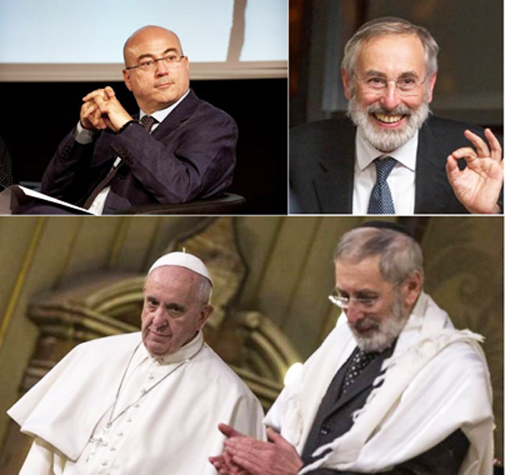
In light of what has been seen in thearticle in the Gospel of St. Matthew on reprobation (not definitive) of Israel we can read and comment on the interview with the chief rabbi of Rome, Riccardo di Segni, released to Aldo Cazzullo in the Corriere della Sera (21. I. 2018, p. 21).
When asked that the Jews blamed Italy for voting against the recognition of Jerusalem as the capital of Israel, the rabbi replies that it was done because such a vote "is a reflection of the typical Christian position […] whereby Jews can be subjugated or tolerated, more sovereign, not even at home" (1).
Regarding the anti-Semitism still existing in Italy, Di Segni says that "there is the religious idea according to which the Jewish people have exhausted their function and must wander wandering and dispersed among peoples as punishment for not having accepted the truth" (2).
He also recognizes that “Rabbinic Judaism derives from the Pharisees [of the time of Jesus, ndr]” (3), that “God is only one” (4), that “if you [Christians, ndr] you have Sunday it's because we have Saturday" (5).
Regarding ecumenism he has a very clear vision: “When Pope Francis came to the synagogue he wanted to discuss theology. I told him no: everyone has their own theology, and it doesn't change it". Excellent lesson: “When salt becomes tasteless it is only good to be thrown on the ground and trampled on by men” (Mt., V, 13).
He has much better ideas on migration than the "welcoming" ones of the catholic progressives: “I wonder: all Muslims who arrive here [in Italy, ndr] they intend to respect our rights and values? And the Italian state has the strength to enforce them? Unfortunately I have to answer with two no's. That's why I'm worried. […]. I know that uncontrolled migration can provoke a reaction of intolerance”.
On Jesus Christ he clearly answers that "for us he is not the Messiah" and this justifies the Catholic position of "friendly segregation" regarding Talmudic Judaism.
Furthermore, concludes the chief rabbi of Rome, “The afterlife is not at the center of my concerns”. Here we can see the influence of the theology of the Sadducees who already at the time of Jesus denied the immortality of the soul and the afterlife. Nihil sub sole novi.
Conclusion
We have seen the problem of Israel as the sole capital of the Jewish State and no longer a "separate body" or "internationalized city" when dealing with the interview given by Turkish President Erdogan to Maurizio Molinari.
It seems to me that the entire interview with the chief rabbi of Rome can be interpreted in light of this theory, which risks setting fire not only to the Middle East, already on fire, but the whole world given the interests that the USA on one side and Russia on the other have in this tormented region.
Therefore the solution to the problem posed by Di Segni is the one given to us by Saint Paul in the Epistle to the Romans (especially in chapter XI) and in the 1st Epistle to the Thessalonians (II, 15).
I refer the reader to the article oninterview Molinari-Erdogan to read what God revealed to us about Israel through Saint Paul.
NOTE
1 – Certainly yes, in fact, according to traditional Catholic theology this situation of subordinate separation is a consequence of deicide. Furthermore, speaking of Jerusalem as the "home" of the Jews, who left it burning in the 70 and they returned there by force of arms in 1948 driving out the Palestinians (Christians and Muslims) who had lived there for about 2000 years, it's questionable to say the least.
2 – Same as above.
3 – Absolutely true: the Pharisaism of Jesus' time is the father of current post-biblical Talmudic Judaism.
4 – This too is true, but the only true God is the SS. Trinity unacknowledged by post-biblical rabbinic Judaism, who put the Incarnate Word on the cross and perseveres in his misunderstanding.
5 – This is not accurate: in the Old Testament it was celebrated on Saturday because God rested on the sixth day after creation (on Saturday), while in the New Testament it is celebrated on Sunday because Christ, crucified on Friday by the Jews, he resurrected the following Sunday, that is, the Easter of Resurrection.
