

 This essay takes up the position on Savonarola expressed by our Matteo Castagna in his book, which still continues to spark discussion and which some students would like to translate into English and French.
Strength and limits of Machiavelli
We therefore understand the greatness of Machiavelli and why Croce considers Machiavelli and Vico the authentic modern philosophers, practical. The “philosophy of praxis” was born in the context of Italian Renaissance spirituality, as Burckhardt well understood. Modern and universal thought thus has its roots in the Florence of those times, in Italy not in England not in Germany. But what does this actually mean?? Scientific method based on the mere observation of the harsh necessity of law of nature (therefore Machiavelli) or creative pure intuition based on the free action of the spiritual-political guide, or of the religious elite inspired by the divine (Savonarola)? However we study modern and contemporary history, everything brings us back, continuously, to Italian culture, last fortress in a West clouded by a transvaluing techno-scientist nihilism, anti-humanistic.
Ethics and politics means on the other hand, Today, metaphysics or science, human kingdom or techno-scientific finance? And Burnham's essay on the Machiavellians and the defenders of freedom should be revisited today as it contained intuitions that the facts will later confirm. Basically: authentic Machiavellian the one to whom success smiles? Therefore the prototype of the statesman and the immanent man is the one or those who won the war by dropping the atomic bombs? This is truly the yardstick of "big politics" and statecraft? And Machiavelli would agree with such crudely empirical assessments? I will now try to solve these puzzles, despite knowing that they are very difficult to resolve, never definitive after all.
The Heraclitean contradiction, also violent and dramatic unfortunately, as history has sadly taught us, it is the heart of every reality and ultimately of every authentic "ascension". Machiavelli is the theorist par excellence of political conflict. Very different, in this sense, from Hobbes as from Rousseau. The kingdom of definitive Harmony and collective peace is not possible for him. Probably, Today, would accuse Xi Jinping's Chinese imperial ideology of abstract and dangerous utopianism. It would be okay then, lived today, con i neocon Americans and with the Rumsfeld doctrine as Leeden said, author of an important essay on Machiavelli in the 21st century? Hard to say, every effort at neo-Machiavellian updating is affected by the double reading of the author, that is, that of “I Discorsi” and that of “The Prince”. We will see, Anyway, that Machiavelli can be updated especially in light of the ideological poles of the Risorgimento.
However, the Florentine secretary does not resolve the political ethical dilemma, as even the "Machiavellian" Croce recognizes. The concepts of Virtue and Fortune they are not realized in a superior immanentistic and humanistic synthesis, although dynamic, non-quietistic, but they end up reexploding in all their molecular atomistic contradiction. He's wrong, Anyway, to represent the "philosophy of praxis" of the Florentine secretary as mere cynicism. Rather, it aims to be an apologia for good ethics. Having the courage to even do evil, to immerse oneself in the demonic kingdom of telluric power in order to bring about the triumph of good. Let us look primarily at the end - the good of the country, the reason of State - and the means will therefore be honorable.
For Machiavelli, the "natural forces" of history matter, not "the superior causes" immanent in history, since they are not there. This is Machiavelli's naked logic: his greatness in it, its eternal originality but also its limit. A state is not based on "superior causes" or even on the pure technical virtue of the prince. Machiavelli therefore remains in the middle between medieval transcendence and the new transcendence of naturalism. He thus gives birth to a new form of transcendence, that of nature which cannot be spiritualized or humanized, of nature that remains on this side of man himself. Nature thus becomes the human world itself; nature Machiavellian Fortune itself, which often operates at its discretion. Il Centaur Machiavellian, half man, half beast, it is precisely the symbol of the transcendent naturalism that characterizes the world vision of the Chancellor of Florence.
Therefore Croce and Gramsci are wrong when they see Machiavelli as the forerunner of historicist awareness, immanent, of the new times? No. In Machiavelli, as Hegel saw it, there is a qualitative leap, a leap forward in the “spirit of the times”. In that sense, Machiavelli, as Gramsci rightly says, he is the first Jacobin in history, he is the theoretician par excellence of the bourgeois and revolutionary democratic state. The autonomy of politics of which he was an excellent thinker is domination, the only one, that the strategic elite or “the prince” can snatch from the realm of chance and the unknown. Here the germ of Italian humanism appears in the Florentine secretary.
Savonarola the revolutionary

However, we cannot talk about Machiavelli without talking about Savonarola. Who does it, and today many professors really do it with a light heart, in my humble opinion it goes astray. Your Machiavellian humanism, which is almost a breaking point in its general formal-real system, it could not arise precisely from Savonarola's revolutionary impulse? Both, both the Florentine secretary and the Ferrarese friar, they insist on two eternal moments of the human spirit. If Machiavelli is transcendent naturalism, Savonarola is perhaps, own, spiritualistic immanentism? Carlo Curcio, professor of political philosophy at the University of Perugia between the 30s and 40s of the last century, noted how the central moment of the political and social climate of the time was represented by the irruption onto the scene of Savonarola, much more than from “The Prince”, which, in spite of its full-blown ultrarealism, will have no practical effects in the immediate history of the country. In fact, it will be necessary to wait for the Count of Cavour for there to be "The Prince" of the Machiavellian school in Italy. Savonarolism, the friar's political mysticism, in Curcio's hermeneutics, it is not a realization of Thomistic-Aristotelian theology, it's not medievalism. It is instead a different experimental declination of immanentistic and activist realism that belongs to the Italian political tradition . What should have, concretely, the poor Dominican friar do more to awaken consciences, clouded by the unilateral excess of empiricist-materialistic stupor, from “vice and sin”? The friar del Curcio therefore becomes an anti-bourgeois idealist and a "populist" who aims to establish a concrete anti-plutocratic and anti-oligarchic revolutionary dictatorship, a purifying revolutionary dictatorship, who knows how to affirm republican freedom, the hierocratic popular state, fighting to the death to prevent the fatal birth of the State, night watchman of the materialistic interests of the bourgeoisie. Curcio says during one of his university lectures in 1939:
«Savonarola is a political revolutionary and a conservative in eternal values. Apart from his rebellious attitude towards the Church, before the men of his time, He is an initiator of the new times, much more than Machiavelli and the scientists of the Renaissance. In Savonarola we find hints that are so current and revolutionary that they were not understood at the time. The will to destroy the past, to "renew everything in the light of the ideal", his conception of life as "a sacred and continuous militia above the earth", his hope in the young people facing new times: and above all the awareness of a fatal establishment of a new order, morale, following the terrible massacre caused by the vices and sins of his contemporaries, following extraordinary events that will mark the advent of the new era. The spirit of Savonarola embodied the anti-bourgeois moment, it was the spiritualistic and idealistic reaction to a revolution that had already occurred, which had given birth to the bourgeois state, realistic, land. Alongside the “utopian” spirit, immanent, of the Savonarola revolution, Italy prepares the ground for the Machiavellian conception of politics as the midwife of the state and law".
In Savonarola it comes to life and body, for the first time in history, the Christ impulse as a social and also political engine, beyond the classic dualistic distinction between celestial city and earthly kingdom. Curcio's vision has been confirmed, Today, in what is philosophically the most weighty writing on millenarian political Savonarolism, namely that of Donald Weinstein. It will be said now: “Savonarola defeated”, “unarmed prophet”.
According to Luigi Russo's reading, great interpreter of Machiavellian thought, the seed of the martyrdom of the friars, on the other hand, bore fruit. It was fruitful with Vico and the Vichians, who, alongside the "actual reality" asserted the "ideal reality"; it bore fruit, above all, with the very process of Italian history, when the unity of the peninsula, abstract prophecy on the edge of the 16th century, ended up transmuting Savonarola's prophetic pathos into Mazzini's words and actions.
Sorel and the myth

It thus becomes central, in contemporary political philosophy, as both Gramsci and C. saw well. Schmitt, the spiritual category of “political myth”. Both, the Sardinian and the German jurist, they identify Sorel's doctrine of "political myth" as the metamorphosis of Machiavellianism in the 20th century. However, it is a one-sided reading. Both reread Sorelian ideology through Mussolini's strategic political tactics. It is therefore a forced and abstract reading. Mussolini, than in most cases, as known, he declared himself a disciple of Sorel, he did it because he couldn't, for obvious reasons, calling himself a disciple of Croce. Sorelism arrived in Italy through Benedetto Croce and the entire "national socialist" period (it was naturally a non-enlightenment socialism, not Jacobin, not Russovian) of the Italian philosopher, which lasted more or less until the advent of fascism and Mussolini, it was under the banner of a philosophical theorization of Sorelian political sociology.
So digging, It would also be interesting to see how much Crocean political philosophy there is in anti-democracy, in anti-individualism, in organicism, in the life or death struggle against the "Masonic mentality" and the Anglo-Saxon civilization model, implemented by the leader of fascism. Right, the Israeli Marxist Sternhell, author of the most notable essays on fascist ideology (Cfr. “The birth of fascist ideology”, “The revolutionary right”, “Against the Enlightenment”), he is probably right when he identifies Sorelian ideology as one of the central sources of this historical upheaval. But the political Sorel was a "spontaneist", adverse, like the rest of the Marxist tradition (Gramsci aside), a quell’autonomy of the politician, which was the great strength of Mussolini's strategic tactics. The cult of technique and production, with the ultimate horizon of the extinction of the state and politics, continues to live as a strategic impulse in the spiritualist and moralist Sorel, who considers himself a successor of Pascal, admirer of Corbeille, Racine, Moliere and in the neo-historicist Sorel, collaborator of Benedetto Croce and admirer of Vico and Mazzini. Furthermore, if the ideological baggage of the elite of revolutionary syndicalism then flowed into fascism, we would need to see how and how much, in the Italian trade unionist faction, sorelism integrates with Mazzinianism. How much Sorel is there, for example, in the Machiavellian elitist Michels, first revolutionary trade unionist, then a fascist ideologist? Very, there is no doubt. We therefore do not want to belittle it, at all, the historical impact force of the Sorelian "political myth"., considered by Gramsci a dramatic form of "imaginative social fantasy", capable of operating on a dispersed and pulverized people to arouse and organize their collective national-popular will.
In the Sorelian "political myth", however, the two moments coexist, the Machiavellian one and the Savonarola one. Sorel was obsessed with the decadence to which bourgeois materialism stood, in his opinion, leading France and the West and for this reason he began to study the history of the Italian monastic orders, nothing easier, so, that he met Savonarola. That he met him through Machiavelli, or without him, it is secondary. This concrete historicization of the strength of the "political myth" was implemented in Italy by Mussolini, not in France; not surprisingly Sorel, shortly before dying, he considered Italy his ideal homeland. All of this takes us back to where we started from, to the two poles of Italian ideology. Machiavelli and Savonarola.
Mazzini and Cavour
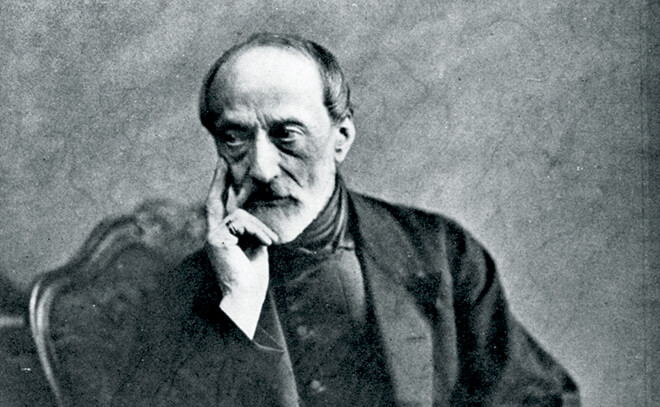
The thesis, how it will be understood, is that the theory of the Machiavellian dramatic phase of the "conflict" is not possible, of the “turmoil”, if not in light of the concrete historical and mystical-political revolution achieved by Savonarola. Savonarolism therefore influenced Machiavellian thought far beyond what is commonly recognized or believed.. Machiavelli and Savonarola as the two vectors of the most daring modern political thought. Consequentially, by any stretch of the imagination, Cavour the ultrarealist and Mazzini the revolutionary idealist creator of the metaphysical myth, “anti-Enlightenment” and anti-Jacobean, of God and People. The two great statesmen of the 19th century. Disraeli was great, for various analysts he was the true creator of the "modern world" and contemporary globalism. It was the greatest, In short. But Cavour and Mazzini were no different. Far from it, and let it be said without nationalistic arrogance. They were two of the prototypes of authentic statesmanship, transforming the Machiavellian and Savonarola moments into modern political action, politicizing with great courage of the unknown the two perennial moments of the human spirit. Mazzini is bolder and more courageous, there is no doubt. But Cavour himself, the statesman of a Risorgimento that was considered impossible by all the legations of the time, he made his journey into the “metahistorical” unknown by politicizing it. However, he sacrificed everything to empirical success and we pay for this, like Italians, still today the very serious consequences. Giuseppe Mazzini, the statesman of the Roman Republic of 1849 who vanished in fire and holocaust of the best, as the chronicles say, the republican statesman who influenced all the patriotic movements of the world, from Russia to India, on the contrary, he acted out of love for man - or even better for the sacred in man - and for history. Success was not the immediate goal for him: creating a vanguard of sacrificial and "religious" minorities was the true success. If well studied, in its various tactical phases, there is a lot of Machiavellian spirit to be found, a lot of realpolitik in Mazzini himself.
In the light of Mazzini's philosophy of praxis and his mythical objectivism, Cavourian “realism”., with its instrumental Masonic liberalism, it would be a regressive element that compromised the roots of Italian moral self-awareness. Cavourist abstract realism would have degraded the soul of the Roman-Italian people in its foundations. Cavourism, consequentially, it is the Scientist's assault on the Italian myth. This was Mazzini's thought since 1860. Cavour was a corrupter and a subverter. He was a Freemason, something that Mazzini despised, but he was also a bad politician, in his perspective. A Cavour, like every political utilitarian, a superior would have been missing, omnilateral strategic perspective. He would not have been able to imagine the historical good, sacrificing everything to abstract immediacy; therefore not a strategist, Mazzini's Cavour, but a Machiavellian tactician of the worst kind. Mazzini admires the Prussian statesman Bismarck, despite ideological differences, he dreams of an Italian-German alliance against the Western Franco-British Masonic bloc, but vice versa considers Cavour a pure catastrophe for the people and for Italian history. And indeed, to more than 150 years away from the facts, we still drag ourselves along, like Italy, problems that arose with formal unification, which seems to have radically torn apart the country's self-awareness. The meeting between the two perennial moments of the spirit from there, in Italian history, it will no longer be possible. But precisely the facts will show that when, fleetingly, there will be a meeting, it will be so thanks to the ideological dominance of the Mazzinian pole, not vice versa. And if modern utilitarian and individualistic thought means "autonomy of moral conscience", for Mazzini this is absolutely integrated into the objective symbol (God-People) of the philosophy of praxis. Otherwise it will be a catastrophe. Anglo-Saxon and extreme omnipotence- western of the ego, says Genovese with prescient spirit from Laystall Street in 1852, will lead to the abyss of the ego, to the rejection of the spirit in the human being.
Gramsci and the philosophy of praxis

Gramsci's critique of philosophical-political Mazzinianism, such as his enthusiastic openness to Giobert's "theoretical Jacobinism"., In my opinion they do not capture the core of Italian national-popular ideology. Which is also the core of a certain Italian "character" that Mazzini, the great Pedagogue, lover of the organic nature of the ethical state, like it or not, he formed anyway. When the great intellectuals of our day, without naming names, from the Corriere della sera, they mock the Genoese, “successful loser”, “nebulous theorist of the doctrine of martyrdom”, they clearly show that they ignore the quintessence of a certain Italianness, which is a minority, avant-garde, it's not mass, but which nevertheless exists and is historically operative. Gramsci's "idealistic" and neo-historicistic voluntarism, in evident epistemological break with the Marxist tradition, it should correspond to Sardinian, in Italian history, at the nexus of the Protestant Reformation and the French Revolution.
Gramscian philosophy, like the Crocean one, it is absolutely historicist and anti-natural-law. But the serious limitation, strategic, of Gramscism is to abstractly chase Mazzinian civil and political mysticism without being aware that that is the aim of his entire political philosophy. Italianism transformed into a historical-universal movement without a Protestant Reformation, nor a French revolution, nor an English civil war. Dostoevsky understood this well. The strategic limit of Gramscian political philosophy therefore becomes the limit of the "Italian road to socialism", which is a serious strategic project. And it is no coincidence that Togliatti's statesman of reference was Camillo Benso, Count of Cavour.
A. Del Noce is right: Italy was the strategic theater of the most intense and evolved political conflict of the twentieth century. First fascism, the only movement in Western history that has overthrown a form of solid liberal democracy. Then "Gramscian communism" in a Togliatti and Berlinguer style, Robespierrist rather than orthodox Marxist, it was also on the verge of doing so several times. He didn't do it though. Why? For its strategic subordination to the USSR, symptom of methodical doubt and intimate uncertainty. The essence of Gramscian Jacobin Machiavellianism was not fully understood; the meaning of Gramscian political thought was that only from Italy could "true Communism" radiate into the universe. But this would have meant a “religious path” to Socialism. The Togliattian recovery of Mazzinianism will be, Instead, only formal, abstract and will be carried out for reasons of mere competition with the "brothers in the black shirt" and the fascistized humble classes. “Italian way to socialism” (Get away), but not followed through to the ultimate consequences.
However two forms of delnocyana"revolution, further and more intense than the pure Marxist one”, the fascist one and the partial Togliatti one. Leeden himself, who knows history and politics much more than the presumed and self-proclaimed pro-European elites, he wrote in a text at the end of the 1970s that the only concrete strategic-universal political and ideological elements, in the twentieth century, they were radiated from fascist Italy first, from the Italian way to Togliatti's socialism then. Geopolitical reasons (the ever central Mediterranean)? Surely. But also ideological and "religious" reasons.
The Italian laboratory
And today, in conclusion, beyond all the necessary criticisms of the case, again the innovation that originates from Italy, from this not the West who found himself in the western camp. Even today, Italy's innovation is the first strategic laboratory of "State Populism". Being against or being for doesn't matter. It's the concrete historical and "ideological" meaning which must be grasped and which the presumed cosmopolitical elites not surprisingly neither grasp nor will grasp. Mazzini writes that spiritualism and materialism are two wrong paths, unilateral, harbingers of an abstract dualism. The religious philosophical path of the Genoese apostle is based on thought as a universal Revelation of the original sacred which penetrates humanity as a political God and active People, creator of history and Mediterranean hegemony, universalistica. A preview of the Sorelian myth, seen by Gramsci and Schmitt as the embodiment of 20th century Machiavellianism.
Returning to today's Italian context, will be able to embody such “populism”., updating it, the qualitative mission of the great Italian political thought, which today can only mean total philosophical opposition, political and religious, on the level of an authentic conception of the world, modern and not “primitivistic”, to totalitarian techno-scientific alienation? But that of the yellow-green government is truly "populism".? What connection does this government have with Argentine Peronist “Evitism”., that can be considered, Today, the most immediate reference, or historically less distant, for a serious "state populism" that wants to make history? These Italian populist leaders are able to mobilize the people on the basis of the "political saint" and the national-popular myth? What myth do they know how to concretely oppose to rampant technoscience?? Questions to which, evidently, Can't answer for now. They have, ultimately, they are the awareness of the whirlwind struggle within the spirit of the time? Whatever you may think of Peronism, according to Kissinger it changed not only Argentine history, but also of the whole of South America, far beyond Castroism and Caudillismo. The same will be said of Salvini and Di Maio between 50 years? Or they will be remembered as inessential meteors of historical spiritual becoming?
Why, returning to the starting point, with"states are not governed with paternosters", as Cosimo de Medici - Savonarola's great enemy - used to say, Mazzini, certain of the presence of the divine in human consciousness, he stated succinctly: “The holiest Prayer is action”. As, political praxis or is it an art that embodies, in praxis, an active spirituality or is destined to lose its way compared to the eternal naturalism that always advances, today precisely in robotic form, intellectualistic-artificial and techno-scientific, until laying the foundations for the definitive defeat of the "man project".
Opposition to totalitarianism, in forma soft e liberal, of mechanistic and techno-scientific alienation cannot therefore mean neo-Luddism or static conservatism but vice versa a leap forward of what Mazzini himself, in “Faith and Future”, defines “Living and Absolute Thought”.
Fonte -https://sollevazione.blogspot.com/2019/03/machiavelli-e-la-politica-italiana-di.html
