Libya-Syria: who they support, who to cheer for
Of Fulvio Grimaldi
Amici, this time too we are long. Pardon. However for 15 days I'm out and, so, there is time to slowly make it. If you believe.
Of Fulvio Grimaldi
Amici, this time too we are long. Pardon. However for 15 days I'm out and, so, there is time to slowly make it. If you believe.
Of Ilaria Bifarini

Source: Heretically
“Migration can benefit everyone in building more inclusive and sustainable societies. Globally, the number of international migrants has reached approx 258 million in 2017, compared to 173 million of 2000. Migration contributes to inclusive and sustainable economic growth and development in both countries of origin and destination. In the 2017, remittance flows to low- and middle-income countries have reached $ 466 billion, more than three times the amount of APS (Public development aid) received in the same year. Remittances constitute a significant source of family income, improving the situation of families and communities
through investments in education, healthcare, sanitation services, housing and infrastructure. Destination countries also benefit, as migrants often fill job gaps, they create jobs as entrepreneurs and pay taxes and social security contributions. Overcoming adversity, many migrants become the most dynamic members of society, contributing to the development of science and technology and enriching their host communities through cultural diversity.”
This is what we read in the Agenda 2030 for Sustainable Development of the United Nations, a firma del cinese Liu Zhenmin, UN Under-Secretary-General for Economic and Social Affairs. So, compared to 2000 the number of people who left their country of birth and now live in other countries increased by approximately 50% percent (il 49% to be precise) with a continuous growth trend. Beyond the optimistic and unrealistic tones used in the programmatic document, we can extrapolate the presumed economic model of development supported by the proponents of current migrations, That, unlike the past ones, have reached massive levels and are following new directions. Triggering a hypothesized virtuous circle of growth would be, on the one hand, the supply of labor by migrants for unsatisfied requests from local workers, on the other, the flow of money sent to the countries of origin, which would be used not only to alleviate family poverty, but for productive investments in the national economic fabric. A virtuous model and a harbinger of growth, accompanied by a happy coexistence, almost symbiotic, between migrants and citizens of the host country. Read More
Reporting of BastaBugie editorial team(AUTOMATIC READING)
You know what Africa's main problem is?
My friend who just returned from a long trip questions me, but I'm prepared. I already have the lesson ready on the exploitation of resources by the white man, I know, I didn't understand it well but I can say it. But before he can leave he answers himself. “E’ witchcraft”.
And he starts to tell me an incredible reality, a primitive world in which if it hails hard and the harvest is destroyed the sorcerer slaughters a chicken, he observes the blood and based on that decides which woman will be punished. Why, you are, It's always a woman's fault. If there is a man you hate with all your heart, wish him to be reborn as a woman in Africa, my says (I don't hate anyone that much, and I don't believe in reincarnation, but I would certainly hope for an internship as an African woman for two months for someone, almost almost). The woman identified as responsible will be expelled from the village, banned, or sometimes put alive in boiling water or thrown into the river with crocodiles (if he survives he was innocent). In certain cases, if the blame for the hailstorm or any other negative event will be attributed with certainty to you – according to a culture for which nothing happens for natural or scientifically explainable reasons – she will be killed and her heart will be eaten. Read More
Blog report by Maurizio Blondet
Of Ilaria Bifarini
Where did the billions of dollars of aid to Africa go??
Huge loans from international financial organizations, significant relief from state debt, funds raised by private initiatives, who mobilized everyone, from individual Western citizens through organized forms of charity to show business stars, who worked for the rights of the weakest through concerts and performances.
Rivers of billions of dollars that do not seem to have made any dent in the problem of underdevelopment and endemic poverty in the Third World. On the contrary. It was found that, since the mid-1990s, circa 60 developing countries have become poorer in terms of per capita income than 15 years before. By 2030 two-thirds of the world's poor will come from Africa.
Africa is therefore increasingly poor, but of a new poverty compared to that of the colonial past. In fact, the African continent includes the countries with the highest levels of inequality in the world, in which the gap between a small elite dedicated to luxury and the rest of the population living in a state of poverty is abysmal.
So, what didn't work? Where have the rivers of billions of dollars gone? Read More
by Paolo Becchi

Source: Paolo Becchi
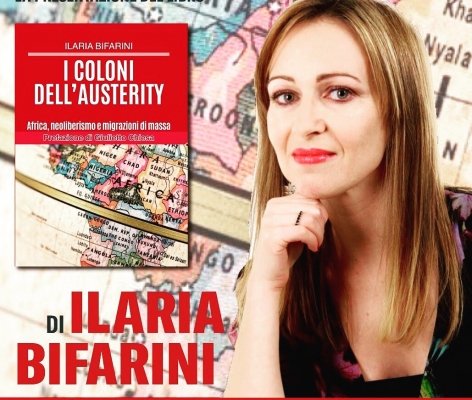
To understand something about what is happening in Africa and the mass emigration from that continent, we must first detoxify ourselves from what the newspapers write every day or what the mainstream publishing houses publish, and maybe start by reading a book recently published by Amazon and Youcanprint (both as an ebook and in paperback).
The author, Ilaria Bifarini, she is a young scholar, who presents herself as a "redeemed Bocconian", already known for a volume, Neoliberalism and mass manipulation (2017), which has sold thousands of copies online. His new book, titled The settlers of austerity. Africa, neoliberalism mass emigration (2018) continues the same critical theoretical path towards the neoliberal doctrine, tackling the topic from a counter-current perspective, very relevant today, of mass migrations. The fundamental thesis is soon stated: let's get out of our heads the convenient narrative that traces current African underdevelopment to the colonial past. This thesis is often supported today to justify uncontrolled reception. But it's false.
The disintegration of colonial empires starting from the 1950s led to the formation of independent national states, who however did not have the opportunity to develop their economies independently because they were prevented from doing so: colonialism was thus replaced by something even worse, a form of postcolonialism, focused on economic control, which prevented local economies from growing and developing. Read More
Of Emanuel Pietrobon

Source: The dissident intellectual
France is one of the few (ex) powers of the defunct European system to have preserved and perpetuated hegemonic designs on what was its colonial empire, despite the loss of relative power, both in Europe and around the world, and the affirmation of a new international order that is no longer Eurocentric. In the beginning I was Charles de Gaulle wanting to prevent France's decline from a great world power to a regional power in decline and in a peripheral position in the new post-war order. For this purpose, France equipped itself with atomic weapons and attempted to reconquer the former imperial African territories through a policy of economic neocolonialism following the ambitious and visionary plan for French-speaking Africa developed by Jacques Foccart, one of the most important ideologues and strategists of the Gaullist era. Foccart's neo-imperial revival plan for France did not only aim at the reconquest of Africa, but to the expansion up every French-speaking territory in the world. The support provided by the Sdece fits into this context, the secret services for foreign countries, to the Quebec separatist movement, and that controversial “Long live free Quebec!” shouted by De Gaulle to the Montreal crowd in 1967. Read More