

Of Emanuel Pietrobon
Source: The dissident intellectual
France is one of the few (ex) powers of the defunct European system to have preserved and perpetuated hegemonic designs on what was its colonial empire, despite the loss of relative power, both in Europe and around the world, and the affirmation of a new international order that is no longer Eurocentric. In the beginning I was Charles de Gaulle wanting to prevent France's decline from a great world power to a regional power in decline and in a peripheral position in the new post-war order. For this purpose, France equipped itself with atomic weapons and attempted to reconquer the former imperial African territories through a policy of economic neocolonialism following the ambitious and visionary plan for French-speaking Africa developed by Jacques Foccart, one of the most important ideologues and strategists of the Gaullist era. Foccart's neo-imperial revival plan for France did not only aim at the reconquest of Africa, but to the expansion up every French-speaking territory in the world. The support provided by the Sdece fits into this context, the secret services for foreign countries, to the Quebec separatist movement, and that controversial “Long live free Quebec!” shouted by De Gaulle to the Montreal crowd in 1967.

Quebec aside, the French aims, from Gaullism to today, they turned towards French-speaking Africa, of which attempts have been made to influence its economic and political dynamics in every way through political assassinations, coups d'état, support for military dictatorships and terrorist groups, fueling civil wars and inter-ethnic conflicts, creating over time a renamed sphere of hegemonic influence Françafrique, substantially extended over the entire former colonial empire. Foccart was the power behind the crown from De Gaulle to Jacques Chirac, called to provide opinions, strategy development, carry out secret diplomatic missions, dal 1960 al 1995. It can be said that Foccart was for France, what Henry Kissinger it was for the United States, or, a strategist guided by visions as intelligently far-sighted as they are subtly imperialistic. La Françafrique is a multidimensional reality, in fact it acts on an economic level, politico, diplomatic and ideological of numerous countries, dal Magreb al Sahel, all’Africa sub-sahariana.
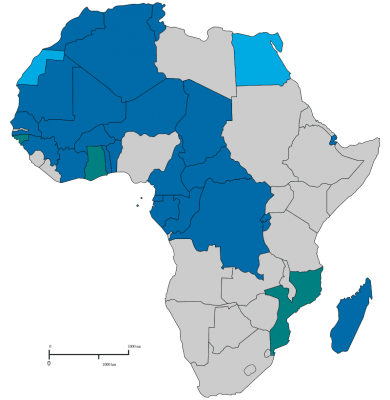
Economic subjugation is essentially made explicit in the existence of the so-called free area, of which they are part 14 African countries, obliged to use the CFA franc, whose convertibility into euros is handled by the French Ministry of Economy and Finance. Membership of the franc area also requires that member countries deposit at least the 65% of foreign currency reserves in France. Furthermore, the large French companies in the energy and mining sectors enjoy privileged treatment in the exploitation of the territory and in the sharing of profits with the States. The political-diplomatic dimension concerns the pressure placed on the Françafrique countries to support national interests, French foreign policy positions and doctrines at the international level, for example instead of the United Nations General Assembly. The ideological dimension initially concerned the containment of anti-colonial national liberation forces during the era of decolonization, it later focused on the containment of communist movements on the continent supported by the Soviet Union, and today it is mainly focused on two fronts: the competition with Italy for hegemony over Libya and Tunisia and the containment of Sinic expansionism, the latter much more difficult than the first objective, so much so that the neologism has fully entered the vocabulary of political scientists and geopoliticians China Africa.

Françafrique's numbers are impressive: beyond 40 direct military interventions aimed at defending pro-French regimes, both democratic and dictatorial, or to help rebels overthrow hostile regimes. Currently, France is linked to 12 countries from defensive military agreements, and is present in 10 countries with military missions, for a total of over 5 thousand units present. Behind the excuse of the war against the imperialism of Western multinationals, France used the historic mercenary's private security company Bob Denard to fight in Katanga and Biafra, and attempt regime changes in Gabon, Angola, Zimbabwe, Benin, Democratic Republic of Congo and Union of Comoros. Lo just it was the main defense instrument of Françafrique, publicly or allegedly involved in numerous political assassinations, especially of charismatic leaders known for their denunciations of the continent's submission to Western imperialism: Reuben Um Byobe e Félix-Roland Moumiéof the Cameroon People's Union, Barthélemy Boganda of the Central African Nationalist Party, the Chadian political opponent Outel Bono, the anti-apartheid activist Dulcie September, up to the sacred monsters of the African nationalist front Thomas Sankara e Patrice Lumumba.
French governments have often exploited the inter-ethnic and inter-religious tensions present in the most ethno-religiously heterogeneous countries to fuel civil wars decades, through which to maintain the most hostile regimes, or the richest territories, in a constant state of siege and underdevelopment, used to purchase raw materials smuggled by terrorists and rebels at low cost: a real predatory capitalism. Between the 1967 and the 1970, France was actively involved in Biafra war, supporting secessionists through weapons, capital, means, mercenaries, food. Together with the intervention in Libya of 2011, the Biafra war represents one of the darkest chapters in the history of Françafrique. France was intimidated by the prospect of Nigeria, one of the most dynamic economies on the continent, could fall under British or Soviet influence, therefore it fueled the discontent present between the armed forces and the Igbo ethnic group towards the central government to give rise to a secessionist movement that would permanently divide the country. They were Foccart, the Michelin and the French Limited Company for Petroleum Research and Exploitation (Safrap), to convince De Gaulle, demoralized by the failures in Algeria and Katanga, to intervene in the nascent Nigerian question for capture important crude oil reserves present in Biafra.

A delicate work of secret diplomacy carried out by Foccart brought numerous countries, Europeans and Africans, to support France in the secret war against Nigeria, including Israel, Portugal, Spain, Rhodesia, Gabon, Sud Africa, Ivory Coast, who helped the secessionists by sending them weapons, exchanging intelligence information, training them. A role of fundamental importance was also played by the non-governmental organizations, precursor sign of the imminent advent of the new wars described by Mary Kaldorin the aftermath of the implosion of Yugoslavia; in fact the planes of the French Red Cross were used to transport loads of weapons to the secessionists. In conjunction with the French support for the secessionists, the self-proclaimed government of Colonel Ojukwu he introduced French language courses in Biafra schools and signed important oil concessions to Safrap. Furthermore, an effective propaganda machine was set in motion aimed at portraying the Nigerian government negatively in the eyes of world public opinion., in such a way as to legitimize the French intervention in the country. The fictitious news agency Biafra Market Press, based in Geneva, financed by SDECE, it became the main source of supply for the major European newspapers, churning out beyond 250 insights into the Biafra war.
The Nigerian government was accused of having reduced the Biafran population to famine through naval and air blockades, with the aim of purifying the country of the Igbo component. Several newspapers, including Le Monde, they started talking about genocide. A very familiar story of psychological terrorism and information warfare, if you think about the hoaxes produced bySyrian Observatory for Human Rights, based in London, managed by a single individual, and funded by the British government, since the outbreak of the Syrian civil war, with the aim of plagiarizing world public opinion and creating a false image on the role of the parties in conflict. The intervention in Libya of 2011, strongly supported by the then president of the republic Nicolas Sarkozy, he reconfirmed the importance for France of having the entire continent under its hegemony. The fall of Gaddafi it meant not only the re-tribalization of Libya, now considered a failed state comparable to Somalia, but also many other things: the downsizing of Italy's geopolitical position in the Mediterranean and North Africa, the fall of the country in one civil war which made him vulnerable toadvance of Daesh and to radicalization of the youngest, the end of the Italian-Libyan pact for the control of maritime borders and the fight against illegal immigration.

French interventionism towards a country traditionally close to Italy was made possible also and above all by the absence of a local political class truly devoted to the national interest. When in the 1986 the United States decided to react militarily to theattack on the La Belle nightclub of Berlin, blamed on the Libyan secret services, with the El Dorado Canyon operation, the then prime minister Bettino Craxi, suggested by the then foreign minister Giulio Andreotti, decided to warn Gaddafi of the imminent attack and denied the use of the airspace to US Air Force aircraft, in the awareness that the destabilization of Libya would have meant instability in the Mediterranean, therefore along the Italian coasts. Today we are witnessing a return of national interest to the center of the Italian government's political agenda, with the Minister of the Interior Matteo Salvini who declared that he was planning a trip to Libya with the aim of definitively resolving the migrant crisis, along the lines of what his predecessor had already done Marco Minniti.
France has also extended the tentacles of Françafrique into Libya to the detriment of an ally, member of the European Union and NATO, which he then suffered, and continues to suffer, the entire costs of that anti-historical action. Africa will not experience true economic growth and lasting social stability as long as Françafrique exists, since it feeds on maintaining the continent in a state of violent subjugation. Likewise, Italy will only be able to resolve the migrant issue by going to the root: he Sahel, because that's where the main caravans leave from, and France has always deployed men and equipment there, and has politicians on the payroll, being able to determine the halt of migratory flows and generating development conditions that, improving the quality of life of local populations, they can create opportunities on the continent who in thousands continue to desperately search for Europe.
