

Of Ilaria Bifarini
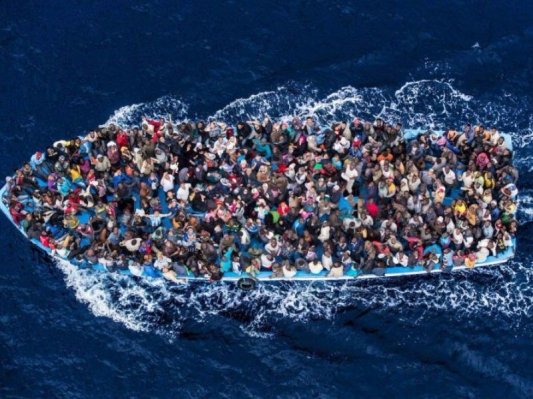
Source: Heretically
“Migration can benefit everyone in building more inclusive and sustainable societies. Globally, the number of international migrants has reached approx 258 million in 2017, compared to 173 million of 2000. Migration contributes to inclusive and sustainable economic growth and development in both countries of origin and destination. In the 2017, remittance flows to low- and middle-income countries have reached $ 466 billion, more than three times the amount of APS (Public development aid) received in the same year. Remittances constitute a significant source of family income, improving the situation of families and communities  through investments in education, healthcare, sanitation services, housing and infrastructure. Destination countries also benefit, as migrants often fill job gaps, they create jobs as entrepreneurs and pay taxes and social security contributions. Overcoming adversity, many migrants become the most dynamic members of society, contributing to the development of science and technology and enriching their host communities through cultural diversity.”
This is what we read in the Agenda 2030 for Sustainable Development of the United Nations, a firma del cinese Liu Zhenmin, UN Under-Secretary-General for Economic and Social Affairs. So, compared to 2000 the number of people who left their country of birth and now live in other countries increased by approximately 50% percent (il 49% to be precise) with a continuous growth trend. Beyond the optimistic and unrealistic tones used in the programmatic document, we can extrapolate the presumed economic model of development supported by the proponents of current migrations, That, unlike the past ones, have reached massive levels and are following new directions. Triggering a hypothesized virtuous circle of growth would be, on the one hand, the supply of labor by migrants for unsatisfied requests from local workers, on the other, the flow of money sent to the countries of origin, which would be used not only to alleviate family poverty, but for productive investments in the national economic fabric. A virtuous model and a harbinger of growth, accompanied by a happy coexistence, almost symbiotic, between migrants and citizens of the host country.
The reality, Unfortunately, turns out to be completely different, as often happens in economics, does not respect ideal conditions (or perhaps idealistic) of the models adopted. Most of the destination countries of migratory flows find themselves facing a lasting crisis situation, which has a significant impact on the demand and employment side. Furthermore, in the face of an increasingly automated production system, the job application, especially for unqualified profiles, is increasingly contracted. Following a process of ungoverned hyperglobalization, which in Europe has found maximum expression in the Eurozone, competition between workers is growing, while wages and labor rights are continually decreasing. It should therefore not surprise us if, in such a contingency, the massive flows of immigrants will swell the ranks of the local unemployed.
As far as remittances are concerned, it is proven like them, which are also very substantial and continually growing, are used, especially in the case of Africa, for primary consumption by families. In a continent where interference by powers persists (ex?) colonial – like France – and postcolonial – like China – investment opportunities are quite limited, considered the lethal neoliberal recipe imposed for decades by the Monetary Fund and the World Bank (see “The settlers of austerity – Africa, neoliberalism and mass migration"). On the other hand, but, Remittances are a thriving business for money transfer agencies, than for the one sent to Africa, for example, they apply commissions that reach up to 10%.
Therefore the situation id illiac disease that the UN speaks of not only does not exist, but it is absolutely unachievable given the current conditions of the world economy, however, destined to worsen. Yet the same enthusiasm for migratory flows comes from another international organization, the OECD, than in one of his documents, “The political challenges for the future 50 years" (2014), hopes that Europe and the United States will welcome from now until 2060 the considerable sum of 50 millions of migrants to meet the demands for the necessary workforce (again!). In the same document, the Organization for Cooperation and Development outlines future economic scenarios. From here to 2060, global growth considered at an aggregate level, i.e. OECD countries (which include the so-called Western economies) and not OECD, will slow down and settle at levels far lower than pre-crisis levels.
The scenarios predicted by economists for the labor market are rather dramatic. As the future economic model is increasingly "technology oriented", automation will reduce the demand for medium-skilled workers, while those with high and low levels of qualification and responsibility will survive, which corresponds to a related salary level. The result will be an inevitable and unstoppable increase in the population's inequality rate: it is the already ongoing phenomenon of the destruction of the middle class, founding element and prerogative of the well-being of Western economies. On a global scale the level of inequality (Gini index) from here to 2060, keeping the current economic model unchanged, might find, according to the studies conducted, an even surge of 40%.
Therefore the current and failing economic model that we want to continue to apply, of which migratory flows are a key element, will lead to an increase in poverty and inequality, as a demonstration by its supporters themselves. However, we persevere with myopia and masochistic obstinacy to administer the same lethal prescription to a dying patient, now trapped in the neoliberal logic of TINA (there is no alternative). Yet not only do alternatives exist, but the current one is the worst possible. The time has come to change course, and also leaders!
___________________________________________
Ilaria Bifarini (http://ilariabifarini.com/)
was born in Rieti on 1 April 1980 and graduated from the “Terenzio Varrone” classical high school. After moving to 1999  in Milan, In the 2004 she graduated with top marks in Economics of Public Administration and International Organizations from the “Luigi Bocconi” University of Milan. He later attended the Italian School for International Organizations in Rome and the Liberalism Course at the “Luigi Einaudi” Institute in Rome. She also obtained the qualification to practice as a chartered accountant and auditor. After professional experience in the public and private sectors, through a journey of study and introspection, it gradually diverged from the purely neoliberal education resulting from my studies. In the 2017 published my first book, “Neoliberalism and mass manipulation – Story of a redeemed Bocconi student”, starting to concretely commit myself to unmasking the neoliberal deception. A year later his “The colonists of austerity” was released. Africa, neoliberalism and mass migration" (https://www.amazon.it/coloni-dellausterity-Africa-neoliberismo-migrazioni/dp/1980621195/ref=sr_1_2?ie=UTF8&qid=1521981805&sr=8-2&keywords=bifarini), where he continues the research path undertaken and analyzes the causes of the current migratory phenomenon through a new interpretation unknown to the mainstream. I collaborate with various online newspapers and speak at conferences and television broadcasts.
Similar Posts
