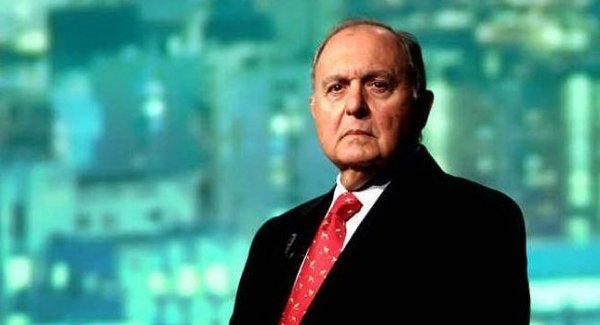
Message from Minister Paolo Savona to Confindustria

Image results for Minister Paolo Savonaof the Minister for European Affairs Paolo Savona

Signor President of Confindustria, Lord and Gentlemen,

the date of 27 June, day before the Council of Europe, has proven to be an obstacle to fulfilling my commitment to attend this meeting. At this very moment I am in the Chamber to gather the will of the Deputies on the position that the Government, through its President, will take over at the next summit of 28-29.

Nonetheless, I want it to come to this meeting, together with my apologies for the involuntary absence, a short message from me.

1° The Chapter 2 of the Report on “How and why to strengthen Europe” is the best most recent analysis I have read on the subject. I feared that this topic could not even be discussed in Italy and reading the document reassured me and encouraged me to address the problems under discussion in Brussels by leaving the ccontingent and framing them in the need and urgency of changes in institutional architecturealand dellEU. Congratulations therefore to the authors of the Chapter and to the Presidency who wanted this meeting-debate.

2° The first, the third and fourth blocks of theIntroduction contain a summary of the contents of the European matters waiting to be regulated. They are therefore an excellent agenda of the choices that must be made. Obviously it doesn't mean that I agree with all the initiatives proposed as a solution, but if we agree on the objectives, an agreement can be found on the technical tools. Read More

Share

Euro Italy: the blackmail of Target2

Of Roberto Pecchioli
Euro Italy: the blackmail of Target2
Source: Heretically
Ambrose Evans-Pritchard is probably the best economic journalist in Europe. From the columns of the conservative Daily Telegraph, his gaze sweeps over the business international without blinders and, above all, without becoming a megaphone for the interests of the upper levels. His recent speech should prick up the ears of observers and decision-makers in our country. Evans claims that a creeping flight of capital from Italy is underway. The proof is our liabilities in the Target2 system of the European Central Bank. In a month, increased by 39 billion up to 465 billions of euros. One of the causes would be the possibility that the issue becomes operational (which Evans sarcastically calls subversive) day Minibot, the parallel currency intended for Public Administration payments, but usable in general, since every means of payment works on a fiduciary basis, that is, if people are willing to accept it.
The worry (or the secret hope) of the markets is that Italian private savers, holders of very significant sums,join the exodus. The first consideration is that capital flight comes from large investors, by funds and investment banks, supported by the ECB itself. It therefore has an eminently political character, exactly like the manipulation of spread, not in the hands of metaphysical markets, but the Central Bank's blackmail weapon. Read More

Share

Draghi: sulla fine del QE "non è detta l'ultima parola"

Mario DraghiReporting of Wall Street Italia
Of Alessandra Caparello
Inflation is on the right track but “there is still a need for significant accommodative measures”. Go back to talking about Quantitative easing the number one of the European Central Bank Mario Draghi during his speech at the Sintra Economic Forum in Portugal where his colleagues from the Fed and the Bank of Japan, respectively Jerome Powell and Haruhiko Kuroda.
For Draghi thelast word regarding the end of Qe.

"In the 2017 Eurozone growth was higher than we had expected: growth on annual basis recorded in the fourth quarter was the strongest in a decade. But in the 2018 growth has slowed and, until now, it was lower than our expectations (…) Regarding the ECB's monetary policy, as indicated last week the progress made so far towards a sustained adjustment in inflation has been substantial. The expected end of our net asset purchases in December this year is subject to new macro data confirming the medium-term outlook for inflationinflation. Furthermore, the asset purchase program can always be used if contingent events arise that we cannot see at the moment.".

Draghi underlined how confidence in the return of inflation towards the long-term objective has strengthened significantly over the last few months., but uncertainty permeates theeconomic outlook.

“With long-term inflation expectations well anchored, the underlying strength ofEuropean economy and the continued large degree of monetary accommodation allow us to be confident that inflation will converge towards our objective and that this convergence can be maintained even after a gradual winding down of our program of net asset purchases.".

Therefore, says Draghi, the "monetary policy in the Eurozone must remain patient, persistent and prudent”. Read More

Share

Austerity? Nonsense, word of the ECB

Of Roberto Pecchioli
Austerity? Nonsense, word of the ECB
Source: Heretically
Consulting foreign newspapers broadens your horizon. Far from our home journalism, busy rummaging through CVs or fueling fascist hunts - now it's the Minister of the Family's turn Lorenzo Fontana – we can read interesting news carefully hidden from us. An example is the European Central Bank report entitled “On the sources of economic cycles. Implications for DSGE models.” The acronym means General Equilibrium of Stochastic Dynamics. In the initiatory jargon of economists, stochastic stands for probabilistic, and talking about probable scenarios is already a nice bath of humility on the part of the snooty masters of histograms and mathematical models. Economists are very good at explaining in retrospect how things did not go as they had predicted. Il report of the ECB follows the opposite path, a commendable example of realism and concrete research. Read More

Share

EXCUSE OF EU-ECB-IMF, L'UNGHERIA RINASCE

Hungary continues its policy of lowering taxes and tariffs. The newspapers and various Italian talk shows continue to ignore the economic revolution that is taking place in Hungary because they want to keep the people ignorant in order to prevent an ever-increasing number of people from starting to oppose the blood and tears measures launched by this government on behalf of the European Union.
For those who don't know (and unfortunately there are still many) a few months ago the Hungarian government decided to repay the debt contracted with the International Monetary Fund two years in advance in order to no longer suffer blackmail pressure from its inspectors.
After getting rid of these blackmailers and loan sharks, the government began to adopt a series of measures aimed at stimulating the economy and helping the weakest groups and thus decided to lower electricity bills, water, gas and urban waste disposal 20% and increased pensions to compensate recipients for the rising cost of living.
These measures would have been sufficient to improve the living conditions of Hungarians but the government has decided to go further and in fact in the tax bill recently approved by parliament new measures on family allowances and reduction of VAT from 27% al 5 % on live and slaughtered pigs. Read More

Share

The Yankee Way to Sovereignty

Of Riccardo Paccosi
The Yankee Way to Sovereignty
Source: Bye Bye Uncle Sam
The ambivalences of the emerging sovereignist perspective analyzed in relation to the Italian case.
A contribution to read carefully.
I started talking about the existence of a Yankee Way to Sovereignty, more or less since I started identifying myself, from a Marxist point of view, with this political category. So, around the 2012.
Indeed, since the advent of the Monti Government's austerity in 2011, it was immediately clear that, in the face of German rigidity which directed the positions of the European Union by imposing social butchery policies on Greece and Italy, on the part of the United States there was a decidedly more elastic attitude towards public spending and the state budget. The troika that gave order to the Euro-Mediterranean governments, in other words, appeared to be made up of the “good cop” IMF and the “bad cop” European Commission.
As, many public figures who in that period and in various capacities spoke out against austerity - for example Paolo Barnard, but also Stefano Fassina - also explicitly stated the need to seek political support in the United States and in the Monetary Fund to escape from the death trap of the fiscal compact and German control over our economy.
Since then, a lot of water has flowed under the bridge.
Eight years of austerity have almost completely eroded it, among Italian and European public opinion, the pre-existing support for the Eurofederalist perspective and have brought, Therefore, sovereignism at the center of the political debate and made those political forces that have a parliamentary majority, with varying degrees, they claim to go back to sovereignist issues. Read More

Share

“If people knew what the spread was, violence would break out in the streets"

Of Robert Dejan
A Great Nando Ioppolo “What is it spread... I think that if people knew, war would break out in the streets from today to tomorrow “ SPREAD, THE DEATH TRAP In a recent interview Professor Nando Ioppolo (lawyer and economist, recently passed away), claims that SPREAD is something if people knew what it was, violence would most likely break out in the streets because a shameful media campaign based on lies was launched on SPREAD.

Ioppolo explains that the game starts from the ECB ( European Central Bank) which lends to private banks 0,75% all the euros they ask for for whatever reason they ask for them. Then the bank (UNICREDIT in the Professor's example), with this 0,75 he buys us the BTPs which technically should be allo 0,76. Why then al 5 %? Because this way the Bank can speculate on it. Read More

Share

The economic colonization suffered and the recovery of monetary sovereignty

Very interesting interview with the Minister of Economy indicated by Salvini. Maybe it's because of what he says, here too, that the establishment sees it as smoke and mirrors?
Of Paolo Savona
The economic colonization suffered and the recovery of monetary sovereignty
Source: The Antidiplomat
“The Maastricht operation was politically and technically very poorly conducted at the time. The few people who thought like me were marginalized”
Of Alessandro Bianchi e Simone Nastasi

Paolo Savona.
He taught economics at the universities of Perugia, of Rome Tor Vergata, at the Higher School of Public Administration and at the Guglielmo Marconi University. Founder of’ Open Economies Review and former president of Assonebb, the Association for the Encyclopedia of Banking and the Stock Exchange. Industrial miner (1993-1994). Author in 2012 Of Heresies, exorcisms and right choices to get out of the crisis. The Italian case
Read More

Share

Only the servants and the ignorant are still pro-Europeans

Of Gabriele Sannino
Only the servants and the ignorant are still pro-Europeans
Source: counterinformation
Feeling pro-European today implies courage and recklessness. More simply, serve so much, a lot of ignorance, both processes and phenomena.
If for the man in the street - who is necessarily ignorant given everyday life, the work, the mass media that misinform and so on - Europe is beautiful because it allows you to travel without a passport, you don't have to change the currency, or because Erasmus allows you, for many citizens - more informed and aware - this Europe of the bankers, at this point, It's becoming a real nightmare.
Already, because this is where we need to start to think: the Europe of the peoples no longer exists, perhaps it never existed, only the Europe of finance exists, of technocracy and bankers.
The man in the street or perhaps the young man with high hopes forced to emigrate to London or Dublin to work as a dishwasher or waiter is unaware - for example - that it is precisely this Europe with its monetary mechanisms that leads him to this gesture. Read More

Share

"Inattuabile" it is the sovereignist narrative or the pro-European one?

Of Maurizio Blondet
"Inattuabile" it is the sovereignist narrative or the pro-European one?
Source: Maurizio Blondet
So Mattarella, on behalf of a parasitic oligarchy that has ruined the country economically with its servility to Berlin, he warned us citizens and our elected officials against "the sovereignist narrative" - ​​and what it does? Immediately afterwards he attacks with the well-known "pro-European narrative": overcome particularisms, no country can do it alone, “we need more integration” etc.
We need to finally get him and those who repeat this old story, pick up a book, finally, that helps them understand how their "narrative" is fantastic and far from reality.
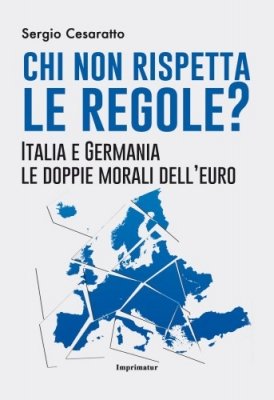
The book could be that of the professor of Monetary and Fiscal Policy at the University of Siena, Sergio Cesaratto , “Who doesn't respect the rules? Italy and Germany, double standards of the euro" (Imprimatur, 124 pages, 14 euro).
The book proves exactly what it says in the title, which Germany constantly violates, and always to your advantage, the rules of a monetary union; which imposes absurd regulations, which bring the destabilization of weak economies closer, instead of avoiding them; who wants to “obtain the discipline” of countries with high debt, like Italy, “increasing the possibility of a financial crisis”, and claims to "stabilize markets by bringing their breaking point closer", as Walter Munchau of the Financial Times wrote, therefore it is even negative in achieving the goals it proposes, recovery and prosperity.
It's about understanding that Germany, “obsessed with Italian bank bad debts”., has banks that, together with the French, they have toxic derivative securities in their belly for 6899 billion, or 12 times our sufferings. Europe seems to have only one need and urgency: how to force Italy to reduce its public debt, making the markets understand that we are potentially insolvent (and therefore they should demand higher interests from us), when in reality almost 30 Italy has maintained a primary surplus for years, that is, its tax revenues are higher than public administration expenditure (once the interest expense on the debt has been deducted). Read More

Share
1 2 3