

Of Riccardo Paccosi
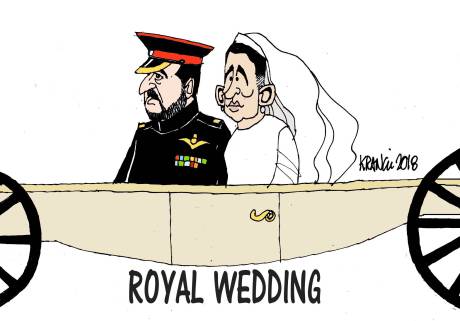
Source: Bye Bye Uncle Sam
The ambivalences of the emerging sovereignist perspective analyzed in relation to the Italian case.
A contribution to read carefully.
I started talking about the existence of a Yankee Way to Sovereignty, more or less since I started identifying myself, from a Marxist point of view, with this political category. So, around the 2012.
Indeed, since the advent of the Monti Government's austerity in 2011, it was immediately clear that, in the face of German rigidity which directed the positions of the European Union by imposing social butchery policies on Greece and Italy, on the part of the United States there was a decidedly more elastic attitude towards public spending and the state budget. The troika that gave order to the Euro-Mediterranean governments, in other words, appeared to be made up of the “good cop” IMF and the “bad cop” European Commission.
As, many public figures who in that period and in various capacities spoke out against austerity - for example Paolo Barnard, but also Stefano Fassina - also explicitly stated the need to seek political support in the United States and in the Monetary Fund to escape from the death trap of the fiscal compact and German control over our economy.
Since then, a lot of water has flowed under the bridge.
Eight years of austerity have almost completely eroded it, among Italian and European public opinion, the pre-existing support for the Eurofederalist perspective and have brought, Therefore, sovereignism at the center of the political debate and made those political forces that have a parliamentary majority, with varying degrees, they claim to go back to sovereignist issues.
The point is that this centrality of the sovereignist instance, correspond to geopolitical maneuvers and strategies by foreign forces - especially the United States - to orient Italy's role in the future Europe to its advantage, after the probable failure of the Eurozone and after the possible collapse of the federalist perspective.
In the face of these maneuvers, the attitude of various sovereignist forces (that is, the sovereign-constitutionalists, the Marxists critical of Eurofederalism and the more right-oriented forces) it's confusing, divided, sometimes even indifferent and in any case, in practice and in my opinion, inadequate to address this strategic issue.
Compared to today's political situation, I therefore invite you to read three texts published in the last four days:
1) the article by the essayist Federico Dezzani entitled The Anglo-Americans play the M5S-League card aiming for Germanexit, published on the eponymous blog;
2) the intervention of the geopolitical analyst Pierluigi Fagan entitled Complexity democracy and change, published on the latter's Facebook page;
3) the letter from Professor Paolo Savona, of commentary on the crisis that has arisen around his person, published by various websites.
From these very different interventions, A picture that is certainly not exhaustive emerges, but in relation to which some elements of correlation between the Italian political crisis and the crisis in relations between Germany and the United States are clear. Specifically, it turns out that:
a) The recent Lega-M5S government attempt, had the blessing of US Ambassador Lewis Eisenberg and the enthusiastic and militant support of American right-wing guru Steve Bannon;
b) as the editors of the magazine claim Limes, although there is currently a lacerating internal conflict at the top of the United States, the various factions fighting in Washington agree on one point: the existence of another conflict – geopolitical and strategic – between the United States and Germany; this conflict is due to the progressive "ostpolitik" of the latter, materialized in growing bilateral agreements with China and in the North Stream gas pipeline project 2 with Russia;
c) exactly like Germany, the United States does not believe in the fatalist-determinist vision that dominates in Italy, according to which the process of a single European state is inevitable; on the contrary, countries that think free from the trappings of ideological superstition, are working hard on possible post-eurozone scenarios, really, post-eurofederal; within these scenarios, the United States intends to ride and direct Italy's inevitable sovereignist process to its advantage, that is, they intend to prevent the latter from entering the orbit of pro-Russian and pro-Chinese Germany and that, thanks to the pressure of Italian sovereignism, Germany itself will find itself forced to decide the end of the single currency experiment;
d) Obviously, a government with more or less sovereignist demands, would naturally find itself allied with this part of the United States since, immediately, the obstacle to putting it back in the hands of elective and democratic institutions (that is, national ones) the reins of the economy, would be represented by Germany;
e) in this way, the possibility of a "Yankee way to sovereignism" is being envisaged which, by force of circumstances, it would distance Italy from Central Europe and strengthen its ties with the United States.
These years of German austerity, they have made many forget what Italy's bond with the United States means in terms of submission to neoliberal dogmas. That bond means, among many things: economic deregulation, resulting in degradation of social rights (see CETA treaty or the temporarily blocked TTIP); by mimicking the USA in abolishing public financing of political parties, privatization of politics or its definitive submission to lobbyism and private interests; through relationships between the Italian healthcare system and large American pharmaceutical companies, abolition of the principle of free and universal healthcare; through NATO, involvement in wars which - such as the one in Syria or the currently "cold" one with Russia - totally and heavily collide with Italy's economic and strategic interests.
Despite all this, in the sovereignist sphere or in any case among the critics of Eurofederalism, there is a tendency to demonize Germany which imposes austerity and, Therefore, to put the problem represented by the United States into the background.
Or, an irenic neutrality with respect to both countries is theorized. Which, in principle, it is certainly shareable. But neutrality never arises from inaction, rather it is the result of diplomatic activity, of tireless weaving of international alliances.
But above all, the objective of neutrality can only have, as an unavoidable priority step, the revision of relations with that one and only country that he placed, on Italian territory, 40 military bases e 90 nuclear warheads.
The point, so, is knowing how to distinguish between the immediate and contingent aspects of international politics and medium-long term geopolitical perspectives.
It is quite clear that, immediately, Italy's sovereignist instance will find itself in conflict with the German direction of the Eurozone.
But in a post-single currency or post-federal scenario, the relationship with Germany could instead take on a diametrically opposite meaning. And not only in the "post" scenario, but also in the immediately preceding phase: in the event of a crisis in intra-European relations, Indeed, Germany - which has historically experienced the euro as an imposition - could find itself leading the eurosceptic countries.
From a sovereignist point of view, it would be truly sad to observe - in a possible post-federal European scenario - Italy closely tied to the United States while Germany sails away, autonomous, towards a space of cooperation with the BRICS.
In the Italian political context, if on the one hand the M5S totally bases its international legitimacy on relations with English and American environments, we see the League moving in a more unscrupulous way and, Therefore, more autonomous. While on the one hand Salvini has cordial meetings with Steve Bannon, on the other, he establishes relations with Putin's United Russia party and announces - in the press conference to present Alberto Bagnai's candidacy - a future alliance with Germany in a "Eurosceptic" version.
Since, for numerous reasons, one cannot pin one's hopes on an ideologically contradictory and improvisational character like Salvini, it is necessary that a long-term vision on the relationship with the United States and Germany also takes root in the actual sovereignist circles. A vision that can distinguish between an immediate prospect of conflict with the German leadership of the European Union and a long-term geopolitical perspective, which requires Italy to loosen its historic bond with the United States and embrace the new multipolar world structure.
A perspective, above all, which prevents Italian sovereignists from playing the role of useful idiots, that is, from opposing Germany where necessary, but without supporting Atlanticist projects aimed at giving greater weight to the United States in Europe: no, there is a well-founded suspicion that the Lega-M5S government would not have had this foresight at all.
Similar Posts
