

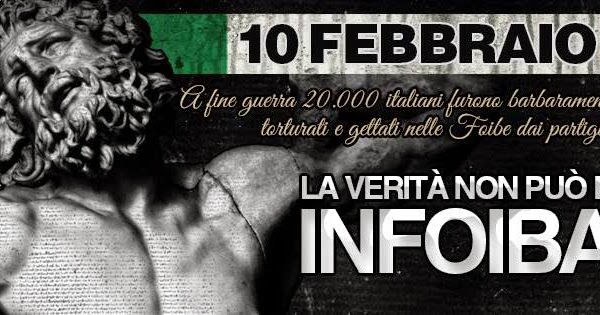
 TOMORROW, SATURDAY 10 FEBRUARY DAY OF REMEMBRANCE FOR THE VICTIMS OF THE FOIBE
reporting of Federici Studies Center
The cowardly silence on 50 priests and friars massacred by communist partisans in the foibe: these victims are of no interest to memory professionals, perhaps because they were at the service of the Catholic Church and not the Synagogue.
The priests massacred in the foibe
Among the many, many thousands murdered in the foibe there were at least 50 priests. Ranieri Ponis dedicated a monograph to the story, entitled “Stories of Istrian priests killed to erase their faith”, published by Litografia Zenit.
The Slavic invaders in fact tried to attack first of all those who were in various ways part of the Italian ruling class or in any case points of reference and aggregation, such as intellectuals, and politics, entrepreneurs, the teachers, the ecclesiastics.
The hatred towards the latter also derived from the ideological beliefs of the Yugoslav partisans, Tito being Stalin's close ally at the time.
After the total cancellation of every Italian civil and military body in Venezia Giulia and Dalmatia, only bishops and priests capable of representing the Italian population remained on site, who was usually very religious.
There is no doubt that, among the causes that led the Italians of Venezia Giulia to the exodus, religious persecution played an important role, which was also carried out with the specific intention of pushing the Italians to leave.
The idea of attacking "foreigners" in their religious faith had already been formulated in the so-called "Cubrilovic manual", originally designed by its author to expel Muslim Albanians from Kosovo, but which ended up being applied by him, became a high personality of Tito's regime, against the Italians.
Obstruct or prevent religious practice, and at the same time marginalize, drive away or kill the Italian clergy, remained to constitute the only "ruling class" of Italians in the face of the invaders, it was therefore functional to further terrorize the Giulio-Venetian people of Italian origin, hitting them together in Christian beliefs, usually rooted, and their latest representatives, the ecclesiastics.
The "Cubrilovic manual" in fact suggested choosing the most representative and authoritative members of the enemy population as privileged targets.
The massacre of Italian priests began as early as September 1943, when Slavic gangs temporarily took control of Istria. In that month a group of Slavic partisans kidnapped the parish priest of Villa di Rovino, don Angelo Tarticchio, imprisoning him in the Montecuccoli castle in Pazin, Istria, which had been used as a prison.
Don Tarticchio ended up being killed after a few days of imprisonment in a mass shooting. The bodies of those shot were thrown into a bauxite quarry. The bodies had been tied together with barbed wire and a crown also made of barbed wire had been placed on the ecclesiastic's head..
Among the other priests killed by the invaders as early as 1943 was Don Placido Sancin, parish priest of San Dorligo della Valle, who was kidnapped by Slavic partisans in October 1943 and disappeared into thin air. He may have been thrown into the San Servolo foiba, located near San Dorligo, since ecclesiastical clothing was found in the cavity.
A similar fate befell Don Giuseppe Gabbana, military chaplain of the Financial Police, who was killed by a gang the 2 March of 1944 in his home in Trieste.
After confidently opening the door, not suspecting that he was faced with hitmen who had come to assassinate him, he was massacred with machine guns and rifle butts.
Then among the victims of the partisans there was Don Nicola Fantela who drowned in Ragusa with a stone around his neck 25 October 1944, Don Giovanni Dorbolò, infobated on May 1st 1945.
Don Francesco Bonifacio born in Piran on 7 September 1912, nicknamed "el santin" in the seminary and ordained a priest in Trieste on 27 December 1936, he was kidnapped by a group of "people's guards" and Slavic soldiers on September 11th 1946. Information about his assassination, known with great difficulty, allow us to know that the Titos beat him, they denuded him, they stoned him and finally killed him with a knife. The body was perhaps burned, perhaps he was thrown into the foiba called Martines. The body was never found and the brother who was looking for news of him was imprisoned.
The bishop of Trieste, Monsignor Antonio Santin, he almost ended up lynched in 1947 in Koper.
A crowd broke into the seminary, smashing the door and throwing himself on the prelate, from whom the pastoral cross was torn away. Then a beating began that lasted a couple of hours. The police, i.e. the Slavic communist "people's guard", were alerted, but he didn't move. In truth, some of its members were among the bishop's attackers, with bourgeois clothes. The "people's guards", present at the scene, they intervened only when it was clear that otherwise the bishop would have been killed, which would have damaged the image of Tito's dictatorship internationally. Monsignor Santin was, after being almost killed and wounded in the head, expelled from Koper, preventing him from holding the religious celebrations for which he had gone to the Istrian city. The attack on the prelate was due to the fact that he was one of the crucial points of reference for the Italians who opposed the Slavic invasion and Tito's aims of annexation in the Trieste diocese..
Other violence was added to the killings or attacks against Italian ecclesiastics. There were limitations or prohibitions on religious activity (teaching, catechesis, celebration of masses etc. ecc. which were subject to strong limitations and restrictions, and sometimes prevented.
There were also destructions of sacred buildings, including a good number of churches of notable artistic value, of Byzantine style, Romanesque and Venetian.
The destruction of Romanesque and Venetian churches certainly responded to the desire of the Tito people to erase even the visible traces of the region's Italian past, vandalizing the same works of art, as had already happened in Dalmatia, however, at the same time it resulted in the deprivation of the entire local Italian population of places of worship.
