

 Of Elena Quidello
Source: Counterinformation
IL 10 maggio 2019 the author of the book 'Usurocracy Unveiled' Cosimo Massaro, he will be the guest of an important conference on 'Spirituality and Finance' in Rome which will be held at the headquarters of the Sdebitalia Movement with the participation of eminent figures including the moderator Prof Nino Galloni, President of the Center for Monetary Studies, (association for the study of financial markets and monetary forms that do not create public debt), and the emeritus prof. Alessandro Meluzzi, well-known psychiatrist and criminologist has enriched the creative effort of the writer Cosimo Massaro with his valuable preface.
The Meluzzi, already a prominent exponent of the Autocephalous Italian Orthodox Church, he has a profound knowledge of the human psyche and had the ability to identify that universal Spirit that moves the life and history of peoples in the world.
The Massaro's book, 'Usurocracy Exposed' , makes use of a panoramic and at the same time analytical vision of the current and tormented century that, through war and finance it is still disrupting the world, our Europe, our Italy, our lives.
Who are the lords of war and money who have generated and continue to generate so much horror and misery in every corner of the planet is no longer an occult matter thanks also to the work of Cosimo Massaro , writer born in Turin but resident in the ancient Messapian city of Manduria, with to his credit 5 easy-to-read books published, among which this new book of his entitled 'Usurocracy Unveiled' has finally seen its editorial birth; this is a work that could become a best seller for the unusual themes that Massaro courageously tackles with the intent of revealing the hidden causes of European economic decline and that slow and almost inevitable death of our Christian civilization. Read More
Does Honorius "Refute" Sedevacantism? NEW Fr. Cekada Articl1
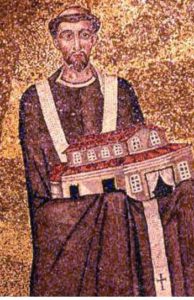 Reporting of don Anthony Cekada
Does the Pope Honorius Affair Refute Sedevacantism?
THE MULTITUDE of theological errors and evil laws that have emanated from the Vatican II popes over the past fifty years — and that is exponentially increasing during the madcap reign of Bergoglio — has prompted many traditionally-minded Catholics to seek out ways to reconcile the notion of papal authority with the obvious destruction wrought by those in our day who claimed to wield it.
Sedevacantists like myself settled on the following explanation a long time ago: the very errors and evils officially sanctioned by the Vatican II popes demonstrate that they never truly obtained papal office (or authority) in the first place, and were therefore false popes. (For an explanation, see Sedevacantism: A Quick Primer)
Others — be they Novus Ordo conservatives, neo-traditionalists within the Vatican II establishment, or traditionalists of the Recognize-and-Resist (R&R) variety — shied away from this conclusion. They sought to reconcile “recognizing” the V2 popes as true Successors of Peter with simultaneously “resisting” them — minimizing any obligation to adhere to the teachings of the V2 popes, to observe their laws, or in practice, to submit to their authority.
To achieve this end and to negate the logical appeal of sedevacantism, the conservative/neo-trad/R&R camp sought to demonstrate two things:

Sedevacantists like myself settled on the following explanation a long time ago: the very errors and evils officially sanctioned by the Vatican II popes demonstrate that they never truly obtained papal office (or authority) in the first place, and were therefore false popes. (For an explanation, see Sedevacantism: A Quick Primer)
Others — be they Novus Ordo conservatives, neo-traditionalists within the Vatican II establishment, or traditionalists of the Recognize-and-Resist (R&R) variety — shied away from this conclusion. They sought to reconcile “recognizing” the V2 popes as true Successors of Peter with simultaneously “resisting” them — minimizing any obligation to adhere to the teachings of the V2 popes, to observe their laws, or in practice, to submit to their authority.
To achieve this end and to negate the logical appeal of sedevacantism, the conservative/neo-trad/R&R camp sought to demonstrate two things:
- Since ordinary papal teaching lacked the “infallible stamp” that the rare from the chair papal pronouncement possessed, Catholics had no obligation whatsoever to submit or adhere to it. Ergo, you’re free to ignore Bergoglio’s (or for that matter, Paul VI's) teachings and laws.
- Some popes in the past (Nicholas I, Vigilance, Honorius, Freer, Celestine III, John XXII, Alexander VI) were heretics, but nevertheless were always recognized as true popes. Ergo, a pope can teach heresy and still remain pope — take that, wicked sedes!
 This is old stuff that the “right” subjected to constant recycling, even before Bergoglio’s Laudato Yes, and it always manages to float back, like gas from the landfill. I refuted point (1) in section 1 of 9/11 for the Magisterium, as well as in the introduction to my recent article, The Errors of Athanasius Schneider. I have refuted point (2) in a variety of articles listed in section 3 of my sedevacantist primer — and in so doing, please note, I have always pointed out that it was the Protestants, the Gallicans, and other haters of papal authority who raised these charges of “papal heresy” and were roundly trounced by an array of Catholic dogmatic theologians.
For the conservative-neo-trad-R&R camp, however, the historical case that seems both to provide a refutation of sedevacantism and to demonstrate the validity of points (1) and (2) is the case of Pope Honorius. From this, we are supposed to draw by analogy a principle for a course of action vis-à-vis Bergoglio and all the Vatican II popes that will allow one to recognize them as popes, but never, ever submit to them.
I dealt with the case in my lengthy article on Bp. Schneider, but since Honorius always seems to pop up in discussions of papal authority, I’ve been asked to sum up my arguments as a separate article.
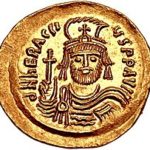
Emperor Heraclius
1. General Background. Pope Honorius I (625–638) reigned during the great controversy over the Monothelite heresy (=Christ had only one will, the divine). Around 634, he was approached by Sergius, Patriarch of Constantinople, who was attempting to resolve the dispute and pacify all sides in order to please the emperor Heraclius. Honorius responded to Sergius with several letters dealing with the controversy. Their contents became public only after the death of Honorius, and led to his being accused, variously, of either being a heretic himself, or at least, of being soft on heresy.
In 681 the Third Council of Constantinople posthumously condemned and anathematized Honorius, together with several Monothelites, which condemnation was subsequently renewed by the Second Council of Nicaea in 787 and the Fourth Council of Constantinople in 870. The condemnation subsequently made its way into the texts of some ecclesiastical oaths, and the Roman Breviary prior to 1570 portrayed Honorius as having been condemned for heresy.
Nevertheless, despite these condemnations, the Church continued to recognize Honorius as having been a true pope and true successor (albeit perhaps weak) of St. Peter.
Thus the facts in the story of Honorius that everyone agrees upon.
Points of contention!
2. Disputed Facts and Interpretations. But there are countless other facts and complications in this story that church historians and theologians do not agree upon, have interpreted in different ways and, generally, have been fighting over for centuries.
These disputed issues include: whether the texts themselves of Honorius’s letters really prove he was a heretic, or merely that he was “soft” in combatting heresy; how the term “heresy” is to be understood in the various conciliar condemnations, since at the time it did not always have the precise technical meaning it has today; whether the subsequent papal approval of the conciliar acts of Third Constantinople (necessary for their legal effect), approved the condemnation of Honorius for heresy properly speaking, or only cowardice; or whether some of the documents were or contained forgeries, a common problem during the era.
Countless other uncertainties like these muddy the waters, making it difficult not only to arrive at a clear and objective historical account of the Honorius affair, but also to tease out of these complicated events correct theological consequences.
Protestants, French, rationalists and others, especially in the 19th century, had no hesitations about their conclusions, of course, and they routinely trotted out the Honorius affair as one of their main arguments against papal authority in general, and papal infallibility in particular.
READ EVERYTHING
Source – http://www.fathercekada.com/2019/04/24/does-the-pope-honorius-affair-refute-sedevacantism/
Prayer to preserve the true Faith
 Prayer to preserve the true Faith” written by Saint Peter Canisius (1521-1597), Dutch of the Society of Jesus, apostle of the Counter-Reformation in Germany, defined as the “hammer of heretics”, beatified by Pius IX in 1868 and canonized by Pius XI in 1925 who also appointed him Doctor of the Church.
I confess aloud for my salvation everything that Catholics have always rightly believed in their hearts. I abominate Luther, I hate Calvin, I curse all heretics; I don't want to have anything in common with them, because they neither speak nor hear aright, and they do not possess the only rule of true Faith proposed to us by the only one, santa, Catholic, apostolic and Roman Church. Instead, I join in communion, I embrace faith, I follow religion and approve the doctrine of those who listen to and follow Christ, not only when he teaches in the Scriptures but also when he judges at the mouth of the Ecumenical Councils and defines at the mouth of the Chair of Peter, testifying it with the authority of the Fathers. I also profess myself a son of that Roman Church which the impious blasphemers despise, they persecute and abominate as if it were anti-Christian; I do not depart from his authority at any point, nor do I refuse to give my life and shed my blood in its defense, and I believe that the merits of Christ can procure my salvation or the salvation of others only in the unity of this same Church.
I profess with frankness, with Saint Jerome, to be united with those who are united to the Chair of Peter and I protest, with Saint Ambrose, to follow in everything that Roman Church which I respectfully recognize, with Saint Cyprian, as the root and mother of the universal Church. I rely on this Faith and doctrine that I learned as a child, as a young man I confirmed, as an adult I have taught and that so far, with my weak power, I defended. There is no other reason that drives me to make this profession other than the glory and honor of God, awareness of the truth, the authority of the canonical Holy Scriptures, the sentiment and consensus of the Fathers of the Church, the testimony of the Faith that I must give to my brothers and finally the eternal salvation that I await in Heaven and the bliss promised to the true faithful.
If it happens that because of this profession of mine I am despised, mistreated and persecuted, I will consider it as an extraordinary grace and favor, because that will mean that you, my God, you give me the opportunity to suffer for justice and because you don't want those people to be benevolent to me, as open enemies of the Church and of Catholic truth, they cannot be your friends. However, forgive them, Gentleman, so long as, or because they were instigated by the devil and blinded by the glimmer of a false doctrine, they don't know what they are doing, or they don't want to know.
Grant me this grace anyway, that in life and in death I always bear an authoritative testimony of the sincerity and loyalty that I owe to you, to the Church and to the truth, may I never distance myself from your holy love and may I be in communion with those who fear you and who guard your precepts in the holy Roman Church, to whose judgment I submit myself and all my works with a prompt and respectful soul. All the saints who, either triumphant in Heaven or militant on earth, they are inextricably united with the bond of peace in the Catholic Church, may they exalt your immense goodness and pray for me. You are the beginning and the end of all my goods; Praise be to you in all respects, everlasting honor and glory.
SOURCE – http://www.centrostudifederici.org/preghiera-conservare-la-vera-fede/
La violenza "fascista"? Invented, the numbers say it
 “Fascist” violence is ainvention of the media and politicians. This is not only confirmed by newspaper reports, but also the data of the last one Interior Ministry dossier.
The party that is truly the object of intimidating and violent acts is, currently, the League. From January 1st to today the Carroccio has been the victim of 60 acts defined as “intimidating” e 66 less serious but still “worthy of attention”. In the 2018, since the party led by Matteo Salvini has been in government, we assist from June to 31 December until well 138 violent acts, one each 32 ore.
The latest vandalism was recorded a few days ago, as we also reported Beyond the Line: the League headquarters in Bergamo was defaced, written “Salvini die” on the sidewalk, shop window totally smeared with red paint.
READ EVERYTHING
source – https://oltrelalinea.news/2019/04/29/la-violenza-fascista-inventata-lo-dicono-i-numeri/
Spain, socialists first but there is a boom in anti-Islam sovereignists
 The outgoing prime minister Sanchez will try to form a new majority. The risk of new elections is high.
Predictions perfectly confirmed. In Spain nobody wins and finding a new majority to support the next government seems really difficult. The Socialist Party of the resigning Prime Minister Pedro Sanchez takes first place with the 28,7%. Very detached, in second place are the Popular, collapsed to 16,7%. Followed – and growing – are the centre-right liberals of the “Ciudadanos” party, al 15,9%, while the far-left populists united in “Podemos” lost some points, today at 14,3%.
But those who marked the turning point of this electoral round were the “Christian” sovereignists of “Vox”. The right-wing party, led by Santiago Abascal managed to go beyond the 10%, entering the national parliament for the first time. Incredible numbers, if we consider the traditional center-left culture prevailing in the Iberian peninsula.
Now, but, the knot will need to be untied for the new government. On paper, the only possible alliance remains that between Socialists, We can and indipendentisti. But Sanchez has already made it known that he will not make agreements with parties that want to break up the unity of Spain. We will then go on trial and error, but the risk of a new vote in the coming months remains on the horizon.
source – https://vocecontrocorrente.it/spagna-socialisti-primi-ma-e-boom-dei-sovranisti-anti-islam/
«L'apologia del comunismo è reato»: city council sweeps Fiano away
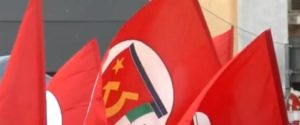 Il Municipality of Soragna, a country a 32 kilometers from Parma, ha “banned” communism. The city council approved a motion that follows the contents of the Fiano law, the measure approved in the Chamber to punish the various forms of manifestation of the apologia of fascism, referring them to communist ideology. The document, proposed by the councillor Maria Pia Piroli of the “Soragna ci Lega” group, as reported Libero, commits the mayor Salvatore Iaconi Farina to «put forward to the government the request to criminally prosecute with severe penalties anyone who propagates the images or contents of the Communist Party».
Soragna against the apology of communism
In the text we read that the apologia ofMarxist ideology it is punishable even if committed "through reproduction, distribution, diffusion or sale of goods depicted, people, images or symbols clearly referring to them, or publicly recalls its symbolism or gestures, with increased punishment if the crime were to occur via computer"
READ EVERYTHING
Source – https://www.secoloditalia.it/2017/09/lapologia-del-comunismo-e-reato-consiglio-comunale-spazza-via-fiano/
Shame on you
 This evening, in Milan and Verona we will be present at the commemorations for Sergio Ramelli.
Shame on you. The dust raised against the commemorations of the death of Sergio Ramelli it is emblematic of the evil that reigns in this country. Why in Milan, Tomorrow, two events will be held, one in favor of an innocent boy, the other against that young man, killed not only by the "antifa" of the time, but also by the current ones and by the institutions themselves, determined not to even give him the honors of a tragic end, for the sole fault of having different ideas, those that "killing a fascist is not a crime", because it was right like this anyway and the truth is that everyone is convinced of it.
The torchlight procession is organized by Forza Nuova, Loyalty and Action e Casapound. The "protest" against the memory of the poor young man by the collective "Anti-fascist, anti-racist, mixed-race and solidarity Milan".
And let's not even talk about Republic, who, in order to hide her head in the sand of indifference towards a dead boy, was able to state that Ramelli "died in the clashes with Avanguardia Operaia". Article on time "correct", probably so as not to go further in the already low level of dignity reached for decades now.
The torchlight procession is organized by Forza Nuova, Loyalty and Action e Casapound. The "protest" against the memory of the poor young man by the collective "Anti-fascist, anti-racist, mixed-race and solidarity Milan".
And let's not even talk about Republic, who, in order to hide her head in the sand of indifference towards a dead boy, was able to state that Ramelli "died in the clashes with Avanguardia Operaia". Article on time "correct", probably so as not to go further in the already low level of dignity reached for decades now.
Misery and Freedom

FIFTH COLUMN
by Marcello Veneziani
The echo of the 25 April, with Mattarella's warning not to trade freedom for order. The only true one rings in my ears, sensible objection to the opinions expressed here on the 25 April: as the anti-fascist Vittorio Foa reminded the fascist Giorgio Pisanò, today you are free to speak because we won the 25 April. Even more true in the mouth of Vittorio Foa who was an anti-fascist against the prevailing regime, ended up in prison, he was not a posthumous anti-fascist, when it was easy and advantageous to be so.
But I would like to understand what happens to freedom now, how it is conceived and experienced today by ordinary people. That is, I would like to test drive Mattarella's declamations on freedom or in the name of Foa. I try to put the noise about the Resistance and anti-fascism on silent mode and focus on present and current freedom. But what is this absolute value today, Freedom, which should not be exchanged either for order or for any other good or principle? How the vaunted freedom is actually understood and practiced by ordinary people, come on guys, from the opinion factories of today?
I walked around alone among the people on holidays, il 25 April, I could hear the conversations in the bars or the kids perched on their scooters, I smoked a cigar in a secluded corner where the kids were smoking joints and there was a coming and going of immigrants. I listened to their chatter and it reminded me of other conversations I had already heard elsewhere. Languages change, but not the horizons. And in the end I feel like I can answer the question this way, what is it freedom for the people, for young people, for current opinion? It's the freedom to do whatever I feel like doing, that goes around in my head; freedom is having no limits, except the cheap ones, get rid of rules, moral obligations and boundaries, free your desires, live as I like, I am what I want to be; without following any prescription, no tradition, no rules. Even if then, in fact, follow fashion, i trend, conditioned reflexes, the consumption conveyed, prefabricated opinions. And then, nothing to think about, only things to buy. Read More
Available numbers 158 Give Up Hearts – 5×1000
The. is available on the site number 158 (of the day 28 April 2019) Of Hearts Up®.
– Co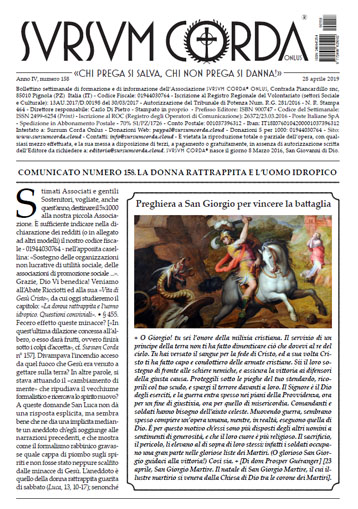 communicated number 158. The shrunken woman and the dropsical man;
– Some convivial issues;
– Prayer to Saint George to win the battle;
– Pope Saint Pius X on Processions and Rogations;
– Extract from the Catholic Encyclopedia on the Rogations.
source – https://www.sursumcorda.cloud/tags/numero-158.html
EXPLAINING GOD'S MERCY
 What is God's mercy? (from «The Treasures of Cornelius ALapide»)
As a property of light it is to illuminate, thus the property of God is to have mercy on his creatures, said San Nilo (Vit. Father.). Mercy is a natural and divine virtue; the Supreme Good is supremely merciful and beneficial. Therefore the Psalmist places mercy above all the works of God: – His compassions are above all his works (Psalm. 144,9). Saint Peter urges us to bless God the Father, due to the great mercy by which impulse has regenerated us to living hope: Blessed be the God and Father of our Lord Jesus Christ, who, according to his magnanimous mercy, regenerated us into a living hope! (I Petr. I,3). Finally the Church is turning to praying to God in the liturgy: «O Lord God, for whom it is entirely proper to always have pity and forgive, receive our request favorably" – A God whose property is always to have mercy and to spare, accept our entreaty.
Great and boundless is the mercy of God: 1° For its efficient cause, because it comes from God and his immense love for us; 2° For the object it presents to us. God has given us his Only Begotten Son, to show us how much abundance he spreads, through him, his mercies upon us; 3° For the subject to which it applies. We are nothing but earth worms, loaded with sins and miseries. He called us to himself and enabled us to receive his grace and glory. In this sense says the Psalmist, that "the abyss calls upon the abyss" – The abyss calls out to the abyss (Psalm. XL1, 7). The abyss of human miseries invokes the abyss of divine mercies; 4° For the multitude of gifts he has given us. In fact, who could enumerate the graces and favors with which God has filled us and continually showers us? This was what Saint Augustine had to say: 0 Gentleman, I have from your mercy all that I am; in fact what did I do, that I deserved to live for? What have I done, to deserve to be able to invoke you? No one can compare to you in mercy; from you, oh my God, my mercy, I received being, from you I received being good (Conc. 11, in Psalm. LVIII); 5° Respect to places and times. In fact it extends to all men of all times and places, according to those words of the prophet: «The earth is full of the mercy of the Lord» – The earth is full of God's mercy (Psalm. XXXII,5). For the saints this mercy lasts forever; 6° For the purpose it aims at, which is to lead us to the kingdom of eternal glory. Davide, rapt in ecstasy at the consideration of divine mercy, dice: «You have, oh Lord, your mercy is multiplied immensely" – You have multiplied your mercy (Psalm. XXXV,7).
Read More
Interview with lawyer Luciano Randazzo. The truth about Mussolini's death
 The lawyer Luciano Randazzo was a close friend of Guido Mussolini, passed away last December. Together they had long planned to bring out the truth about the Duce's death. Above all, reveal why, in certain forums, it was decreed that he should not be tried. We interview the lawyer on the day the news of the death of Benito Mussolini's nephew spread.
How the idea of the Duce's trial was born?
«One day I met Guido Mussolini with his architect friend Filippo Giannini. On that occasion we thought about arming, obviously in a theatrical way, the trial of the Duce. A bit following the work of Mino Caudana, great forgotten writer, author of The Blacksmith's Son as well as The Prisoner of the Gran Sasso and other certainly hagiographic works by Benito Mussolini. What about Guido Mussolini, great personality, certainly forgotten: cultured man, great lord. Guido was, to use an ancient adjective, a man from another time. I often found myself talking to him for hours. In the environment we considered him the true heir of his grandfather Benito's cultural revolution. In my opinion he was overshadowed by the undeserved notoriety of some of his relatives who landed in politics in the 90s. But we must underline how Guido had the courage, and first, to shed light, in court and through a criminal investigation, about the death of the Duce. A murder still shrouded in mystery. Certainly the first unsolved mystery of the Italian Republic, and because many protagonists of the so-called First Republic will benefit from his death. So it's fair to ask, also out of historical duty, who were the traitors and the great imperialist powers responsible for that murder. And whether they are not the same ones who handed over to those who today combine political and economic power. The new republican and democratic Italy was certainly born with the stain of a mystery, the death of the Duce. Thanks to Guido for the first time, and not in a mere literary treatment, an attempt was made to shed light on the deaths of the Duce and Mrs. Petacci: both were killed by unknown persons. The partisan and resistance tradition sees Colonel Valerio as the executor and creator of the murder, tradition now canceled because it has been disproved by the many tests, even if as a pseudo truth it has influenced entire generations of students in a false way."
Spanish elections: occhi puntati su 'Vox', anti-abortion and anti-gender sovereignists
 Everyone is looking at the possible boom of the new party that defends Christian values.
It could be the surprise of the next elections. On Sunday, Spain will vote to elect the parliament and allow the formation of a new government. According to polls, the first party will still be that of the resigning prime minister Pedro Sanchez, socialist, radical and secularist, but forming a centre-left majority appears completely impossible. Thus the ball could pass into the hands of the Popolari (accredited as the second political force), looking for allies in the liberals of “Ciudadanos” and in the sovereignists of “Vox“. The latter could really be the revelation of tomorrow's election.
Born in 2013 by a split to the right of the People's Party, is currently growing strongly and could point to a result between 10 and the 15%, thus proving crucial for the formation of the new executive. Led by Santiago Abascal, it is a party that has always declared itself sovereignist and identity-building. Against illegal immigration, Vox based its program on the defense of Spanish identity and Christian roots. Its exponents say so anti abortisti e pro life, as well as against gender ideology and far from the LGBT world. His statement, resulting in his entry into government, it could really bring about a total change of direction in Iberian politics, dictated by the progressive left for years now, abortionist and radical.
Source – https://vocecontrocorrente.it/elezioni-spagna-occhi-puntati-su-vox-sovranisti-anti-aborto-e-anti-gender/
The schools of Verona pay homage to Ramelli

The euro has ruined Italy, lo dice Bloomberg
 Twenty years of a single currency would have brought nothing to our country. However, our economy also suffers from much deeper structural problems
With the beginning of 2019 l’euro will accomplish 20 years, since exactly January 1st 1999 the single currency made its official entry into the financial markets, to arrive three years later, on January 1st 2002, into the pockets of European citizens, Italians included.
A significant period of circulation for be able to make an initial assessment of its advent. And the sums, especially for the’Italia, They're not flattering at all, actually quite the opposite. Scrolling through the figures put together in recent days by Bloomberg Economics, who gave an account of the first twenty years of euros, in fact, our country emerges with broken bones.
However, what should be explored further is whether our current economic malaise depends directly on the euro, or how much not rather by the fact that the single currency has contributed to amplifying structural deficiencies in our production system. But let's go in order, and let's see what they tell us numbers.
Twenty years of setback
The first evidence, related to the Bloomberg study, they show us without mercy, a devastating scenario for our country. Just think for example that between 1985 and the 2001 il gross domestic product Italian he had grown up with 482 billions of euros (+44%), while between the 2002 and the 2017 the growth was equal to 31 billion, that is, a skimpy one + 2% in almost twenty years.
Another very sore point is that of exports, always the workhorse of our economy. Well, always between 85 and 2001, l’export he grew up in Italy 136,3%, While, since the advent of the euro, growth stopped at a modest +40,9%, that is, less than a third.
To this already desolate panorama, we could then add the fact that GDP per capita is at the same level as 1999, that the unemployment for six years it has always been around 11% and that the industrial production still languishes 22% below the maximum levels reached in 2007. Read More
Survey: the traditional family wins
 The concept of family has been a cause of discussion among the right for years, Catholics and the left.
According to a sample survey promoted by the company “ Known Surveys” il 62% of those interviewed stated that the family is only one composed of two people of different sexes who are married or cohabiting.
While only the 31% recognizes it even if it is made up of two people of the same sex.
Il 60% is in favor of adoption by a straight couple, even if not married, and only the 22% is in favor of requests from same-sex couples.
Difference in line also on surrogacy col 55% ffavorable in the case of hetero couples, percentage that drops to 18% in case of homosexual couples.
While it is of 18% the percentage of unmarried couples of which the 64% he has children.
The request was generalized – 58% – of economic incentives to help the family, regardless of whether you are married or not.
In recent years the family conceptia, but not the centrality that this nucleus must have, which remains a fundamental part of Italian society.
Over the years the family has been at the center of political debates starting from divorce referendum which split Italy into two parts.
Or like cohabiting as equals with children born outside of marriage, have been subject to criticism, but also transgressive choices, before becoming socially legitimized.
But even today there is no divorce, it is not possible to remarry and religious marriage is prohibited even after divorce.
What is certain is that the value map of Italians has changed and in a certain way we have westernized much more than a few years ago.
In conclusion the abortion law for the 58% it must not be changed, for the 32% it must be and the 10% he doesn't have an opinion .
source – https://www.lavocedeltrentino.it/2019/04/27/sondaggio-vince-la-famiglia-tradizionale/
To live according to God, what should we do?
32. To live according to God, what should we do? To live according to God we must believe the truths revealed by Him and observe his commandments with the help of his grace, which is obtained through the sacraments and prayer.
61. What are the commandments of God? The commandments of God or Decalogue are the moral laws that God in the Old Testament gave to Moses on Mount Sinai, and Jesus Christ perfected in the New.
62. Whoever transgresses the commandments of God sins gravely? Whoever deliberately transgresses even a single commandment of God in a serious matter, sins gravely against God e, therefore, deserves hell.
63. Which the first commandment orders us: “I am the Lord your God: you will have no other God besides me”? The first commandment: “I am the Lord your God: you will have no other God besides me”, he commands us to be religious, that is, to believe in God, to love him, worship and serve him.
64. Which the first commandment forbids us? The first commandment forbids impiety, superstition, irreligiosity, heresy and culpable ignorance of the truths of faith.
65. Which the second commandment forbids us: “do not take the Name of God in vain”? The second commandment: “do not take the Name of God in vain”, he forbids us to name him without respect, to blaspheme, to make false or illicit oaths.
66. Which the second commandment orders us to do? The Second Commandment commands us to always have reverence for the name of God, and to fulfill sworn vows and promises.
67. Which the third commandment orders us: “remember to keep the holidays holy”? The third commandment: “remember to keep the holidays holy”, He commands us to honor God on feast days, with acts of external worship, of which for Christians the essential is the Holy Mass.
68. Which the third commandment forbids us? The third commandment prohibits us on feast days from servile works and from any work that prevents us from worshiping God.
69. Which works are called servile? Proper manual labor is called servile, of artisans and workers.
70. Which the fourth commandment orders us to do: “honor your father and mother”? The fourth commandment: “honor your father and mother”, he commands us to love, respect and obey parents and our superiors in authority.
71. Which the fourth commandment forbids us? The fourth commandment prohibits us from offending parents and superiors in authority and from disobeying them. Read More
61. What are the commandments of God? The commandments of God or Decalogue are the moral laws that God in the Old Testament gave to Moses on Mount Sinai, and Jesus Christ perfected in the New.
62. Whoever transgresses the commandments of God sins gravely? Whoever deliberately transgresses even a single commandment of God in a serious matter, sins gravely against God e, therefore, deserves hell.
63. Which the first commandment orders us: “I am the Lord your God: you will have no other God besides me”? The first commandment: “I am the Lord your God: you will have no other God besides me”, he commands us to be religious, that is, to believe in God, to love him, worship and serve him.
64. Which the first commandment forbids us? The first commandment forbids impiety, superstition, irreligiosity, heresy and culpable ignorance of the truths of faith.
65. Which the second commandment forbids us: “do not take the Name of God in vain”? The second commandment: “do not take the Name of God in vain”, he forbids us to name him without respect, to blaspheme, to make false or illicit oaths.
66. Which the second commandment orders us to do? The Second Commandment commands us to always have reverence for the name of God, and to fulfill sworn vows and promises.
67. Which the third commandment orders us: “remember to keep the holidays holy”? The third commandment: “remember to keep the holidays holy”, He commands us to honor God on feast days, with acts of external worship, of which for Christians the essential is the Holy Mass.
68. Which the third commandment forbids us? The third commandment prohibits us on feast days from servile works and from any work that prevents us from worshiping God.
69. Which works are called servile? Proper manual labor is called servile, of artisans and workers.
70. Which the fourth commandment orders us to do: “honor your father and mother”? The fourth commandment: “honor your father and mother”, he commands us to love, respect and obey parents and our superiors in authority.
71. Which the fourth commandment forbids us? The fourth commandment prohibits us from offending parents and superiors in authority and from disobeying them. Read More