

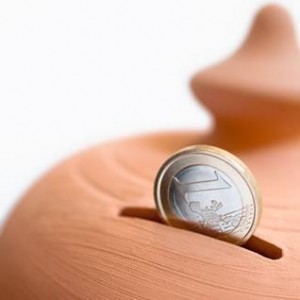
 Twenty years of a single currency would have brought nothing to our country. However, our economy also suffers from much deeper structural problems
With the beginning of 2019 l’euro will accomplish 20 years, since exactly January 1st 1999 the single currency made its official entry into the financial markets, to arrive three years later, on January 1st 2002, into the pockets of European citizens, Italians included.
A significant period of circulation for be able to make an initial assessment of its advent. And the sums, especially for the’Italia, They're not flattering at all, actually quite the opposite. Scrolling through the figures put together in recent days by Bloomberg Economics, who gave an account of the first twenty years of euros, in fact, our country emerges with broken bones.
However, what should be explored further is whether our current economic malaise depends directly on the euro, or how much not rather by the fact that the single currency has contributed to amplifying structural deficiencies in our production system. But let's go in order, and let's see what they tell us numbers.
Twenty years of setback
The first evidence, related to the Bloomberg study, they show us without mercy, a devastating scenario for our country. Just think for example that between 1985 and the 2001 il gross domestic product Italian he had grown up with 482 billions of euros (+44%), while between the 2002 and the 2017 the growth was equal to 31 billion, that is, a skimpy one + 2% in almost twenty years.
Another very sore point is that of exports, always the workhorse of our economy. Well, always between 85 and 2001, l’export he grew up in Italy 136,3%, While, since the advent of the euro, growth stopped at a modest +40,9%, that is, less than a third.
To this already desolate panorama, we could then add the fact that GDP per capita is at the same level as 1999, that the unemployment for six years it has always been around 11% and that the industrial production still languishes 22% below the maximum levels reached in 2007.
Productivity, Achilles heel
But a serious and reasoned analysis cannot stop at these striking evidences. In fact, what should be explored further is, as already mentioned, how the entry into force of the euro did not increase difficulties that were already inherent in ours economic system, and which already made it weaker in itself compared to other European economies.
And in this sense, a very clear example is represented by productivity. The latter represents in a very simplified way, the quantity of product that each individual worker produces in a given unit of time, for example in one hour. Higher productivity, it means that a production system is more efficient, more innovative, and therefore more competitive on the market.
If we go to scroll through the statistics made by Eurostat on the countries of the Union, we then discover that this represents a real Achilles' heel for Italy. In fact, in the period from 1999 al 2017, Productivity in Italy not only has not grown, but it actually dropped almost by 5%.
In the same period, the France saw its productivity grow more than 13%, the Spain of the 12% and the Germany has also made a leap forward 12%, all thanks to strong labor market reforms, which instead in Italy have always been less incisive. Not by chance perhaps, these countries have obtained much more substantial benefits since the entry into force of the euro, as demonstrated by the same Bloomberg study.
Goodbye devaluation
But why does the single currency have such an impact on the relationship between productivity and economic development? The explanation is simple: in the past, to fill gaps in productivity failure, Italy used the tool, overused, from the monetary devaluation.
A lira debole, it still allowed us to be competitive on international markets, even though our productivity was lower than that of our competitors. With the arrival of the euro, the devaluation game was no longer possible, and the issue of a lack of productivity growth has dramatically come home to roost.
We decided to compete with big countries, like Germany and France precisely, and to do it now we must use the same means, that is, theinnovation, investments, the research. All weapons that have been blunt in Italy for years, due to the faults of both politics and the business class.
In this whole scenario therefore, the euro has done nothing but highlight this obvious fact backwardness of ours production system. There would have been plenty of time to fix it, and maybe it still is, the important thing, however, would be not to take on all the burdens faults all’euro, the functioning of which could however perhaps be partially improved, but try to identify the structural weaknesses of our economy and intervene on them. Starting with productivity.
source – https://www.panorama.it/economia/euro/euro-rovinato-italia/
