

Political Theology n 83. Taxation cannot compensate for the deficit caused by an improvised administration
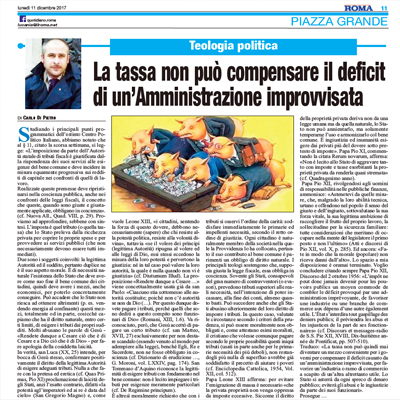
Studying the main programmatic points of the extinct Italian Political Center, we noticed that in § 11, mentioned last week, it reads: «The imposition by the State Authority of fiscal taxes is justified by the correspondence of its services to the needs of the common good and must have an equally progressive impact on capital income compared to labor income. Once these premises have been achieved, it must reinstate itself in the public consciousness, also with respect to tax laws, the concept that these, when they are right and rightly applied, oblige in conscience". (cf. New All., Quad. VIII, p. 29).
Let's try to delve deeper, albeit with summary. The tax is that tribute (or that tax) that the State withdraws from private wealth to cover its expenses and to provide public services (which do not necessarily all have to be immediate). There are two subjects involved: the legitimate Authority and the subject, therefore its moral aspect is twofold. The existence of the State is of natural necessity and must have the common good of its citizens as its aim, therefore he must have the means, also cheap, to be able to actually achieve it. It may happen that the State is unable to obtain otherwise (p. es. selling energy to the neighbor) these means, totally or partially, so that we understand that he has natural right, within certain limits, to demand taxes from their subjects
Let's try to delve deeper, albeit with summary. The tax is that tribute (or that tax) that the State withdraws from private wealth to cover its expenses and to provide public services (which do not necessarily all have to be immediate). There are two subjects involved: the legitimate Authority and the subject, therefore its moral aspect is twofold. The existence of the State is of natural necessity and must have the common good of its citizens as its aim, therefore he must have the means, also cheap, to be able to actually achieve it. It may happen that the State is unable to obtain otherwise (p. es. selling energy to the neighbor) these means, totally or partially, so that we understand that he has natural right, within certain limits, to demand taxes from their subjects
read everything
source – https://www.sursumcorda.cloud/articoli/teologia-politica/1367-teologia-politica-n-83-la-tassazione-non-puo-compensare-il-deficit-causato-da-un-amministrazione-improvvisata.html
 Louis Bonaventure, former boss of Crotone, he is certainly one of the few 'ndrangheta turncoats who made numerous arrests possible by collaborating with various prosecutors (“definitely more than 500”, he tells me, confessing that he had never kept a total count). Collaborator of justice for years (“for the love of my wife and children”, dice) he decided to tell TPI how the new 'ndrangheta moves.
 “Christianity is the greatest faith in a world of thriving religions,” writes John O’Sullivan. “Sometimes it's hard to hear, since it is the mental image that grips most Westerners, including many Christians, it is a dying faith in a disenchanted secular universe in which God is not so much dead as retired. The reality is very different. In the 2015 the four largest religions (conventional) of the world were Christianity in descending order (31,2% of the world population), l’Islam (24,1%), Hinduism (16%) and Buddhism (7%). Looking ahead to population projections for the 2060, this image changes only slightly but significantly. Islam surpasses Christianity as the world's largest religion. More worrying than the overall numbers is the distribution of Christianity's decline. Almost all of the growth in Christian numbers is occurring in sub-Saharan Africa. And the decline occurs in the traditional heartlands of Christianity, namely Europe, the Middle East and North Africa and the Americas. In Europe the decline is absolute and relative. European Christians are declining as a percentage of all Europeans in part because they have a lower birth rate than others, partly because many simply abandon their religion. Between the 2015 and the 2020 the number of Christians in Europe will decrease by 8,2 millions. In addition to demographics, Christians around the world face two additional and growing dangers: religious persecution and the lack of powerful friends. They are not, Obviously, the only believers who face persecution. The murder of Jews in France; the attempted genocide of the Yazidis in Iraq and Syria; the repression of the Zoroastrians (among others) in Iran; the recent mass murder of Muslims in New Zealand; These and other examples show that religious persecution is rampant, widespread and largely unashamed throughout the world. However, Christians in particular are attacked from three directions. First of all, in Muslim-majority countries in the Middle East, Nord Africa, Iran, Pakistan and Türkiye, the Christians (together with the Jews) they are victims of a growing wave of Islamist and jihadist fervor.
  .
.
 The Hungarian Prime Minister Viktor Orbán launched his party's election campaign for the European Parliament, and describes the next competition as a continental clash between open borders and sovereignists. The Prime Minister noted that the next European elections will decide “the future of Europe”. This is the news
  A specter is haunting Europe: the specter of sovereignism.
 A system of motorized sheets to hide Christian symbols and make the burials of the deceased 'neutral'.