

 Reporting of M. Orlando
At the ecclesial level, after Bolsonaro's victory, what remains? A very serious situation for the Conciliar Church
Of Matteo Orlando
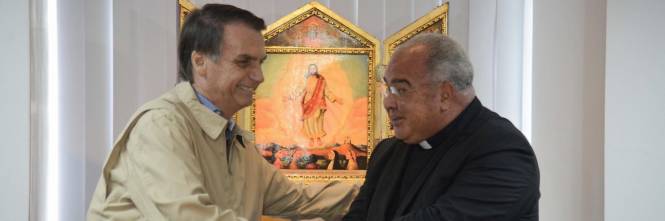
In Brazil some Catholic leaders have already shown concern about what may happen after the rise to power of 63-year-old Jair Bolsonaro, elected to the presidency of the enormous South American country with the 55 percent of the votes 28 last October.
The most demanding opinion was expressed by the powerful secretary of the CNBB (the National Conference of Bishops of Brazil).
“The Episcopal Conference is worried because the words towards the indigenous people were too strong: we have a great concern for the future of indigenous peoples”, ha supported monsignor Leonardo Steiner. “We are also concerned about the words addressed to the Quilombole, who are the descendants of slaves who escaped into the country at the time of slavery, and also for the words that were pronounced towards some parties... Let's see if these words now become an action or remain just words in the wind. But the concern is there, Yes, because we have always been close to the indigenous peoples, to the Quilombole, to the poor. We expect him to have respect for the poorest, for Brazilians who sometimes are unable to participate, to have an opportunity in Brazilian society”.
What is Haddad?, who also went to churches to affirm that his government program included, according to him, the agenda proposed by Pope Francis, which aims to “strengthen democracy, environmental protection and social issues”, all this was not enough.
And so, at the ecclesial level, after Bolsonaro's victory, what remains? A very serious situation for the Catholic Church.
Meanwhile, come explains Vicente Montesinos, glaring cracks remain between the bishops and the clergy. Several priests, Indeed, they supported the PSL candidate, then winning, but they suffered consequences: from the simpler ones (the systematic invitation to silence by some bishops) to the more drastic ones (Father Cleidimar Moreira, after declaring his vote for Bolsonaro, received the threat of “canonical punishment” by his bishop).
After Bolsonaro's choice, a rift also opened between the Christian clergy and lay people. While the former perceived the vote for the far right as a betrayal towards the “Lula's messianism”, the people, voting for Bolsonaro, he rebelled against the experience of Liberation Theology (who preached, to an unprepared people, the closeness of Christianity to socialism, the fight, also armed, in favor of indigenous people and the disadvantaged, against capitalism and the colonialism that would oppress them), ideology, more than theology, which has gripped Brazil for decades.
In the 2018, multimedia development and the prospect of economic progress, ventilated by a right-wing government, it sort of woke up Brazilians and suddenly made them immune to the virus of Catholic-communism. But another virus is hovering around Carioca Catholicism: that of the increasingly powerful evangelical and Pentecostal groups.
If Brazil is the largest Catholic country in the world, come explains John L. Allen Jr., with a Catholic population of over 170 millions (il 70% of the national total), however within a few years the Pentecostals and Evangelicals conquered the 30% of Brazilians.
Dal 1969, since the United States decided, come writes Lucía Etxebarria, that the Catholic Church was revolutionary and advised countering its dangerous influence with that of other Protestant churches, more related to their interests, and after its creation by the Reagan Administration (in April of 1981) of the Institute of Democracy and Religion to integrate all evangelical churches and finance them in Latin America, evangelicals have spread enormously “because the United States paid them”.
The same new president Bolsonaro, who is Catholic, he is very close to the evangelicals and has found his main supporters in them. And he often reciprocates by participating in numerous religious events. Sunday 4 November accompanied a worship service at the Igreja Batista Atitude in Barra da Tijuca, a noble neighborhood in the west of Rio de Janeiro. In his speech, Bolsonaro attributed his election to God, he knelt, prayed and posed for photos with Pastor Josué Valandro Jr.
“If I think about four years ago, when I decided to run for president, without resources, without parties, timeless on TV, with many media against our proposals, and I think there is only one explanation for what happened: it was God who decided”, he said. Next to his wife, Michelle Bolsonaro, the president-elect thanked God for having survived the attack on 6 last September. His conduct was similar to what he had done on Saturday 3 November in the program of Pastor Silas Malafaia, show on TV Bandeirantes. Furthermore, la Assembly of God Victory in Christ, to Rio de Janeiro, it was the place where Bolsonaro made his first speech, off social media, after being elected.
Twitter, as happens with United States President Donald Trump, it is Bolsonaro's favorite tool, he wrote through this social network (on November 1st) which will change the Brazilian embassy in Israel from Tel Aviv to Jerusalem and typed (il 2 November) That “for a long time our teaching institutions have been gripped by harmful and value-inverted ideologies, people who hate our colors and the Anthem. Raising a Brazilian flag is not related to politics, but to the pride of being Brazilian and the hope of better times”.
The Brazilian electoral process, finished a few days ago, it will be relevant not only for Brazil. With Bolsonaro there will be no more money from the Brazilian state to subsidize all the actions of left-wing parties in Latin America and, consequentially, to inflate the left all over the world. E, in Italy, hopefully it will bring back a known terrorist…
On the side of world ecclesial geopolitics, while the Holy Father Francis is notoriously reluctant to take sides among the contending parties, especially in his native Latin America, and he doesn't like the idea of the Church, or him personally, manipulated for political gain, it is also true that Bolsonaro is probably not the head of state that the Pope expected for the great neighbors of his Argentina. Plus Bolsonaro, which wants to commercially exploit the Amazon, he is not on the same wavelength as the pontiff of Laudato Si', of the Successor of Peter who next year has convened a special Synod of Bishops in the pan-Amazon region to also focus on the issues of conservation and sustainability. Still, Bolsanaro's attitude towards immigrants, of indigenous people, of the LGBT community, of the poor, it is not in line with papal thought.
However there are many affinities on other topics. Bolsonaro has signed, before the elections, a commitment with the Catholic Church not to legalize abortion (in Brazil abortion is allowed only in cases of rape, risk for the mother or serious malformation of the fetus) and drugs, to defend the family, the innocence of childhood in schools, freedom of religion.
Bolsonaro's victory, In the end, not only does it take down the Brazilian and Latin American left, but it strengthens the opposite axis: that of the new Brazil that joins forces with Trump's United States, Orban's Hungary, the very Catholic Poland, the Italy of Salvini and Di Maio and other European countries where anti-system forces are growing.
