

Of Ilaria Bifarini

Source: You are afraid
In recent years, European public opinion has learned to understand and in some way metabolize the phenomenon ofmass immigration. Throngs of men, women and children crowd around uncomfortable boats that sail the Mediterranean Sea until they are reached by boats of the now well-known NGOs, which take on the task of ferrying migrants to the northern coasts. This is only the last stage of a process that begins in the immigrants' countries of origin, but which has its roots in the financial mechanisms that regulate the global economy.
Austerity, debt, Malthusianism
The topic was discussed last Thursday at the Theater Hall of the Cristo Re Foundation, in Rome. Speakers Enzo Pennetta, biologist, teacher and writer, e Ilaria Bifarini, economist, author of the books Neoliberalism and mass manipulation (2017) e The Colonists of austerity: Africa, Neoliberalism and mass migration (2018). It is an analysis of the facts that starts from afar that Bifarini offers, which is defined as one “redeemed Bocconian”, from the name of the prestigious university where he studied, the “Bocconi” in Milan, factory of future high finance managers.
L’austerity, in his opinion, e even before the debt, they would be the triggers of mass immigration as well as the globalization of poverty. Austerity that, in Pennetta's introduction, would find a correlation with the Malthusianism, economic doctrine inspired by the Englishman Thomas Malthus according to which the population grows faster than the available resources. Hence the necessity, promoted by followers of this theory, Of reduce social assistance because it encourages population growth. And exactly cuts in public spending are the point of contact between Malthus and austerity.
Blackmail to Africa
The latter, has become a recurring theme in the West, “found in Africa, and in the Third World in general, its own testing laboratory”, Bifarini said. His reflection started from Third World debt crisis 1982, when – he said – “Western ultra-liberal policies are breaking into the African continent through structural adjustment plans, that is, a series of economic reforms imposed by International Monetary Fund and the Central Bank, set as conditions for the granting of loans".
What kind of reforms? Quickly said: privatizations, cuts in public spending, liberalizations. A jumble of ultra-liberal economic recipes that – observed Bifarini – “they have produced an increase in inequality, of poverty and, consequently, of emigration”. It is no coincidence that the countries with a higher propensity to emigrate are precisely those with the lowest public debt, that is, those who paid the most “tears and blood”, to use an infamous expression. The economist was keen to point out that before this short circuit, albeit in small steps, several African countries had also started to grow, and they had made it through Keynesian policies, that is, with state interventions to stimulate demand. Method that – he added – it was also used in the West to cope with and overcome the great depression of 1929.
Who benefits from mass immigration?
Today instead, to stay in the West, the economic crisis of 2008 is addressed by not promoting greater public investment, but rather by pandering to ultra-liberal pressures. This attitude – took over Bifarini – “already applied in the Third World, it will also create here with us, also through the uncontrolled emigration of those same African victims of neoliberalism, a globalization of poverty which spares no one and which is the lifeblood of international speculative finance".
The migratory flow is now well established and appreciated by the markets. “L’Africa – Bifarini said – is facing exponential population growth, that in 2050 will cause the continent's population to double, passing from 1,2 a 2,5 billions of inhabitants. On the contrary the West is caught in the grip of a declining birth rate and an aging population". That's how it is – he continued – “through mass migration, on the one hand, African countries get rid of their surplus population, on the other hand, the West circumvents the unavoidable task of implementing employment and family protection policies".
The industrial reserve army
Not only that, the arrival of masses of desperate people, willing to do anything to have a job, significantly lowers labor costs, allowing Western countries to compete in the global market with the so-called emerging economies, which often do not have a tradition in employment protection law. They represent – Pennetta underlined – what Karl Marx called “industrial reserve army”, multitudes of people ready to settle for starvation wages and poor working conditions. About that, Pennetta cited the statement of a member of the Democratic Party, than during a TV broadcast in 2016 he said that "one of the parameters" to which Italy is stuck is that of “structural unemployment”. “In the Def – clarified the political exponent – we wrote about that in the next few years unemployment will not fall below 12%, as an almost declared objective of the government". This means – Pennetta's reflection – that at least one citizen in ten is expected to be unemployed, “so that he is willing to accept increasingly lower salaries, to create such unfair competition that wages and benefits continue to fall".
And to achieve the neoliberal objective there is a need, Furthermore, of what Bifarini called the “depoliticization”, per cui lo Stato nazionale assume sempre meno valenza e cede la propria sovranità ad organi sovranazionali. “Nei Paesi africani – la sua riflessione – è stata repressa in nuce la nascita di Stati nazionali indipendenti nel periodo postcoloniale, che sono stati subito sostituiti da élite locali al servizio della finanza e delle multinazionali”. È ciò che sta avvenendo oggi anche in Occidente, took over Bifarini. Ma la soppressione dello Stato non fa altro che generare una schizofrenia socioeconomica per cui non si investe più per risanare l’economia reale, quella delle imprese che producono beni e servizi, ma si alimenta il drago invisibile dell’economia virtuale, quella dei mercati, dei flussi di denaro che si muovono dietro lo schermo di un pc.
La profezia di Sankara
Finally, Bifarini wanted to mention the figure of Thomas Sankara, historic president of Burkina Fasobetween 1983 and the 1987. He denounced and fought the debt deception, seen as a sort of neocolonialism towards Africa, and for this he was murdered by his deputy, with the alleged complicity of some of the major Western states. According to Sankara – said the economist – “The European popular masses are not against the African popular masses, but the same ones who want to plunder Europe are the ones who exploited Africa". Therefore the enemy – Bifarini concluded – it is common to all peoples: “the neoliberal elite who speculates on poverty and profits from mass immigration and globalization of poverty”.
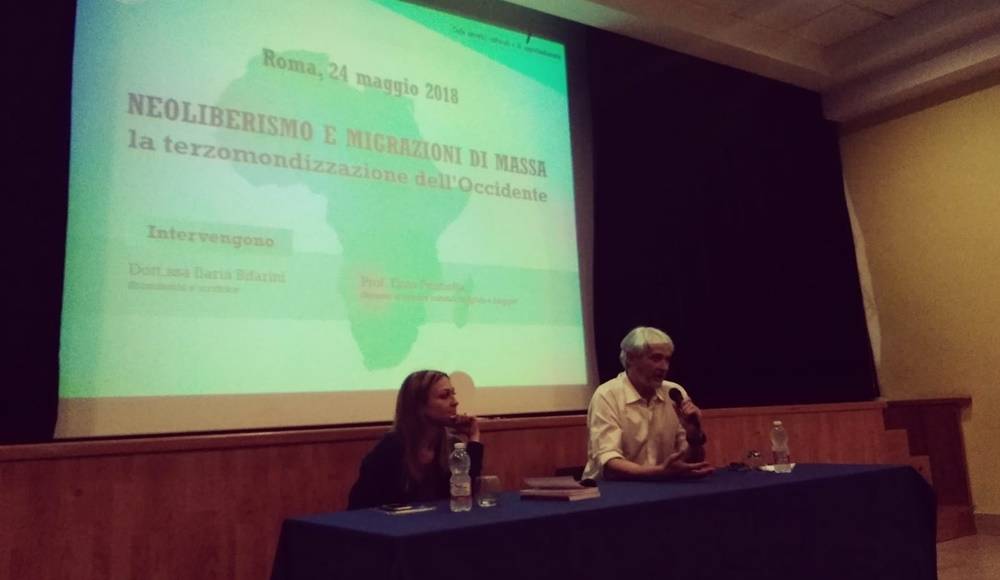
Ilaria Bifarini and Enzo Pennetta
