
 THE ANALYSIS
Of Thomas of Torquemada
For several years, driven by the new revival of an alleged Italian nationalism with positivist roots, secularist and Masonic, certain Italian radical right has embraced the Risorgimento mythology. Practically, the same mythology that is at the basis of the anti-fascist state that, from the foundation of the republic to today, dominates unchallenged with the inevitable blessing of the subversive neo-Church, fruit of the conciliar storm of the Montini operation.
Now we are not interested in disclosing information again, data, statistics on the genocide in Southern Italy and on the Masonic-bourgeois revolution called Risorgimento; the interested reader can consult the texts of the Neapolitan essayist Luigi Di Fiore (largely published by UTET), those of the historical Elena Bianchini Braglia, She is also the author of an excellent monograph on Donna Rachele, the texts of Mattogno on the bourgeois revolution in Italy or the fundamental essay “Il Genocide: the conquest of the Kingdom of the Two Sicilies, mystification, the pain of memory, memory after oblivion” by Stefano Pellicanò, Calzone Publisher, Crotone. We do not consider it necessary to rehabilitate pre-unification history; we are not clericalists, we are not reactionaries nor ridiculous nostalgic commemorators in eighteenth-century uniforms of a finite past, that will never come back. We are and will be Italians and counter-revolutionary comrades, as Romans, Catholics and Mediterraneans. It does not exist nor has it ever existed, nor can it exist, another Italy that does not have Rome as the sacred center of the West and axis of the world.
The texts indicated are more than sufficient for the purpose; then there would be many others, but we don't want to bore the reader with quotations. After all, we can see today that the capitalist-bourgeois and modernist revolution called the Risorgimento was a colossal failure; Reggio Calabria, Palermo, Agrigento, Syracuse, Crotone, Foggia undoubtedly retains an identity and a certain Italian tradition which in the North and Center have been totally submerged by other Protestant forces, Jewish, Islamic or globalist tout-court; not to mention Turin, the capital of Risorgimento, where whoever manages to find some traces of Italianness that is not Southern accomplishes an authentic feat... And so the conquerors ended up being conquered...
What, vice versa, it is very important in this context to underline how this neo-Risorgimento operation of the neo-pagan and atheistic secularist right is based on two fundamental ideological and doctrinal elements that probably escape those, moved by authentic sovereign and national love, they would concretely like to move in historical and strategic continuity with the authentic Italian patriots of history (Cesare, John of the Black Bands, Savonarola, Army of the Holy Faith) and in ideal continuity with the spirit of Fascism.
The first element is the one wisely noted by Gramsci; the so-called resurgence interrupts, after centuries, the authentically Italian ideological trend, strengthened by state Christianity, which originated from Caesarism and which left global centrality to Rome; wrote ours in his notebook dedicated to the Risorgimento: “It does not seem to be understood that Caesar and Augustus actually radically modified the relative position of Rome and the peninsula in the balance of the classical world, taking away Italy's "territorial" hegemony and transferring the economic function to an "imperial" i.e. supranational class. If it is true that Caesar continues and concludes the democratic movement of the Gracchi, by Mario, of Catiline, it is also true that Caesar wins because the problem, than for the Gracchi, for Mario, for Catiline it was a problem to be solved on the peninsula, in Rome, for Caesar it places itself within the framework of the entire empire, of which the peninsula is a part and Rome the capital....This historical connection is of the utmost importance for the history of the peninsula and Rome, since it is the beginning of the process of "denationalization" of Rome and the peninsula and of its becoming a "cosmopolitical terrain".
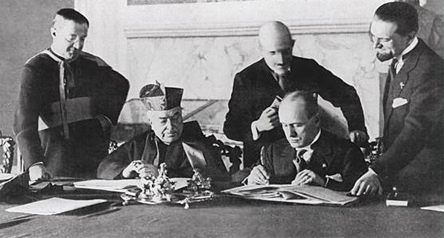
Evidently, the only regime in Italian history that integrated and identified Italianness with what Gramsci considers Caesaristic Roman "cosmopolitanism" - it would be better to define it as imperial universalism rather than "cosmopolitanism" - was the fascist regime of Benito Mussolini. Hence the political and religious necessity of resolving the Roman Question. A few months after the signing of the Pacts, “Fascist criticism”, among other fascist magazines that could be cited, indicated in the Concordat the true culmination of the Risorgimento, whose Catholic essence relegated "Garibaldi habits and frenzies" to the background.
This is what it consists of, On the contrary, greatness, the unity of primacy: this is the characteristic that connects Gioberti more than Mazzini and other philosophers and politicians, peers, to our time, in which the problem of the relationship between Tradition and Revolution... between Church and State continues and is revealed... in the fact as it was intuited by him, that is, as the process of a dualism in which two factors, even if dialectically antithetical, they are equally connatural and essential to the life and destinies of Italy (Rino Longhitani, “Fascist criticism”, 15 April 1935).
G. Rossi dell'Arno – representative of “Italy and faith”- he had the opportunity to underline in an essay dedicated to the Risorgimento, that following the Conciliation, around Rome, there was a spiritual will and a military force that guarantee the freedom and independence of the Chair of Peter. The earthly force that enclosed the Seat of the Church of Christ, it was such as to command respect from every earthly power; you don't get to the Body of the Church, if not passing over the body of Italy. The earthly City was no longer the scene of conspiracies against the Celestial City....The historical function of temporal power was over and the Church shone in the frank light of its eternal Spiritual Father.
So, With Fascism, Rome returned to the center of the West and the world. The Masonic subversive forces were pushed back to the margins, Protestants, Calvinists and Jews who, with the resurgence, they aimed to attack the Roman "cosmopolitical" idea, marginalizing the Italian nation to a provincial dimension and subjection to the more civilized Franco-German Europe or the Anglo-Saxon world: what we were before 1929 and we would have been after the 25 April 1945. Clearly Mussolini did not deny the historical lesson (the suicidal political indecisions of Pius IX with his initial openings to liberal-Catholic modernism will actually be fatal), he did not want to return to the pre-unification states, but he accomplished a political masterpiece by emptying the Risorgimento of its fury at the Protestant disappearance, anti-Romanian, Masonic and xenophile. Obviously the Christian Democrats and Communists will then take care of it, “servants” of foreign powers (USA and USSR) to bring Rome back to the margins.
The second element to consider is that the recovery of a certain radical right of the Risorgimento is happening today, in large part, on the basis of the esoteric-Masonic ideology of the neo-Pythagorean REGHINA. Reghini intended to conciliate, in his political project, an anti-Christian and “neo-Roman”, “pagan imperialism”, with the bourgeois-democratic director, liberal and secularist of the ideology of the Third Estate imprinted on the Italian national movement with the Risorgimento. Reghini in theory contested democracy with Enlightenment roots, but in facts, in Italian history, in any case it ended up supporting the triumph of the Enlightenment vision: ideally with the Risorgimento Protestant Freemasons first, with the anti-Habsburg "nationalists" at the front in the First War, physically and temporally alongside the anti-fascists then. Mussolini himself will feel obliged to react to this Reghini vision (“Hierarchy” October 1924), in the face of the attempt of the pagan and Pythagorean "nationalist" current to "Masonize" the fascist movement, politely contesting its underlying ideology. Below is Reghini, in an open anti-fascist campaign, he will identify Fascism with an anti-Italian Guelph faction. The furthest thing from the truth there was. And how well the famous Pacts showed. Mussolini's Caesarism in this regard, for the objective observer, it's out of the question. In '46, when anti-fascism had already imposed its harsh lex, Reghini will write (Sacred numbers and Pythagorean geometry, pp. 19-20), remembering the sad times, for Freemasons, Protestants and pagans, in the regime:
The savage fury of devastation of our temples was reserved for the fascist mob, of our libraries and the vandalism that tore to pieces the portraits and busts of the great spiritualists such as Mazzini and Garibaldi that decorated our offices”. Or again: “In Italy the persecution against Freemasonry in the last twenty years was initiated and supported by the Jesuits and nationalists; and the fascists, to ingratiate themselves with these scoundrels, did not hesitate to provoke the aversion of the civilized world against Italy with their vandalistic deeds against freemasonry.
The identification of the Jesuit party with the pro-fascist Catholic front is also misleading; actually, the integralists of the flat line and the Franciscans were almost generally the Catholic fascists across the board (with many cases of anti-modernist and anti-Christian espionage at the OVRA, the best known of whom was Mons. Umberto Benigni, often welcomed by the Duce's private secretariat); the Jesuit party led by card. Gasparri first, then from Montini, instead he was already involved hand and foot in a pro-Briandist and pro-Christian Democrat double game, who was opposed by Eugenio Pacelli as secretary of state before, then as pontiff.
Reghini's falsification then emerges to anyone with a minimum of knowledge, even elementary, of French history; not only did the Jesuit party impose the condemnation of the Action Francaise with Gasparri (which His Holiness Pius, as the anti-modernist and anti-subversive hero he was, sending from any compatriot and from the same mother who received in private audience the highest blessings to Maurras and his movement) and directed a French anti-fascist and anti-Italian policy in the 1930s, but during the Catholic Kingdom of Vichy (1940-1944) we can find the entire French Jesuit party on militant Gaullist and even Marxist positions. So, Reghini at least took fireflies for lanterns. In his interpretation, anti-fascists become pro-fascists and vice versa!
Consequentially, it appears problematic at the very least to ideally reconcile the legacy of a regime - like that of Mussolini – in which authoritarian nationalism meant concretely, in the political dimension, State Catholicism and "cosmopolitan" or global Neo-Caesarism with that of a "sovereignist" nationalism which celebrates its origins in a movement and in its various expressions (Mazzini, Garibaldi, Pisacane) he was supported by anti-Italian powers of the time as they were anti-Roman; which could then become a bourgeois "national" state founded on utilitarianism and Cavourian ultra-capitalist liberalism, always thanks to the decisive support of anti-Roman Protestant or Calvinist powers. The "national and sovereign" flag of this Risorgimento "Italy" is today held high by all the various expressions of contemporary anti-Roman Masonic thought, and consequently anti-Italian, from the ultra-Europeanist party of Napolitano and Monti to the Italian Symbolic Rite.
_________________________________________
1G. de' Rossi dell'Arno, The Conciliation and the Risorgimento, Editions of Italy and faith 1935, p. 237.
2After all, the ideological origins of this Europeanism, as Mauro Bottarelli has well shown, they identify with the super-capitalist and Masonic totalitarianism of the GOI in Paris and among public representatives, the most influential exponent of the Masonic and neo-enlightenment party is notoriously Attali, whose subversive and nihilistic ideology is well known.


wonderful article!!!! wonderful to read about the squadristi who destroyed busts of the freemasons Mazzini and Garibaldi!!!
I absolutely agree, toto corde, thoughts and inspirations of the great TORQUEMADA (may God bring him back to us!). Also very true is the fact that the real Italy today begins right from GAETA the BEGIDED MARTYR and reaches the southern end of the country…..other than europ kalergi gender and reforms…go and carry out the reforms in the South
The group is growing around these ideas. Let's imagine that the 2018 it will bring surprises
Fascism dissolved Freemasonry and threw down the statues of the Freemasons GaribaldivCavourMazzini. Those who are Risorgimento are therefore antifa
What the reader claims is only partially true. Without wanting to recall the neo-fascist Southern Wind or the Reggio Revolt, it should be considered that Southern Italy is the most anti-European nucleus in Europe. There are many dark areas and weak points, vero, but traditional religiosity resists and globalism or Europeanism do not dominate like other areas of Italy. If the Italian people are more resistant to Franco-German totalitarianism, the hard core is in the South. Let's consider this data.
I do not yet have the culture and analytical finesse of modern historiography connected to’ ancient, but I would like to underline how in the south I have been able to verify a Masonic cultural pressure in various aspects of common life, not least in toponymy which obsessively uses the names of pseudo-heroes as mazzini, vittorio emanuele, garibaldi etc. (all deliberately lowercase) up to large and small monuments to remind those people…”who's in charge!”…