

Of Maurizio Pallante
Source: Maurizio Pallante
The current situation
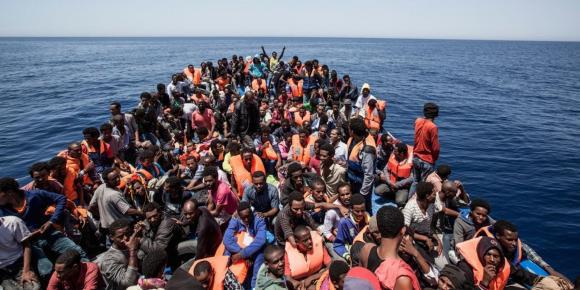
Migrations constitute, together with the greenhouse effect and the economic crisis that began in 2007, the most serious problems of this period of human history. In the countries of departure they are caused by profound upheavals in the production structure, of social relationships and environmental conditions that prevent populations from continuing to obtain the necessary living in the places where they live, as their ancestors did for millennia. In the countries of arrival they generate three types of reactions: one of refusal, which takes the form of support for xenophobic parties;
a welcoming one interested in the contributions that migrants can make to the economic growth and monetary wealth of the natives; one of disinterested and generous welcome, based on solidarity towards the people most affected by life and on the drive for greater social justice. Xenophobic parties emphasize the problems created by the arrival of an ever-increasing number of migrants without professional and economic resources, highlighting the insecurity and degradation that inevitably generates in the places where they somehow camp and make do to survive. Supporters of self-interested hospitality downplay them, insisting on the economic advantages that would derive from their regularization: growth of gross domestic product, increase in tax revenue, payment of pensions. Supporters of disinterested welcome leverage the feelings of brotherhood that, they persist in the human soul despite decades of consumerism, materialism and selfishness that have characterized industrial societies. And they dedicate their energies, their intelligence, their creativity to seek solutions to help the migrants they come into contact with find decent housing and work. Hidden in the shadow cones between these dynamics, two categories of profiteers operate: those who speculate on the desperation of the weakest, exploiting their workforce in despicable ways, until they die; and those who, acting in the hidden depths of politics, they manage to get hold of the funds allocated for reception facilities, leaving only crumbs to the desperate people for whom they were intended.[1]
The aspect of these dynamics on which we should focus most attention instead goes almost unnoticed, it is the fact that all the actors in the field simply take into consideration, each from their own point of view, the consequences of migratory flows in the countries of arrival, but no one asks why in the last thirty years migrations have involved ever-increasing numbers of people all over the world. A question which in relation to journeys from Africa and the Middle East to Europe is made even more dramatic by the fact that they are managed by gangs of human traffickers, are marked by violence, they often end with shipwrecks in the Sicilian channel and, even if they end in some Italian port, there is no certainty that those who arrive will be able to start a new life more satisfying than the one they left. There are those who have written with a superficiality equal to arrogance: «One is the vision of the future, which is good to have but you can't invent. The other is the movement of peoples, which is like the earth spinning or the lunar eclipse. Not recognizing immense events while they are happening is a painful selective blindness.". (Furio Colombo, The Daily Fact, 18 maggio 2017, p. 10). The Earth's rotation can be changed? Lunar eclipses can be changed? We can eliminate the causes that lead growing masses of desperate people to undergo hellish journeys in order to leave the places where their ancestors made a living for millennia? You can put an end to suffering that their ancestors did not have to suffer? There is truly no cause dependent on human choices that can be removed?
Migrations are a phenomenon intrinsic to the industrial mode of production
In the pre-industrial mode of production – still in force in some countries of the world which, for this reason, are defined as underdeveloped – the economy is aimed at producing goods with a use value. The main activity is agriculture for self-consumption. Mercantile exchanges are limited to the surpluses of agricultural production compared to the needs of peasant families and to the objects produced by artisans to meet the demand of customers who order them. Money is the means through which exchanges take place between producers and buyers of goods. In the industrial mode of production, the introduction of machines driven by motors that transform thermal energy into mechanical energy increases production and changes its purpose. Industrial products are not made at the request of those who need them, but to be sold and to obtain more money from their sale than was invested in producing them. They are not produced for their use value, but for their exchange value. Therefore, more are produced, the more they can be sold, the higher the profits of those who produce them can be. Money transforms from a means of exchange to an end of productive activities.
To increase industrial production it is not enough to introduce increasingly efficient machines into production cycles. The number of people working in factories and the number of people with a monetary income that allows them to purchase industrial products must also increase. Those who work in factories do not have the possibility of self-producing the goods they need to live, but he can buy them in the form of goods with the wages he receives in exchange for the work he does. The two reservoirs from which the workers that factories need to increase industrial production can be drawn are the farmers who practice subsistence agriculture and the artisans. But you have to convince them, or force them, to accept this change. At the beginning of the industrial revolution, in England in the second half of the eighteenth century, a series of laws were issued that required the fencing of agricultural land to encourage unification and allow the introduction of agricultural techniques that increased productivity, with the aim of transforming agriculture from an activity mainly for self-consumption into an activity aimed at the sale of agricultural products. The land consolidations were carried out in a way that favored the large landowners and harmed the farmers, to which the least fertile plots were assigned. Common lands were also privatized, preventing farmers from continuing to exercise their right, that they had for centuries, to take the animals out to pasture, to hunt game, to collect firewood, herbs and wild fruits. The combined effects of these two measures made it impossible to survive on subsistence agriculture and farmers were forced to emigrate to industrial areas., where they had no choice but to work as laborers. After all, if they had not done it spontaneously, specific legislation punished begging with a prison sentence to be served by working in special prison factories. Contextually, the development of the textile industry put fabrics woven at home with hand looms by artisans out of the market, who reacted by destroying the mechanical looms powered by steam engines, but their revolt, went down in history with the name of Luddism, it was militarily defeated by government troops sent to aid the industrialists. Since then, the coercive systems used to force farmers and artisans to move from the production of use values to the production of exchange values, from the countryside to the cities, were integrated by instilling in the collective imagination the idea that this passage constituted an indispensable progress to increase well-being and improve living conditions.
This process happened, albeit in staggered times, in all the countries where industrialization developed during the nineteenth century. Except the United States, where the migratory flows that the country needed to support its industrial development were fueled, from the beginning, by masses of desperate people deprived of everything from many European countries, in European countries, in a first phase that lasted roughly until the first half of the twentieth century, migrations from the countryside to the cities have generally not gone beyond regional areas and have only taken on national dimensions in the thirty years following the end of the Second World War, which were characterized by unprecedented economic growth. That growth would not have been possible if migratory flows had not increased the number of people employed in the industrial sector, and if the increase in employment had not increased the number of income earners able to purchase the industrial products placed on the market. In Italy, migrations in those years took on the connotations of an exodus from the south to the north, fueled not only by the laborers and daily agricultural workers who saw the possibility of working in the factory and having a monetary income at the end of each month as overcoming the poverty and precariousness in which they lived, but also by the attraction exerted by life in cities, of which the mass media presented only the positive aspects, cultural vibrancy, the abundance of the supply of goods, work and earning opportunities, while they only emphasized the negative aspects of life in the countryside, the effort, the monotony, backwardness. The migratory flows within each European country were complemented by migratory flows from countries where industrialization had started later and had developed more slowly, towards the countries where it had started earlier and developed more rapidly. For example, from Italy to Germany, to Belgium and France
Current migrations are a consequence of globalization
After the demolition of the Berlin Wall (October 1989) and the collapse of the Soviet Union, the liberal variant of the industrial mode of production no longer had obstacles that prevented it from expanding throughout the world. Moreover, the economies of capitalist countries would not have been able to continue to grow if industrial production and demand for industrial products had not grown in countries such as China and India., where they live 3 billions of people, il 40 percent of the world population. But the demand for goods can only grow if the number of people with income grows, that is, if the number of employed people who receive a salary in exchange for their work grows, the number of entrepreneurs and the number of people who work in the services necessary for the functioning of a complex society. In those countries, in which subsistence agriculture still had a significant role, the transfer of tens of millions of workers from the countryside to the cities, from agriculture to industry and services, from agriculture for self-consumption to agricultural production for the market was implemented with mass deportations. Other deportations of tens of millions of farmers occurred following the flooding of agricultural lands and villages, caused by the construction of gigantic dams to satisfy the growing need for electricity required by the growth of industrial production, by urbanization and rising living standards. In just a few years, cities with tens of millions of inhabitants have been built.[2]
In African countries, it was not industrial development that forced farmers to leave the countryside from which they obtained what they needed to live, but it was the wars between ethnic groups and states fomented by Western countries, and those fought directly by them to keep under control the territories in which there are the mines and deposits of fossil fuels necessary to support their economic growth. They were the reduction in soil fertility and the loss of food self-sufficiency caused by development aid, that is, the commodification of agriculture, which have led them to abandon biodiversity and subsistence agriculture to dedicate themselves to the monoculture of exotic products required by the world market. They were the purchases of huge tracts of unregistered agricultural land by Chinese and Koreans for a pittance with the complicity of corrupt rulers. Since industrial activities to move to have not developed in these countries, the only prospect for populations forced to leave their lands is to find some form of work in European countries.
Free from having to leave
Of course, no one is forced to emigrate. And anyone has the right to leave the places they no longer want to live in, or because they are devastated by a war, or because he is no longer able to obtain what is necessary to meet the vital needs of his family, or because he thinks he can live better in another place in the world. Those who choose to emigrate do so freely, even if the entire history of migration is marked by suffering. The suffering of having to leave the places where you were born and your family affections, the suffering of having to accept strenuous work, dangerous and poorly paid in the places where he moves, the suffering of living in unhealthy homes in ghetto neighborhoods, the suffering due to the hostility of the populations among which it is inserted. A very vivid description of the living conditions of the workers in 1936 in England it was made by George Orwell in travel reports in a northern mining district, collected in the book The Road to Wigan Pier. In relation to the history of Italian emigration abroad, it is enough to remember the lynching of 17 Italians by French farmers and vagabonds who worked with them in the Aigues Mortes salt pans 16 e 17 August 1893. O i 136 miners trapped by an explosion in the Belgian Marcinelle mine on 8 August 1956. If they could earn enough to live where they were born, they would go to work in the French salt pans or in the mines of Belgium? Frees... from signing there (Free... from having to leave), he titled one of his collections of poems in Friulian, Leonardo Zanier, a poet trade unionist who dedicated his life to protecting the rights of Italian workers who emigrated to Switzerland. Is it possible that supporters of hospitality for humanitarian and social justice reasons only know how to say that emigrating is a right that must be protected and facilitated, but they cannot even imagine that if human beings are forced to make a choice that arises from the need to escape from suffering and in most cases leads to more suffering, humanity, the right, sharing requires us to ask ourselves what are the causes of the suffering that forces them to emigrate and of the suffering they will encounter in the places of arrival? Let us commit to making public opinion aware of them and trying to understand how they can be removed? If we limit ourselves to facilitating the reception of migrants, the causes that lead them to emigrate will be strengthened. E, since migrations are caused by suffering and involve suffering, you contribute to increasing it, as well as unconsciously playing the game of the whitewashed tombs of the interested reception.
The welcome of the whitewashed tombs (little anthology)
Carlos Moedas, European Commissioner for Research, to innovation, to science, Statement to the French broadcaster Europe 1, 11 maggio 2015:
We need to have more migrants in Europe. Immigration is essential to growth and it is certain that if we could have more people we could have more growth. My message to the French and to Europe is that we must open our doors.
Caritas and Migrants, XXIV Immigration Report, Migrant development actors, Milan Expo, 4 June 2015:
Migrants constitute an asset for Italy, because they produce 8.8 percent of the gross domestic product, equal to more 123 billions of euros. And they are paid less than Italian workers: an Italian earns on average 1.326 euros per month, a community citizen 993, a non-EU citizen 942 (ndr: what more could you want?, not to mention those who work illegally, who are given only what is necessary to survive and return to work day after day, as long as there is a need).
Maurizio Ricci, They work and have children: this is how migrants finance Europe, la Repubblica online, 8 September 2015:
To save our pensions they are needed 250 million refugees by 2060.
(ndr: «refugees», that is, war refugees, not simple economic migrants, assuming that the distinction makes sense).
According to a Credit Suisse report, made public on 23 September 2015, expenses for migrants are destined to pay off in the form of growth benefits and therefore increases in tax revenues. Managing migrants is not a cost but a good investment. By 2020 Europe will need 42 millions more employed to support its welfare system. The projection to 2060 is of 250 millions. The alternative, according to the study by the Swiss bank, they are purely a question of logic: either the birth rate increases or more immigrants arrive or benefits are reduced.
(ndr: they didn't see the 3 millions of unemployed in Italy, where youth unemployment has fluctuated for years around 40 percent)
Tito Boeri, president of the INPS, interviewed by Francesco Manacorda, Republic of Ideas, Bologna, San Domenico Center, 15 June 2017:
If we closed the borders to migrants we would not be able to pay pensions. Every year foreigners pay eight billion euros in contributions and withdraw three. It is true, one day they will have a pension too, however, many will return to their country of origin. Their payments will be non-repayable.
(ndr: as well as enriching ourselves legally, they even get screwed...)
Tito Boeri again, in the INPS Annual Report, presented on 4 July 2017 he wrote to Montecitorio:
Closing the doors to them would cost us the net loss of 38 billions for the next ones 22 years, an additional annual maneuver. […] By closing borders to immigrants we risk destroying our social protection system. The workers arriving in Italy are increasingly younger, the share of under 25 has passed since 27,5 percent of 1996 al 35 percent of 2015, and therefore it is about 150.000 additional taxpayers per year, which partially offset the decline in births. […] until now immigrants have given us around one point of GDP in social contributions for which they have not been paid pensions.
(ndr: «they gave us approx 1 GDP point": despite their poverty, they are really generous)
International Monetary Fund, The impact of migration on income levels in advanced economies, 5 July 2017:
In advanced economies, a 1 percent increase in immigrant workers corresponds to a growth in gross domestic product of 2 points, in the long run.
(ndr: how much it decreases wealth in the countries of origin?)
Always Tito Boeri, 20 July 2017, hearing at the parliamentary commission of inquiry into the migrant reception system:
Legal immigrants pay every year 8 billions in social contributions and receive them 3 in terms of pensions and other social benefits, with a net balance of approx 5 billions for INPS coffers.
Avoid being used as unwitting Trojan horses
The whitewashed tombs know perfectly well that in developed countries the production and sale of goods cannot continue to grow unless the percentage of the world population that abandons the subsistence economy and enters the market economy increases. They therefore rightly argue that we must welcome migrants because we need them: to continue to grow our gross domestic product, to maintain our lifestyles, to pay our pensions, to do the jobs that Italians no longer want to do, to provide assistance to our elderly. Instead, the motivations with which the Catholic Church despite the slip-ups of Caritas are disinterested and dictated by solidarity, some non-governmental associations and political movements of the non-genetically modified left work to encourage the entry and reception of migrants from the Middle East, from Africa and Eastern European countries. For them, asylum seekers and economic migrants are human beings who were not as lucky as we were to be born on the right side of the world, forced to undertake dramatic journeys of hope in search of a better life, accepting to suffer violence of all kinds from unscrupulous human traffickers and to risk their lives to reach the promised land of our countries, where levels of well-being are higher than those of their countries of origin.
Given that alleviating suffering is an ethical duty to be carried out promptly without any ifs or buts, understanding the causes that cause it is an intellectual duty which leads to the political commitment to try to remove them. Certainly some of the migrants who desperately try to move from Africa and the Middle East to Western European countries are attracted by the abundance of material goods. Those who produce them unscrupulously use the internet and satellite television to arouse in them the desire to have them, knowing that it has an impact especially among young people, who are the most interesting age group from a working point of view.[3] However, the majority is forced to emigrate because industrialized countries, to support their interests they have made it impossible for the people who live there to continue to live there and draw from them what they need to live. The distinction between economic migrants and political refugees, which many repeat as obvious, it is conceptually specious. What difference is there between those who are forced to abandon their land because it has been devastated by instigated wars, or fought directly by developed countries to keep the deposits of a resource necessary for their economic growth under control, those who are forced to abandon it because its fertility has been depleted by chemical agriculture financed by development aid to enhance the supply on the world market of an agricultural product for which there was temporarily unmet demand, and those who are forced to abandon it because an oil field has been established there, or a polluting waste landfill, or because the Chinese took it over? None of them can continue to live on the land where he was born and where his ancestors were born.
Those who believe that industrial societies constitute the highest level reached in history because they have allowed their inhabitants to have an abundance of material goods never known in the past, to defeat hunger, to cure previously incurable diseases and extend lifespan, he is convinced that migrants from Africa and the Middle East cannot help but want to come and live there, «to give yourself and your loved ones a better future», as Silvio Berlusconi mellifluously argued when speaking on a Tunisian television network when he was Prime Minister. And if it is sensitive to humanitarian motivations and believes that equity is a value, cannot fail to be available to help them so that they can share our lifestyle. It does not grasp the hint of racism that clouds this idea of welcome. He doesn't think it's our consumerist lifestyle that prevents migrants from continuing to live on their fathers' lands, because it deprives them of what is necessary to feed our superfluous. He believes that the only alternative to the limitations of their way of life is our way of life, which is less compatible with the biosphere than theirs. He doesn't imagine that there could be another different from ours and theirs, to invent and build together, because ours has no future and theirs is marked by deprivation. He doesn't think that there could be advantages in their lifestyle that our lifestyle has taken away from us (spirituality, solidarity, collaboration) and that their limits can be overcome (very little scientific knowledge, hygiene and health problems, lack of material goods) without necessarily assuming our own. In short, only those who have a very schematic way of thinking and strong mental limitations can think that the only possible alternative to the problems of their society is ours, and that the only possible alternative to the defects of ours is to go back, to our pre-war peasant society, which was similar to theirs. He doesn't even imagine that we can move forward, each in his own way, in a different direction. For example, towards societies in which technology is aimed at reducing the ecological footprint and not at increasing productivity; in which well-being is not confused with having a lot, but identify with the possibility of guaranteeing that everyone can make use of their talents. If you don't ask these questions, the clear supporters of hospitality risk becoming the Trojan horses of whitewashed tombs, who become champions of hospitality to transfer to the service of opulent societies those from whom the opulent societies have already taken away the necessities to live in their home.
Se, as a consequence of the inclusion of an ever-increasing number of migrants in the economic and production system of developed countries, our gross domestic product will grow more intensely again, as documented by studies of whitewashed tombs, our needs for raw materials and energy will grow. Our need to keep the areas of the world in which they are located under political and military control will therefore increase. Consumption of fossil fuels will increase, carbon dioxide emissions and the greenhouse effect. It will increase the amount of waste we produce and our need to find somewhere in the world to dump it. All the factors of the environmental crisis will worsen. The resources available to people impoverished by the greed of people who have more than they need will decrease and their propensity to emigrate will increase. According to a study compiled by 13 US federal agencies dealing with climate change for the National Climate Assessment (the climate assessment requested by Congress every 4 years), published on August 8 2017, Climate change will have its effects felt especially in the countries of origin of migrants and will accentuate their flows. The rise in ocean levels resulting from the melting of polar ice caused by the greenhouse effect will submerge Bangladesh, forcing his own 165 millions of inhabitants to emigrate in search of other places to live. And they won't be the only ones who will have to leave their land.
Generous and disinterested welcome is essential to alleviate the suffering caused by migration, but if it is not part of a project to remove the causes that generate them, can help strengthen them. The fundamental choice to reduce the suffering of migration is not to fluidize the flows without committing to limiting the causes - as they do, for different reasons, the pseudo-left of whitewashed tombs, the non-genetically modified left, religiously inspired movements - but aim to reduce them - without blocking them militarily, as the xenophobic and sovereignist right-wingers propose - but by reducing the causes that provoke them. That is, reducing inequities between peoples.
To reduce the suffering of migration, we must pursue greater equity between peoples.
There are those who believe that greater equity between peoples can be achieved by decreasing the consumption of developed countries to allow consumption of underdeveloped countries to grow. If so, humanity's global consumption of resources would not decrease. Since it has already exceeded the limits of environmental compatibility, humanity would continue to head towards collapse, but in a more equitable way. It's not a comforting prospect, especially for the latest and future generations. And then, how can you think that the populations of countries where the economy continues to be aimed at growth can accept a reduction in consumption; wealth and poverty are measured by purchasing power; the training processes are based on the identification of human fulfillment with the work that is carried out, the income derived from it, the quantity and monetary value of the goods it allows you to buy? Greater equity between peoples cannot be achieved by extending the economic model of developed countries to underdeveloped countries, not even if we intend to reduce the resource consumption of developed countries to allow underdeveloped countries to have more available. Greater equity between peoples can only be achieved if we abandon the belief that the purpose of the economy is the growth of the production of goods.
Creating considerable confusion among the champions of single thought, in the Encyclical Laudato si', Pope Francis wrote: «… the time has come to accept a certain degrowth in some parts of the world, providing resources so that we can grow healthily in other parts". (193) Evidently the parts of the world where "the time has come to accept a certain degrowth" are the developed countries, but they are not very inclined to accept it, because they instinctively conceive it as a decrease in the consumption of material goods - which also, despite common opinion, would be necessary to improve well-being. In reality, much more significant results can be achieved by focusing efforts on reducing resource consumption, which can be achieved by developing technological innovations aimed at increasing the efficiency with which they are used and reducing waste. In the energy sector alone, a great design and innovative impulse, comparable to what started the industrial revolution, can reduce energy consumption at source by at least two thirds for the same final services. In this way it can not only increase the amount of resources available to people who have less than what is necessary to satisfy the basic needs of human beings, but they can be offered the opportunity to "grow in a healthy way", because the technological innovations that allow the resource consumption of developed countries to be reduced more than their final consumption, they also allow the final consumption of underdeveloped countries to increase more than the consumption of resources necessary to support them. In any case, the result of the two processes must lead to an overall reduction in the consumption of earth's resources, of metabolizable emissions and non-metabolizable emissions from the biosphere, but this can only happen if the collective imagination of developed countries is able to free itself from the great deception of identifying well-being with consumerism and the value of innovation as such. Only if you believe that the meaning of life is identified with the possession of things and that the new is always better than the old, every time a new product is introduced on the market you may feel the need to buy it. But the satisfaction gained from this is continually frustrated by the introduction of newer products onto the market which make the new products just purchased become old.. The propensity to consume remains intact precisely as a consequence of the frustration to which it is inevitably subject. Only people incapable of giving meaning to their lives as a succession of discoveries, knowledge, enchantments, they can fall victim to this deception. But it is this deception that allows us to continue producing more and more, to consume ever greater quantities of resources, to introduce ever greater quantities of waste substances into some matrix of the biosphere.
The changing purposes of technology, from increasing productivity to reducing environmental impact, together with a change in values and behavior models that re-evaluates the importance of the spiritual dimension and dismantles the identification of the concept of new with the concept of better, they are the only way to combine environmental compatibility with equity. An equity not limited to the living generations of the human species, but extended to future generations, nor limited to the human species, but extended to all living species, because only this extended equity can allow us to achieve environmental compatibility and only environmental compatibility can allow us to achieve this type of equity, the only one capable of guaranteeing greater equality between peoples. Any person who knows human history, the suffering and violence of which it is woven, he cannot help but think that this is an unachievable utopia, but there are no alternatives if we want to prevent migratory flows from increasing and continuing to cause suffering among the poorest on earth, to enrich the merchants of human beings and those who, taking advantage of their weakness, they reduce them to a state of slavery at work, to create social tensions in the countries of arrival that increase political consensus for xenophobic parties. And if we want to stop the journey towards self-destruction of the human species, which goes hand in hand, tragedy after tragedy, with the journeys of migrants from Africa and the Middle East to Western European countries.
In relation to a different context Ivan Illich wrote words that can also be applied to this one: «Such a program may still appear utopian at the point we are at: if we allow the crisis to worsen we will soon find it extremely realistic."[4]
[1] According to the Modern Slavery Index report 2017, edited by the British research center Verisk Maplecroft, as a result of the high number of migrant landings on the Italian coasts in 2016, the number of vulnerable people has increased, which fueled illegal work and exploitation. Currently in Italy they would be 100 thousand people in conditions of slavery and quasi-slavery in agriculture. 80 percent are foreigners, the remainder 20 percent Italian. Violations of laws against human exploitation show an increase in 20 European Union member countries on 28. In Italy the problem of exploitation and enslavement is not limited only to the agricultural sector, but it also manifests itself in construction and services. And then there is the exploitation of prostitution, where the eastern and Nigerian mafias dominate the market. A market that, according to Istat, vale 90 million euros per month, 1,1 billion per year, powered by approx 9 millions of customers who have available among the 75 thousand and the 120 thousand girls scattered across the country. (Gianni Rosini, il Fatto Quotidiano online, 14 August 2017)
[2] In China, the construction of the Three Gorges Dam on the Yangtze River, finished in 2009, at full capacity it will flood a territorial extension in which they live 5 millions of people. In India since 1980 a project is underway that involves the construction of 3165 dams on the Narmada river. Thousands of hectares of fertile land have already been flooded and thousands more will be, completely disrupting the Gujarat valley, where they live 25 millions of farmers.
[3] Il 23 August 2009 Berlusconi went to Tunisia to the Nessma TV studios, a commercial channel widespread in the Mediterranean Maghreb countries, of which Mediaset has the 25 percent, to participate in the Ness Nessma broadcast. Here is the transcript of part of the interview, of which you can see the original video on the broadcaster's website www.nessma.tv Host: «From the attraction that Italy has on Maghrebians, you can move on to immigration, especially to the clandestine one which unfortunately causes thousands of deaths".
Berlusconi: «The most terrible thing are the criminal organizations, which are very many. Ben Ali told me today 300 organizations discovered by the police in your country. They are people who take advantage of the hope of others, of people who are in poverty and who want to give themselves and their loved ones a better future. And so they rely on people who put themselves into the sea with unsafe boats and this leads to tragedies at every moment. We need to fight all this. It is necessary to increase the possibilities for people who want to try new life and work opportunities, we need to increase the possibilities of legally entering Italy and other European countries. This is what I want done, not only in Italy, but throughout Europe. And then it must be said that Italians were a people who left Italy and emigrated to other countries, especially in the American ones. And so this imposes on us the duty to look at those who want to come to Italy with a total openness of heart. And to give those who come to Italy the possibility of a job, of a house, of a school for their children, and the possibility of well-being which also means health and the openness of all our hospitals to their needs and this is the policy of my government".
Presenter: «You are incredible president, I can't help but applaud".
[4] Ivan Illich, Conviviality, Boroli, Milano 2005, pag. 130, ed. orig. 1973
Similar Posts
