

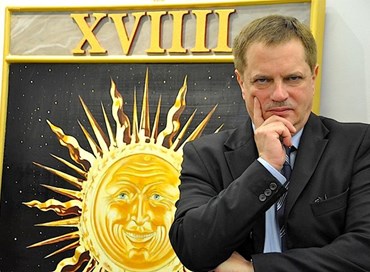
 MASONRY, OMTI: LUIGI PRUNETI SPEAKS
by Vanessa Seffer
Freemasonry in Italy, unlike other countries, it is seen in a negative way. What are the reasons in the opinion of the Grand Master of the OMTI?
The reasons are of an exquisitely historical nature. Freemasonry suffered its first excommunication in Italy with Pope Clement XII in 1738. She was immediately disliked by the Catholic Church and the reasons that led to the excommunication were different, more than anything it was the fear that this strange slice of the United Kingdom was a vehicle of heresy.
The first Florentine lodge had been established in the Anglican country between 1730/1731, especially from foreign residents of other religions who were in the same Lodge, with local Catholic elements. Not only that, but it was well known that there were some in the Lodges, in parity, even hated, hated Jews. He didn't like this promiscuity. Another fundamental element that led the pontiff to excommunication was that many locals, within this Lodge, they were already sick with the disease of the Enlightenment, which was seen by the Church as a devastating philosophy towards religion by carrying forward this verb of universal reason, that is, that men are all equal because they have the gift of reason and the reason that thinks and fights against all those superstitions is not anti-Christian but calls into question many things. So there was no escape from excommunication.
Then there is an element that works in favor of Freemasonry. Even if this has nothing to do with it, for some, Freemasonry is always linked to this episode: the French Revolution. It was a devastating fact for public opinion at the time. Like the Notre Dame scandal, one of the major temples of Christianity transformed into the temple of the goddess reason. There is always in man the refusal to grasp the complexity of history where everything is born, every big event, it does not have just one cause but many contributing causes. Many thought that there must be a conspiracy behind the French Revolution and thus the Masonic conspiracy theory was born, which a French abbot brought forward, Augustin Barruel, father of conspiracy theory, who took refuge in the United Kingdom and wrote "Memoirs for the history of Jacobinism".
But there were many other Masonic plots for the Church: This year is the anniversary of the Masonic plot of the Second War of Independence. Previously, all insurrectional attempts to lead to the unification of Italy, the war of independence, the carbonari, all this was seen, partly rightly so, like a Freemasonry conspiracy. The unification of the country which is then the liberation of 1870 it is seen as "against" the See of Peter. So, united Italy, this ideology of a secular and non-secularist nature in some cases, the Coppino law which eliminated the obligation of catechism in school and replaced it with the first elements of civic education, all being facts supported by Freemasonry, here he gave a negative vision of the Catholic scene there. Freemasonry has also fought battles that it has failed to win, but which were also seen as contrary to Catholic morality, like the divorce battle, the battle for cremation. Now they all agree to cremate a body, but then it was seen as an offense, as a desire to eliminate the possibility of the soul surviving, a terrible slap for the Catholic vision of the time. But Freemasonry continued these battles anyway. Then because he has a cosmopolitan and universal vision, when the nationalist party was born in Italy in 1910 Freemasonry was disliked by this party which was instead against this brotherhood between peoples. Peoples and nations had to be ready to fight for living space, this was the nationalist conception and therefore it was the first party that posed the incompatibility between Freemasonry and party membership.
So it was the Church that feared Freemasonry first and then politics?
In the 1914 there was the excommunication of the Freemasons by the Socialist Party at the Ancona congress with Mussolini. Three components of Italian politics – the Catholics, the extreme nationalist right and Marxist socialism – they are ideologically opposed to Freemasonry. This is essential to ensure that Freemasonry in Italy is seen badly. Furthermore, Italian Freemasonry has had a notable stumble and this cannot be denied, with the P2 case, which was instrumentally used to throw mud on the image of Freemasonry itself. It is essentially an ideological and political legacy that acts against Freemasonry.
Perhaps due to its nature as a secret association?
Freemasonry in itself is not a secret association, it has always been a private association. It was secret when if it had been open it would have been persecuted. Confidential means not being forced to play big brother. Confidentiality is respect for privacy, it is the fact that members of Freemasonry, like members of any other cultural or thought association, are not required to call out or declare in the streets what they think. That there is this fundamental right of not having to necessarily declare what you think to others, otherwise you would be judged. In times of persecution, Freemasonry paraded through the streets with its vestments and therefore is not in itself secret. If you consider that the Grand Orient of Italy is still called Palazzo Giustiniani because its historical seat was in Rome, if it had been secret no one would have known this. The obediences that refer to Piazza Del Gesù because they had their headquarters there in Rome were evidently not so secret and hidden. The most important exponents of Freemasonry are all known and not secret. The documents on membership in Freemasonry are all there, those who aren't there, they were burned, destroyed by fascists or other freemasons, otherwise they are there.
Why should a young person in our era of increasingly sophisticated technologies approach Freemasonry, to a ritual made of aprons and compasses, of temples to be built?
Because Freemasonry indicates a path, a way forward. Freemasonry is many things: an associative phenomenon, a civil education school, it is an initiatory community, a spiritual path. If someone wants something different from what an exclusively consumerist and hedonistic society can offer, Freemasonry can be a path. There are many others, but Freemasonry is one of these, which pursues certain goals. One is that of sociability, an ability to be together despite absolute freedom of thought and therefore there is a free comparison of ideas, with a basic intuition, than the comparison of diversity, a civil confrontation for a dialogue between diversities leads to growth, it keeps you going, it's inspiring. It teaches a behavioral way of being together in diversity, precisely. Among other things, it leads you to a continuous desire for growth, of in-depth analysis, of improvement. Freemasonry deliberately uses its method of growth, the “symbol”, because the symbol is a vehicle of ever-changing messages. While the word indicates a concept, just this, a symbol can contain many different indications and therefore those who are members of Freemasonry are led to always go further, not to be satisfied with what is sent to you, indicated by the media, but to try to understand and have absolute autonomy of thought. Freemasonry is also an impulse to live better the relationship with oneself to know oneself better and improve the relationship with others which is fundamental, for the world that is moving towards globalization and a total and absolute interculture; Freemasonry is a tool for coexistence, for growth together which is the future.
Words like Lodge or Temple can intrigue or worry a reader, or whatever they say, a layman. Can you explain better what a Lodge is, what is meant by Temple?
It's quite simple: Freemasonry is made up of nuclei that are autonomous, this Log. As if they were many clubs. Each nucleus has its distinctive name and has a location where it meets and naturally follows the general rules which are the Constitutions, uses the method indicated by the rituals and gathers in a place which is called the Temple. The Temple is the place of meetings. Since Freemasonry uses the method of symbolism in its path, this place called the Temple has fundamental symbolic elements within it, which refer to the mythical Temple of Solomon, the Temple of Temples. The Temple represents infinite space, a general universal and cosmic context. Effectively, in the Temple, cross the two pillars of Hercules which represent the limit between the external world and the internal world, you arrive in an environment where there are astronomical symbols, that I am the sun, the moon the starry vault, and astrological symbols with the constellations that always refer to the universal: the checkered floor where there is black and white, the black and white tiles that indicate our life, our existential plan, the continuous conflict between good and evil but also the conflict between the positive and the negative, the need to overcome the difficulties that will always be there during one's life journey. There will never be white unless you first cross the black and therefore it is an existential message. Then there is also the reminder of the work that every Freemason must do on himself, self-building, from rough stone to polished stone. Everyone must work on themselves to improve themselves, to ensure that the potential within us then produces a perfect work. What Michelangelo said that “Every David is enclosed in every block of marble, it's up to the artist to bring it out". Every Freemason is his own artist.
Contrary to other obediences, his accepts women. Why and above all do you have women at the highest levels of your institution?
Our communion accepts women but is not the only one. There are now many communions at European and global level that welcome women. Freemasonry was originally reserved only for men, because women were not considered free beings in all respects, they were always subject to protection, marital or paternal, then Freemasonry in England at the beginning of the 18th century was a sort of club and the clubs were exclusively male. The men formed a society within the clubs, women formed societies within the living rooms. Obviously men and women of a certain caliber. Then times naturally changed, since today the woman is rightly a free being in all respects, why it should be excluded from this context which is a context open to "all men of good will", to all those who consider themselves equal to other men, free among free, brothers for brothers, it would be a contradiction. And breaking down the grids of a traditionalism that no longer has any reason to exist, Freemasonry has opened up. But already the first examples of mixed Freemasonry can be found in the first of”800. Our communion is of this opinion.
You are considered one of the most authoritative experts on esotericism. It manages to make the general public understand what it is about?
For esotericism, which has become a very vague term, which indicates a lot of things, esotericism was born from the Hellenic philosophical schools and was contrasted with exotericism. Communications addressed to everyone were exoteric, the esoteric ones, however, were the internal teachings of the school, those reserved for students, it was an absolutely confidential teaching, therefore there was a more closed aspect, hidden. Esotericism is a teaching more aimed at an anthropological branch where one goes beyond appearance, we go inside the mystery of things. There are many esoteric teachings, like the Jewish Kabbalah. A particular reading of the Jewish Torah that goes beyond the communicative language of the Jewish text, that tries to interpret hidden messages, secret messages, subliminals. Another esoteric teaching or esoteric aspect of our Western tradition is alchemy, the desire to transform matter until arriving at the philosopher's stone, that very pure element that transforms lead into gold, but beyond this purely symbolic aspect it is an intimate transformation of man and his way of being, a refinement of man through the transformation of himself. Esotericism is understanding symbolism, the symbolic language that art often communicates to us because in art there are hidden messages that go beyond appearance. Think about how much some works by great authors cause discussion because they represent something but in reality we know well that the author wanted to convey something else. Let's think about Giorgione, to Giorgione's “Tempesta”., a painting representing a naked woman and a knight in an environment under a stormy sky. Let's think about Giorgione's “Three Philosophers”., to the “Flagellation of Christ” by Piero della Francesca. There is a different message within the work of art, a closed message, a message perhaps reserved for a few, to those who can read it. Esotericism is therefore a going beyond what appears, what is the surface and enter into the depths, to try to understand the true and hidden origins of that phenomenon.
Intrigue, conspiracies, power games, they call you knife brothers also because of your internal fights. They accuse you of everything and more. If this is the case, what are you busy with in the little time of the day that remains?
In fact, one of the greatest enemies of Freemasons is precisely the time to do everything that should be done. We deal with various aspects. The first is to number yourself together following a very specific method, the Masonic one. A method that is essentially based on elements: the silence, the value of the word, the symbol and a ritualized way of behaving. In working together in a Masonic Temple, which is a container of symbols on topics always on the agenda and which always have a connection with Freemasonry. Through this method there is cognitive growth, psychological and social. Then there is an activity of an external nature, which is to act on the world of culture, because culture is the leaven of society. A society that moves culture is a growing society, which has prospects. A society without culture is destined to implode within itself. Since Freemasonry is an association that defines itself as progressive and projected towards the future, starts from the assumption that society must grow through the work of acculturation, therefore it is always proactive. Finally, solidarity, we propose internal and external forms of solidarity, also in foreign countries.
The reasons are of an exquisitely historical nature. Freemasonry suffered its first excommunication in Italy with Pope Clement XII in 1738. She was immediately disliked by the Catholic Church and the reasons that led to the excommunication were different, more than anything it was the fear that this strange slice of the United Kingdom was a vehicle of heresy.
The first Florentine lodge had been established in the Anglican country between 1730/1731, especially from foreign residents of other religions who were in the same Lodge, with local Catholic elements. Not only that, but it was well known that there were some in the Lodges, in parity, even hated, hated Jews. He didn't like this promiscuity. Another fundamental element that led the pontiff to excommunication was that many locals, within this Lodge, they were already sick with the disease of the Enlightenment, which was seen by the Church as a devastating philosophy towards religion by carrying forward this verb of universal reason, that is, that men are all equal because they have the gift of reason and the reason that thinks and fights against all those superstitions is not anti-Christian but calls into question many things. So there was no escape from excommunication.
Then there is an element that works in favor of Freemasonry. Even if this has nothing to do with it, for some, Freemasonry is always linked to this episode: the French Revolution. It was a devastating fact for public opinion at the time. Like the Notre Dame scandal, one of the major temples of Christianity transformed into the temple of the goddess reason. There is always in man the refusal to grasp the complexity of history where everything is born, every big event, it does not have just one cause but many contributing causes. Many thought that there must be a conspiracy behind the French Revolution and thus the Masonic conspiracy theory was born, which a French abbot brought forward, Augustin Barruel, father of conspiracy theory, who took refuge in the United Kingdom and wrote "Memoirs for the history of Jacobinism".
But there were many other Masonic plots for the Church: This year is the anniversary of the Masonic plot of the Second War of Independence. Previously, all insurrectional attempts to lead to the unification of Italy, the war of independence, the carbonari, all this was seen, partly rightly so, like a Freemasonry conspiracy. The unification of the country which is then the liberation of 1870 it is seen as "against" the See of Peter. So, united Italy, this ideology of a secular and non-secularist nature in some cases, the Coppino law which eliminated the obligation of catechism in school and replaced it with the first elements of civic education, all being facts supported by Freemasonry, here he gave a negative vision of the Catholic scene there. Freemasonry has also fought battles that it has failed to win, but which were also seen as contrary to Catholic morality, like the divorce battle, the battle for cremation. Now they all agree to cremate a body, but then it was seen as an offense, as a desire to eliminate the possibility of the soul surviving, a terrible slap for the Catholic vision of the time. But Freemasonry continued these battles anyway. Then because he has a cosmopolitan and universal vision, when the nationalist party was born in Italy in 1910 Freemasonry was disliked by this party which was instead against this brotherhood between peoples. Peoples and nations had to be ready to fight for living space, this was the nationalist conception and therefore it was the first party that posed the incompatibility between Freemasonry and party membership.
So it was the Church that feared Freemasonry first and then politics?
In the 1914 there was the excommunication of the Freemasons by the Socialist Party at the Ancona congress with Mussolini. Three components of Italian politics – the Catholics, the extreme nationalist right and Marxist socialism – they are ideologically opposed to Freemasonry. This is essential to ensure that Freemasonry in Italy is seen badly. Furthermore, Italian Freemasonry has had a notable stumble and this cannot be denied, with the P2 case, which was instrumentally used to throw mud on the image of Freemasonry itself. It is essentially an ideological and political legacy that acts against Freemasonry.
Perhaps due to its nature as a secret association?
Freemasonry in itself is not a secret association, it has always been a private association. It was secret when if it had been open it would have been persecuted. Confidential means not being forced to play big brother. Confidentiality is respect for privacy, it is the fact that members of Freemasonry, like members of any other cultural or thought association, are not required to call out or declare in the streets what they think. That there is this fundamental right of not having to necessarily declare what you think to others, otherwise you would be judged. In times of persecution, Freemasonry paraded through the streets with its vestments and therefore is not in itself secret. If you consider that the Grand Orient of Italy is still called Palazzo Giustiniani because its historical seat was in Rome, if it had been secret no one would have known this. The obediences that refer to Piazza Del Gesù because they had their headquarters there in Rome were evidently not so secret and hidden. The most important exponents of Freemasonry are all known and not secret. The documents on membership in Freemasonry are all there, those who aren't there, they were burned, destroyed by fascists or other freemasons, otherwise they are there.
Why should a young person in our era of increasingly sophisticated technologies approach Freemasonry, to a ritual made of aprons and compasses, of temples to be built?
Because Freemasonry indicates a path, a way forward. Freemasonry is many things: an associative phenomenon, a civil education school, it is an initiatory community, a spiritual path. If someone wants something different from what an exclusively consumerist and hedonistic society can offer, Freemasonry can be a path. There are many others, but Freemasonry is one of these, which pursues certain goals. One is that of sociability, an ability to be together despite absolute freedom of thought and therefore there is a free comparison of ideas, with a basic intuition, than the comparison of diversity, a civil confrontation for a dialogue between diversities leads to growth, it keeps you going, it's inspiring. It teaches a behavioral way of being together in diversity, precisely. Among other things, it leads you to a continuous desire for growth, of in-depth analysis, of improvement. Freemasonry deliberately uses its method of growth, the “symbol”, because the symbol is a vehicle of ever-changing messages. While the word indicates a concept, just this, a symbol can contain many different indications and therefore those who are members of Freemasonry are led to always go further, not to be satisfied with what is sent to you, indicated by the media, but to try to understand and have absolute autonomy of thought. Freemasonry is also an impulse to live better the relationship with oneself to know oneself better and improve the relationship with others which is fundamental, for the world that is moving towards globalization and a total and absolute interculture; Freemasonry is a tool for coexistence, for growth together which is the future.
Words like Lodge or Temple can intrigue or worry a reader, or whatever they say, a layman. Can you explain better what a Lodge is, what is meant by Temple?
It's quite simple: Freemasonry is made up of nuclei that are autonomous, this Log. As if they were many clubs. Each nucleus has its distinctive name and has a location where it meets and naturally follows the general rules which are the Constitutions, uses the method indicated by the rituals and gathers in a place which is called the Temple. The Temple is the place of meetings. Since Freemasonry uses the method of symbolism in its path, this place called the Temple has fundamental symbolic elements within it, which refer to the mythical Temple of Solomon, the Temple of Temples. The Temple represents infinite space, a general universal and cosmic context. Effectively, in the Temple, cross the two pillars of Hercules which represent the limit between the external world and the internal world, you arrive in an environment where there are astronomical symbols, that I am the sun, the moon the starry vault, and astrological symbols with the constellations that always refer to the universal: the checkered floor where there is black and white, the black and white tiles that indicate our life, our existential plan, the continuous conflict between good and evil but also the conflict between the positive and the negative, the need to overcome the difficulties that will always be there during one's life journey. There will never be white unless you first cross the black and therefore it is an existential message. Then there is also the reminder of the work that every Freemason must do on himself, self-building, from rough stone to polished stone. Everyone must work on themselves to improve themselves, to ensure that the potential within us then produces a perfect work. What Michelangelo said that “Every David is enclosed in every block of marble, it's up to the artist to bring it out". Every Freemason is his own artist.
Contrary to other obediences, his accepts women. Why and above all do you have women at the highest levels of your institution?
Our communion accepts women but is not the only one. There are now many communions at European and global level that welcome women. Freemasonry was originally reserved only for men, because women were not considered free beings in all respects, they were always subject to protection, marital or paternal, then Freemasonry in England at the beginning of the 18th century was a sort of club and the clubs were exclusively male. The men formed a society within the clubs, women formed societies within the living rooms. Obviously men and women of a certain caliber. Then times naturally changed, since today the woman is rightly a free being in all respects, why it should be excluded from this context which is a context open to "all men of good will", to all those who consider themselves equal to other men, free among free, brothers for brothers, it would be a contradiction. And breaking down the grids of a traditionalism that no longer has any reason to exist, Freemasonry has opened up. But already the first examples of mixed Freemasonry can be found in the first of”800. Our communion is of this opinion.
You are considered one of the most authoritative experts on esotericism. It manages to make the general public understand what it is about?
For esotericism, which has become a very vague term, which indicates a lot of things, esotericism was born from the Hellenic philosophical schools and was contrasted with exotericism. Communications addressed to everyone were exoteric, the esoteric ones, however, were the internal teachings of the school, those reserved for students, it was an absolutely confidential teaching, therefore there was a more closed aspect, hidden. Esotericism is a teaching more aimed at an anthropological branch where one goes beyond appearance, we go inside the mystery of things. There are many esoteric teachings, like the Jewish Kabbalah. A particular reading of the Jewish Torah that goes beyond the communicative language of the Jewish text, that tries to interpret hidden messages, secret messages, subliminals. Another esoteric teaching or esoteric aspect of our Western tradition is alchemy, the desire to transform matter until arriving at the philosopher's stone, that very pure element that transforms lead into gold, but beyond this purely symbolic aspect it is an intimate transformation of man and his way of being, a refinement of man through the transformation of himself. Esotericism is understanding symbolism, the symbolic language that art often communicates to us because in art there are hidden messages that go beyond appearance. Think about how much some works by great authors cause discussion because they represent something but in reality we know well that the author wanted to convey something else. Let's think about Giorgione, to Giorgione's “Tempesta”., a painting representing a naked woman and a knight in an environment under a stormy sky. Let's think about Giorgione's “Three Philosophers”., to the “Flagellation of Christ” by Piero della Francesca. There is a different message within the work of art, a closed message, a message perhaps reserved for a few, to those who can read it. Esotericism is therefore a going beyond what appears, what is the surface and enter into the depths, to try to understand the true and hidden origins of that phenomenon.
Intrigue, conspiracies, power games, they call you knife brothers also because of your internal fights. They accuse you of everything and more. If this is the case, what are you busy with in the little time of the day that remains?
In fact, one of the greatest enemies of Freemasons is precisely the time to do everything that should be done. We deal with various aspects. The first is to number yourself together following a very specific method, the Masonic one. A method that is essentially based on elements: the silence, the value of the word, the symbol and a ritualized way of behaving. In working together in a Masonic Temple, which is a container of symbols on topics always on the agenda and which always have a connection with Freemasonry. Through this method there is cognitive growth, psychological and social. Then there is an activity of an external nature, which is to act on the world of culture, because culture is the leaven of society. A society that moves culture is a growing society, which has prospects. A society without culture is destined to implode within itself. Since Freemasonry is an association that defines itself as progressive and projected towards the future, starts from the assumption that society must grow through the work of acculturation, therefore it is always proactive. Finally, solidarity, we propose internal and external forms of solidarity, also in foreign countries.
source – http://www.opinione.it/societa/2019/01/22/vanessa-seffer_massoneria-pruneti-omti-loggia-massoni/

Freemasonry servant of Zionist Judaism…that's all. What's the fault? ? Just say it clearly…(even if it's not just this)