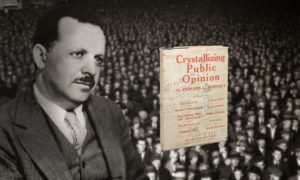
The father of propaganda: Edward Bernays

Of Ilaria Bifarini
Source: EreticaMente
“The individual makes his choices driven by irrational and uncontrolled impulses. It is the task of a minority of chosen people to guide it "as a flock of sheep should be guided"
Listed by the authoritative American magazine Life among the 100 most powerful men of the 20th century, unanimously acclaimed as the creator of consensus engineering, Edward Louis Bernays is a name unfamiliar to European audiences. Perhaps known to some curious people for his relationship with the father of psychoanalysis, of his uncle Freud, the young Louis quickly assimilates and brilliantly reworks the theory of revolutionary knowledge of the unconscious. Of Jewish and bourgeois extraction, he moved at a very young age to New York in the early twentieth century where, abandoned the pre-established path of continuing his father's business, takes his first steps in the world of journalism, to establish himself in a completely new role as a communicator for the times.
After the glories recorded by the manufacturing industry serving the war production of the First World War, the United States finds itself having to face the scariest of market specters: the risk of overproduction. The "brain storming" of illustrious bankers and influential entrepreneurs leads to finding the solution in a decisive and unequivocal way: we need to ferry the American citizen from the culture of needs to that of desires, making people eager to satisfy ever new needs, burdensome as pressing needs. The economic logic, after having enslaved the war industry to increase its own production, he thus approaches the newborn science of psychoanalysis.
Read More

Share

“Multipolar World Theory”. Towards a new Nomos of the Earth

Of Alexander Dugin
Source: Heretically
We present, courtesy of the publisher, an extensive excerpt from the book by the Russian philosopher and political scientist Alexander Dugin “Multipolar World Theory”, recently released for the types ofAGA Publishingand can be ordered at the following address:http://www.orionlibri.net/negozio/teoria-del-mondo-multpolare/.Translation of: Donato Mancuso. Curator of the work: Maurizio Murelli.
After the Second World War and the defeat of Nazi Germany and the Axis powers, a has developedbipolar systemof international relations called «Yalta system». Legally, international law continued to recognize the absolute sovereignty of all nation states but in fact fundamental decisions on central issues relating to world order and world politics were taken in only two places: a Washington e a Mosca. […] THE UNIPOLAR MOMENT
With the collapse of one of the two poles (the Soviet Union collapsed in 1991), the bipolar system has also collapsed. […] While acknowledgingde juresovereignty, the world of Yalta wasin factbuilt on the principle of the balance of two symmetrical and relatively equal hegemons. With the exit of one of the hegemons, the entire system has ceased to exist. […] From this moment, the entire structure of the world order has changed qualitatively and irreversibly. The pole led by the United States and based on liberal ideology, democratic and capitalist, it is a phenomenon that still exists and has continued to spread over the years, on a global scale, its own socioeconomic system based on democracy, on the market and on the ideology of human rights. We are therefore faced with a phenomenon that we can precisely identify asworld, and world order, unipolar. Within the unipolar world there is a single decision-making center regarding major global issues. The West and its core, the Euro-Atlantic community led by the United States, assumes the role of the sole hegemonic power. […] In the 1990s the unipolar world seemed to be a definitively consolidated reality, and some US analysts have elaborated, on this basis, the thesis of «end of the story» (Fukuyama). This thesis consisted of the idea that the world would become completely homogeneous ideologically, politically, economically and socially, and that from now on all the trials that would take place, they would no longer be a historical drama based on the clash of ideas and interests, but rather an economic competition (and relatively peaceful) between market players, similar to how the internal politics of liberal democratic regimes are constructed. As, democracy becomes global. On the planet there is only the West and its periphery, composed of the countries that gradually integrate into it. […] Therefore, according to Fukuyama, the time of national states is over and the world is close to complete and definitive integration. Humanity is transforming into a global civil society, politics gives way to economics, war gives way to trade, liberal ideology becomes the undisputed and universally recognized standard, and all peoples and cultures blend into onecruciblecosmopolitan. […] CIVILIZATION AS AN ACTOR
Huntington objects to these points from a pessimistic position. According to him, the end of the bipolar world does not automatically lead to the creation of a global and homogeneous liberal democratic world order, Therefore, history is not over and it is premature to talk about the end of conflicts and wars. The world has ceased to be bipolar, but it has become neither global nor unipolar. It has a completely new configuration characterized by new collisions and clashes, tensions and conflicts. Who, Huntington gets to the most important point of his argument: he puts forward a hypothesis that is entirely valid and still underestimated todaywho will be the actor, the main character of this future world. He calls such an actorcivilization.
This conceptual step could be considered the beginning of a completely new theory: themultipolar world theory. Huntington highlights a central element: identifies a new actor, civilization, and at the same time it speaks of the multiplicity of these actors, using this word in the plural in the title of his book –The clash«of civilizations". […] Thanks to Huntington, we obtain as a first approximation a picture of a new theory, which postulates a model within which different decision-making centers coexist at a global level in the field of international relations, and each of them corresponds to a civilization. Read More

Share

Con Notre-Dame brucia l'Europa

by Umberto Bianchi
It burns, burns and burns again…never, within living memory, fire was seen to be so strong and resistant to human technologies…And yet it is whispered that, in France, as well (at least that's how it should be...sic!) in San Pietro or at the Milanese Cathedral, quasi-infallible security systems are in operation; real micro-devices complete with sensors connected to emergency response centers... But there seems to be nothing ready here, except for a fire that had broken out hours ago and was inexplicably indomitable. Media that quietly prophesy the destruction of one of the most beautiful architectural jewels in the world, while someone tells us that this was already destroyed by a previous fire a century or so ago and skilfully rebuilt, as if this were a belated consolation to what, now more than ever, it is becoming a symbol of the bonfire of a profoundly sick West and Europe. Sick with the most insidious and disgusting form of syphilis that a civilization can know: that of do-goodism. Sick of a religiosity that is no longer such, now reduced to a pure and simple mass media phenomenon, full of beautiful words, good intentions and nothing else, that is not a lax adaptation to the vital rhythms of a prevailing economic materialism. Read More

Share

Denatality, the crucial problem

Of Roberto Pecchioli
Denatality, the crucial problem
Source: Heretically
If we ask a sample of averagely informed and well-educated citizens what the most serious problem in Italy is, we will get a remarkable variety of answers. Some will talk about immigration, many of unemployment, others of the loss of social rights, some of the decline of moral principles, of corruption and so on. Our thesis is different: the most relevant issue is the birth rate. A people who do not have children is destined to end up through biological consumption. It drags itself into selfishness, in the distrust of the future, in mental closure, in the very rejection of life. Because nature abhors a vacuum and elsewhere the demographic pressure is immense, someone, fatally, will replace us. The civilization in which we were born will disappear and Italy will become a concept of the past. They will study it in history books. This intervention has an objective: state that the empty cots are the nation's most serious and urgent problem and economic difficulties, financial and social issues in which we are struggling have aging and the consequent decrease in the population among the triggering causes. Maybe that's not entirely true, as Benito Mussolini thought, that number is power, but certainly, in a time that aspires to infinite growth, losing population is an element of profound weakness, the visible sign of decline. In the present, only arguments related to economics or interests can convince. For this reason we renounce the motion of feelings, to the appeal in favor of our civilization, to patriotism, to the need to save our nation from extinction. Our thesis is that the biological continuity of the Italian people is worthwhile, it is the best investment for the future, a big deal for each and every one. Read More

Share

The Forgers of the New Science

Of Roberto Pecchioli
The Forgers of the New Science
Source: Heretically
We know well the level of manipulation reached by contemporary culture and communication, dominated by a few giants, property of the planetary economic and financial oligarchy. Likewise, we have become convinced of the ideological falsification of the so-called human sciences, at the service of an anthropology interested in creating the new man, the fluid and generally transgender consumer. It is clear that many disciplines that deal with sensitive topics such as gender, sexuality, psychoanalysis, racial identities are the terrain of authentic evildoers who have occupied the academic level doing political activism, ideology, certainly not culture and much less science.
Nonetheless, reality surpasses fantasy; one is left speechless when reading the incredible background of an article published in the "prestigious" American magazine Gender, Place and Culture. These are dog parks, apparently innocent places where man's best friend can run around safe and happy, play and have fun. According to a study signed by Dr. Helen Wilson of a mysterious Portland Ungendering Initiative, the reality is much more sinister. Dog parks, he claims, they are places completely pervaded by an oppressive and heteropatriarchal culture aimed at violating nature, where innocent animals are oppressed as a direct reflection of sexist violence, structural in our society. Read More

Share

West, lo zoo di Babilonia

Of Roberto Pecchioli
West, lo zoo di Babilonia
Source: Heretically
The humanity of the terminal West has found its destiny, become the zoo of Babylon. A fake environment, a theme park, a lush cage where animals are prisoners in a fake forest, deprived of their natural dignity to be exposed to the amazed gaze of a paying crowd moving along established routes, between kiosks, refreshment points and gadgets. The difference with the wild animal zoo is that we become spectators of ourselves. The culture that discovered the concept of person dies for having enthusiastically accepted the zootechnical fate. From primacy over nature, from the certainty of having had the gift of reason and self-awareness to the sad future of a zoological species. Intelligent farmed beasts without the innocence of the animal, This is what we are reduced to.
Alexis de Tocqueville imagined that the idea of ​​equality would be taken to its extreme consequences, combined with the mirage of unlimited freedom, it would have eradicated every other aspiration from the human heart. Almost two centuries after the intuitions of the Norman count, the journey is complete. Freedom has been exchanged for liberation, then with desire, finally with a whim, assumed the postulate of equality as an indisputable value, Western man has set out on the most dangerous path, become a highway with no exits, that of an all-out fight against nature, its laws, its limits. He built a society of disintegration, an oxymoron of which we are witnesses, mostly unaware of the fate of mutants. Read More

Share

The future of Sovereignty

The future of SovereigntyA RELIABLE OPINION TO REFLECT ON
Of Roberto Siconolfi
Source: Heretically
The entire political-ideological movement linked to the sovereignist/populist alignment moves in a context and in a series of precise directions. Continuing along this path new questions arise, on crucial choices which can be responded to either with the dry alternative or with the affirmation of a plural ideological-political wave which despite having a very distinct central axis, contains “different” if not even “contrasting” options. As for the context,starting from the most obvious aspect, we must take note of the definitive drying up of the left political area but more precisely of Marxism. The death of Domenico Losurdo embodies a symbolic end of all "intellectually honest" Marxism with which it is still worth dealing and with which one can also find points of convergence for very concrete political battles. The same can be said for certain political subjectivities, representatives of that area. However, we must realize that Marxism is completely finished, and not for reasons of who knows what historical significance. It has reached its lowest point, the “0” of its descending parable.
The new era, the new millennium, the possibility of looking with a broad historical perspective must bring, and already brings, for those who haven't noticed, to the affirmation or rather the "return" of completely different principles and values ​​that would be more appropriate to define as "spiritual". The inconsistency and "desolation" of the "materialist" and "economist" proposal of Marxism is very little in comparison and is no longer even felt. It is no coincidence that these war remnants of intellectuals, various groups and small groups, they no longer know what to do with the current phase. The worst of them bark fascist and racist, the best present us with the usual pappardelle about socialist revolutions, with the "economy at the center of everything" and the "class struggle" as the engine of historical changes. (…) Read More

Share

The future of Sovereignty

Of Roberto Siconolfi
The future of Sovereignty
Source: Heretically
The entire political-ideological movement linked to the sovereignist/populist alignment moves in a context and in a series of precise directions. Continuing along this path new questions arise, on crucial choices which can be responded to either with the dry alternative or with the affirmation of a plural ideological-political wave which despite having a very distinct central axis, contains “different” if not even “contrasting” options. As for the context,starting from the most obvious aspect, we must take note of the definitive drying up of the left political area but more precisely of Marxism. The death of Domenico Losurdo embodies a symbolic end of all "intellectually honest" Marxism with which it is still worth dealing and with which one can also find points of convergence for very concrete political battles. The same can be said for certain political subjectivities, representatives of that area. However, we must realize that Marxism is completely finished, and not for reasons of who knows what historical significance. It has reached its lowest point, the “0” of its descending parable. Read More

Share

Genoa Bridge, Diciotti ship: the story runs…

Of Roberto Pecchioli
Genoa Bridge, Diciotti ship: the story runs…
Source: Heretically
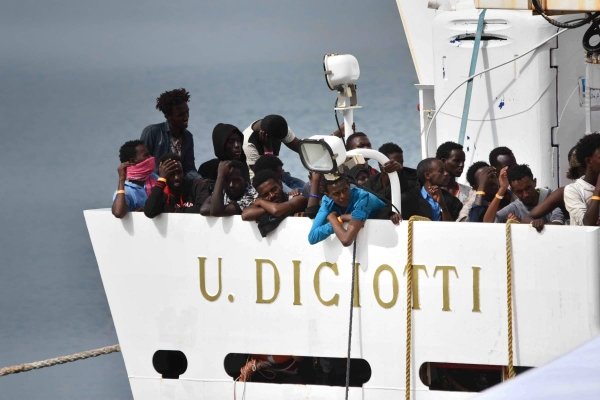
The story runs. There are times when everything seems to stop, others where the movement seems to precede time and escape understanding. The last few weeks, in full August holidays, they produced a profound acceleration, left a significant mark, marked a before and an after. Little will be as before in the common opinion after the collapse of the Morandi Bridge in Genoa and the affair of the Diciotti ship of our Navy. The facts are known. In the first case, a bridge built by themselves 50 years, only means of communication between the two parts of Liguria, leaning towards France, breaks and leaves on the ground, after a scary flight, over forty victims, six hundred displaced people, since that motorway structure, managed by the private Benetton group, it rested directly above a working-class neighborhood of the city and threatens to deal a mortal blow to the economy of a region that thrives on tourism and transport logistics. In the second, an Italian ship cruising in the Mediterranean collected approx 180 Eritreans who, upon arrival in Catania, they were not disembarked for health reasons, public safety and to give a further signal of change in national politics in the face of the invasion of fake refugees coming from Africa with the help of private boats ( the so-called Non-Governmental Organizations) financed by those who organize human trafficking under the cover of humanitarian reasons. Following the events in Catania, the current Interior Minister is under investigation for kidnapping, abuse of office and illegal arrest. Marcello Veneziani titled one of his masterful speeches "defending Italians is a crime".
The largest opposition party, the PD cornerstone of the system from 25 years under different names, has mobilized its leaders in Catania in favor of foreigners, but he was conspicuous by his absence in Genoa in the face of the tragedy of a large Italian city which, incidentally, he has been debating for more than that 40 years, like PCI before, PDS, DS and PD then. The few representatives seen at the funeral were greeted by impressive salvos of boos, which left the poor girl in shock (so to speak) MP Pinotti, charming party lady in the city, former Minister of Defense, therefore directly responsible for years of the movements of the Navy in the waters of the southern Mediterranean. An observer of Professor Meluzzi's caliber, former politician, he thundered against the de facto alliance between media power (all on the side of the old system), the technological apparatus of domination (the world of the internet, of Facebook, Google, Silicon Valley) and financial oligarchies. He forgot, for Italy, the lump of judicial power that has kept politics in check for a quarter of a century, actively trying not only to influence general choices, but even to rewrite the history of the nation of the last 75 years. Read More

Share

Because international organizations like migration so much?

Of Ilaria Bifarini
Because international organizations like migration so much?
Source: Heretically
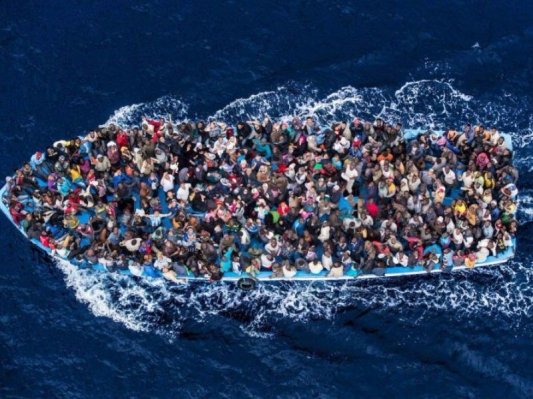
“Migration can benefit everyone in building more inclusive and sustainable societies. Globally, the number of international migrants has reached approx 258 million in 2017, compared to 173 million of 2000. Migration contributes to inclusive and sustainable economic growth and development in both countries of origin and destination. In the 2017, remittance flows to low- and middle-income countries have reached $ 466 billion, more than three times the amount of APS (Public development aid) received in the same year. Remittances constitute a significant source of family income, improving the situation of families and communities through investments in education, healthcare, sanitation services, housing and infrastructure. Destination countries also benefit, as migrants often fill job gaps, they create jobs as entrepreneurs and pay taxes and social security contributions. Overcoming adversity, many migrants become the most dynamic members of society, contributing to the development of science and technology and enriching their host communities through cultural diversity.”
This is what we read in the Agenda 2030 for Sustainable Development of the United Nations, a firma del cinese Liu Zhenmin, UN Under-Secretary-General for Economic and Social Affairs. So, compared to 2000 the number of people who left their country of birth and now live in other countries increased by approximately 50% percent (il 49% to be precise) with a continuous growth trend. Beyond the optimistic and unrealistic tones used in the programmatic document, we can extrapolate the presumed economic model of development supported by the proponents of current migrations, That, unlike the past ones, have reached massive levels and are following new directions. Triggering a hypothesized virtuous circle of growth would be, on the one hand, the supply of labor by migrants for unsatisfied requests from local workers, on the other, the flow of money sent to the countries of origin, which would be used not only to alleviate family poverty, but for productive investments in the national economic fabric. A virtuous model and a harbinger of growth, accompanied by a happy coexistence, almost symbiotic, between migrants and citizens of the host country. Read More

Share
1 2