

 The War of the 7 years to our savings.
Of Bagnai tree
In the my last contribution to Radio Me too you will have heard me claim to have noticed the problems of the banks a little before those who are now tearing their clothes (the “spread predictions”, as @lemasabachtani calls them on Twitter).
This applies to bail-in (That I reported to my readers shortly before its approval) and it applies to a pre-existing problem, bank bad debts (which you also see called NPL: non-performing loans), whose growth is due to austerity, today recognized by the Abi and by other posthumous mainstream priests, it was foreseen by me in first of many QEDs on the blog.
Appreciate the honesty of the web, which allows those who have seen before (predicted) to prove it, putting those who had the obligation to be foresighted and vigilant faced with the shame of their own non-compliance: if a "provincial professor" like me came along, because there were no institutions with prestigious study centers and analysts?
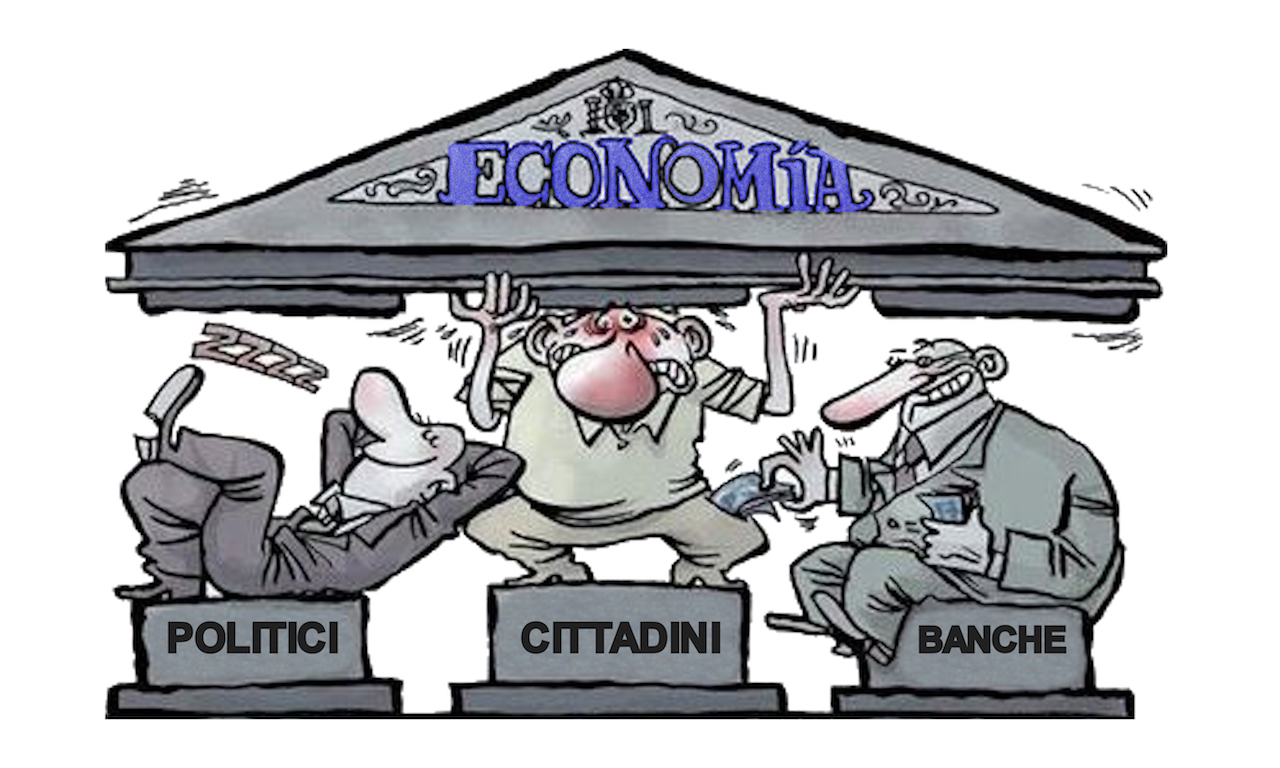
A piece of the answer, Perhaps, it is in the fact that the two themes (the expropriation of savers and the deterioration of loans) they are not untied. In particular, the expropriation of savers caused a wave of banking panic which forced banks to "dispose of bad debts" at sale prices to raise liquidity, thus suffering heavy losses, far higher than those envisaged due to the spread, for the simple reason that banks have more credits in their portfolio than securities. (for the nerds: loans are beyond 2300 billion, public securities less than 380).
In the most egregious cases (on which he will focus, I hope, the commission of inquiry which will be approved by the Senate in about ten days, after having been approved in the drafting stage by the VI Commission) the prices at which the banks sold the doubtful loans to the recovery "specialists" were absolutely incredible.
The buyers, Therefore, they made us nice profit margins. If the bank sells credits for a value of 100 at the price of 17, and whoever buys the credit manages to recover 34 (approximately one third of the initial value of the credit), the bank lost 83% (he lent 100 and it comes back 17) but the buyer of the credits earned the money 100% (doubling from 17 a 34).
Recover the 30% of a credit, even in case of problems, it is not a utopian perspective (we are talking about credits mostly "assisted" by real guarantees, that is, from mortgages on properties) and therefore no institution would have sold them at such a low price if it had not been for the urgency caused by the "early" bail-in in November 2015.
This, which has a name (“salvabanche” decree, because it's not enough for the piddini to ruin you: They also have to take you for a ride!) and surnames (Read, Saccomanni, Renzi, Padoan,…) it was the real carnage for the Italian banking system, not the spread of the last six months.
Ma, naturally, like all stories where someone earns a lot, it's difficult to find someone who can tell you about it well: those paid not to understand it prevail.
It does, with extensive use of official sources, one of my readers in this thread which I advise you not to read: it might happen that you understand what has happened, and you could be seized by an uncontainable disdain towards the spread mourners and the executioners (data) of our banks.
Sometimes ignorance makes you less unhappy, and this is one of those…
(Read the rest – many tables – on StartMag: https://www.startmag.it/economia/bagnai-guerra-risparmio-banche/ )
