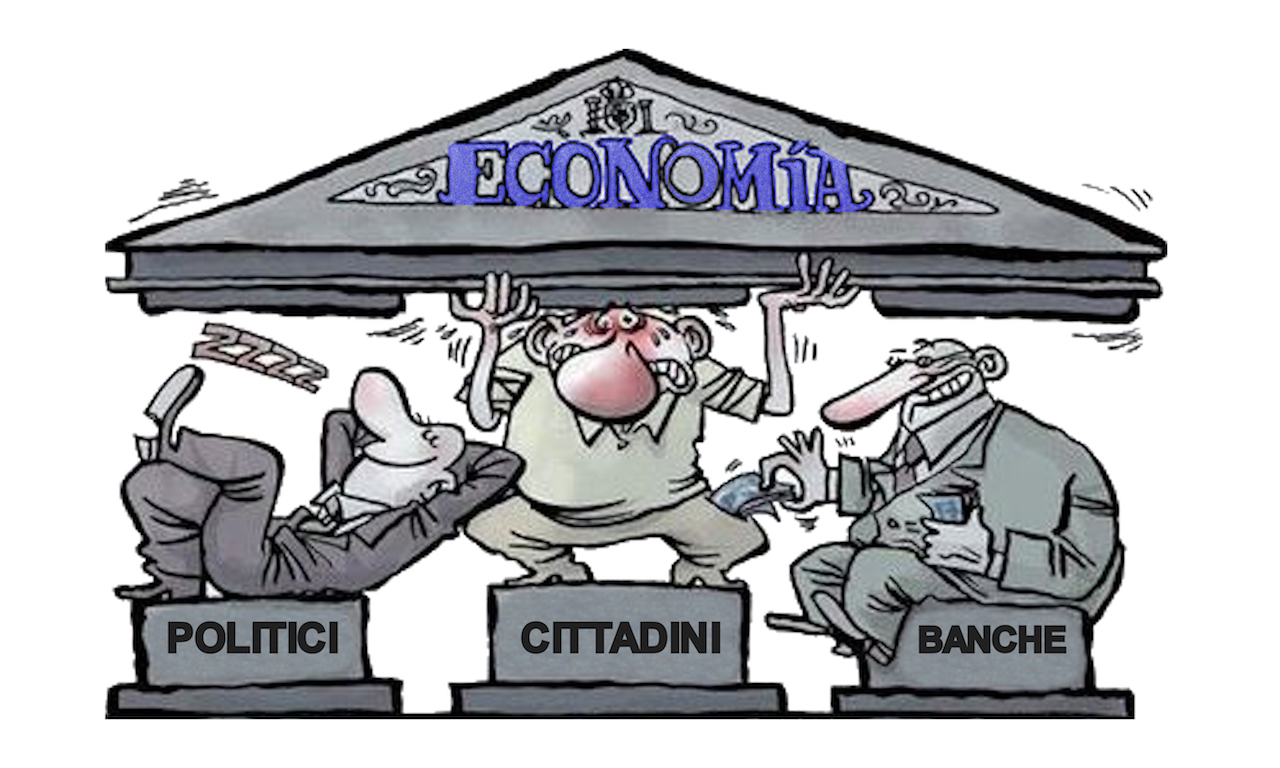
Euro: twenty years of trouble. He knocked out businesses and made a fortune in the world of high finance
Euro: twenty years of trouble. He knocked out businesses and made a fortune in the world of high finance
The euro has been a disaster for Southern European countries and in particular for Italy, but not so much - as we often hear - because it did not allow for devaluation as in the days of the Lira. In reality, the euro was and is a mechanism for inflating the credit and debt of families and businesses and then also of states and banks. The proof is that in the years of the common currency the indebtedness of the economy as a whole exploded, to the point that the repayment of the debt and interest (overall, by families, businesses, State) he arrived at 70% of GDP! This is the real reason why the euro system caused economic stagnation in much of Europe and depression in Italy.
Read More

Share

What does Alberto Bagnai think (League) of maneuver, European rules and France

Here is the intervention at Palazzo Madama by Alberto Bagnai, president of the Senate Finance and Treasury Committee, economist and senator of the League, on the maneuver
«A balance of 2,4% it would have been great in terms of sustainability. What bothers Europe is that we now have less subordination". As Alberto Bagnai, president of the Senate Finance and Treasury Committee, as well as the economic mind of the League, spoke in the Chamber of Palazzo Madama on the government's maneuver.
After negotiations with Brussels, the deficit/GDP ratio, initially set by the executive at 2,4%, was leveled to the 2,04%. A move that the opposition branded as a reverse. The majority, from the mouth of one of its most authoritative exponents in the economic field, he counterattacked.
Two targets were chosen by the economist and Northern League senator: Europe itself and previous governments, judged to be subservient to Brussels.
Read More

Share

Italy's problem is not debt but interest


by Paolo Becchi and Giovanni Zibordi on Libero, 27/12/2018


The purpose of this article is to compare the much ado about nothing of current economic maneuvers, with those of the past, when the Italian government allowed the economy to really function, thanks to the fact that he kept taxes low and made public investments.
The current financial maneuver is perplexing from an economic point of view because in the end the result from that point of view is practically irrelevant. That is to say, it is not built with the growth of the country in mind. Over the last ten years, the Italian economy has lost 9% of GDP, with the recession of 2008/9 and then that of 2012, a loss that he only recovered in a small part. And the new maneuver, in its latest formulation, it does not indicate a concrete change of direction. In short, it was supposed to be an expansive maneuver and instead it isn't.
Read More

Share

For those who say the EU makes us stronger

FOR THOSE WHO SAY: “THE EU MAKES US MORE’ STRONG

Ashoka Fashion “Dal 2007 Korean companies have caught up with Germany in number of patents. They now register almost double the number that their German counterparts, thanks to enormous investments in education and research. @AshokaMody “The reality is that the E.U, applying the Germanic policies of deflation and austerity, it is causing the entire continent to move backwards also on a technological level and...

Read all.

source – https://www.maurizioblondet.it/per-quelli-che-dicono-la-ue-ci-rende-piu-forti/

Share

Franco-German crafty people

by Pietro Ferrari
SOVEREIGNIST LAMENTATIONS

Let us remember well that entry into the’ euro was the business card that the post-communist left had to show to the financial elite. We couldn't stay there but they wanted to let us in at all costs. L’ we have paid and are paying very dearly for it.
First problem: the euro is a foreign currency but the lira was also owned by private monopolists.
Second problem: the euro is one “colonial currency” like the lira because it cannot directly buy oil.
If Europe were sovereign not only would it have a public currency but it would have had people like Renzi and Macron as anti-Europeans.

Read More

Share

Monti (him himself) accuses the government of having ceded national sovereignty

MontiRoma, 21 Dec – This afternoon on maxi-amendment to the maneuver will be presented by the government in the Senate and then placed question of trust. The calendar voted by majority, without the approval of the opposition, expects the debate to begin immediately in the Chamber, bypassing the vote of the Budget Committee.
This failure to pass - obviously dictated by the rush to present the budget law within the deadlines established by the EU - has sent the opposition into a rage.
So much so that the "resurrected" Mario Monti he had the opportunity to accuse the yellow-green majority. “The sovereignist government has given in, in a clumsy way, to Europe a share of its national sovereignty: took it away from Parliament", accused the former first, he is the one who knows much more about the transfer of sovereignty than others. We are at a paradox, In short. Read More

Share

COMPLAINT FILED WITH THE PUBLIC PROSECUTOR'S OFFICE OF ORISTANO

Today (24/9/2018), also driven by the umpteenth disappointment felt in hearing Conte's words at the Ambrosetti Forum in Cernobbio (see my post from 11 September), I have filed a complaint with the Oristano Public Prosecutor's Office with a brief description of the incredible consequences and suffering caused in Civil Society by the fraudulent debt monetary issue by a private banking system which passes itself off as the owner of the value of the currency without having title. Read More

Share

Let's go back to the lira, S. also says it&P

Of Paolo Becchi e Giovanni Zibordi
Let's go back to the lira, S. also says it&P
Source: Paolo Becchi
We want to say it clearly: the Italian State is a victim of usury. Interest accumulates on interest and increases the debt even if you no longer go into debt. And 25 years the State has not or rather would not need to go into debt because it collects more taxes than it spends: in the last year or so 30 billions in taxes more than expenses, but it results in a deficit of approx 40 billion a year because it pays approximately 70 billion per year in interest. This has been happening since the early 1990s: the state has since paid 2.500 billions in interest, more than the debt. The State has a debt of approximately 2.360 billion even if from 25 years he has not gone into debt because he has paid well 2.500 billions in interest since the early 1990s. This is a classic case of wear and tear, the increase in debt due only to the accumulation of interest over time and which becomes impossible to repay because the interest is too high.
The increase in the spread is a phenomenon of usury to the detriment of the State. Here's why. Read More

Share

I'll explain the real carnage for the Italian banking system

Image results for Italian banking system carnageThe War of the 7 years to our savings.

Of Bagnai tree
In the my last contribution to Radio Me too you will have heard me claim to have noticed the problems of the banks a little before those who are now tearing their clothes (the “spread predictions”, as @lemasabachtani calls them on Twitter).
This applies to bail-in (That I reported to my readers shortly before its approval) and it applies to a pre-existing problem, bank bad debts (which you also see called NPL: non-performing loans), whose growth is due to austerity, today recognized by the Abi and by other posthumous mainstream priests, it was foreseen by me in first of many QEDs on the blog.
Appreciate the honesty of the web, which allows those who have seen before (predicted) to prove it, putting those who had the obligation to be foresighted and vigilant faced with the shame of their own non-compliance: if a "provincial professor" like me came along, because there were no institutions with prestigious study centers and analysts? Read More

Share
1 2 3 4 5 6