

 Reporting of Federici Studies Center
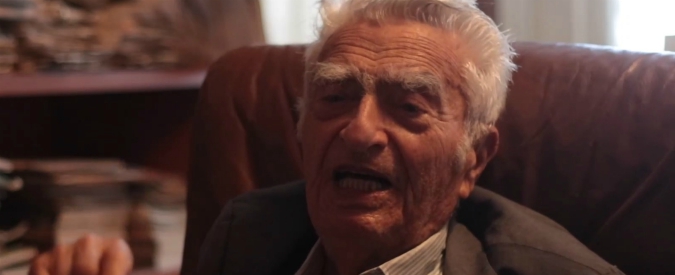
We report an interview that Bruno Segre released to the newspaper “La Stampa” for his hundredth birthday. The errors of secularism and anticlericalism emerge in the responses in a transversal way (like the Masonic sects that have always professed and spread these errors) they are present in the programs of several Italian parties, from far left to far right.
They are the errors that fought and overthrew the social kingdom of Christ, the only reference that a Catholic should have in the political and social sphere. In the interview Segre defends the divorce, euthanasia and civil unions, accuses the Catholic Church of "inadmissible privileges" and hopes for an increasingly stronger public school system (against denominational schools). The lawyer ends the meeting with a petty blasphemous expression. Our wish for him is to get on the right side at least in the last days of his life, to avoid the eternal mortal embrace with that Satan who, in his long life, he contributed to reigning in the Italian state.
Bruno Segre: “My battles for rights in Turin with a thousand faces”. One hundred years of the lawyer, a life of political and civil commitment (interview by Alberto Sinigaglia, The Press of 3/9/2018, pag. 25)
He interviewed Magnani and Totò, Josephine Baker naked and the "teacher with the red pen" dressed: Bruno Segre dreamed of being a journalist, it seemed like a good job to him. But he chose to be a lawyer and was the first to defend a conscientious objector. He started in 1949 twenty years of battles that would have established that right. Then, alongside Loris Fortuna, worked towards the introduction of divorce. Tomorrow he turns one hundred years of a high intensity life: friendship with Natalia Ginzburg in high school, the meetings with Pavese, graduating with Luigi Einaudi, the humiliations of the racial laws, anti-fascism, two arrests, the escape, the bullet stopped by the cigarette case, prison in the political slaughterhouse in Via Asti, free thought as faith and mission. How many things he has seen change? Energetic and lucid, it starts from Turin, where he was a municipal councilor elected in 1975 in the ranks of the PSI, when eighteen-year-olds voted for the first time. Objectives achieved: September Music, Green dots, Summer guys. Dreamed goals: two subway lines.
What has changed the most in a century: the sky, the people, the breadsticks?
«The faces. For two waves of migrants: over the years 60 thousands of unskilled workers, suitcases with rope, “You don't rent to southerners”, scenes from Furore by Steinbeck. Forty years later, Chinese, Romanians, Albanians, Africans. The population decreased by one million 200 thousand a 900 mila, the fast-food restaurants of dietary malfeasance have grown".
And the character of the Turin people?
«From traditional confidentiality we have moved on to a certain expansiveness, to a freedom of customs incomparable with the long skirts and long courtships of the past. Today women have the initiative, men must defend themselves. Before there was more virility, a much more accentuated sexual impulse, this is demonstrated by the reduction in the number of births".
The most obvious social changes?
«The no longer conservative and reactionary attitude of a large part of the bourgeoisie. The proletariat disappeared, the nobility, the monarchists. End of the dialect: you no longer hear healthy "waxy". The custom of taking off one's hat has disappeared".
The worst defects of Turin today?
«A ruling class ended up on trial. Elected characters who are too attentive to their own gain. A municipal administration looking for consensus. The organized left has almost disappeared. The inadmissible privileges of the Catholic Church".
There remains something of anti-fascism, of the Resistance, of the post-war spirit?
«Few survivors remembered only in obituaries, associations with little money, road plaques for the fallen, stumbling blocks".
The strongest memories of his battles?
«The trial of the first conscientious objector Pietro Pinna before the Military Tribunal. When during the divorce campaign I rented a plane that dropped posters over Turin: “Divorce does not come from heaven but from Loris Fortuna's project which tonight at 18 will speak to you at the Gobetti Theater”. It was a memorable success. My rallies at the Carignano Theater and at the Roman Cinema, the processions, the flyering, the booing of Fanfani at the Alfieri Theatre".
Some doctors use the law on freedom of conscience to deny other citizens the freedom to have an abortion. What do you think??
«That freedom of conscience applies to everyone. We must also admit it for Catholic doctors, although in cases of absolute emergency the Hippocratic Oath should prevail".
What battle would he face tomorrow?
«Fundamental battles for democracy in Italy remain: euthanasia; the modification of the extinguishing provisions of crimes; the abolition of the unfortunate Gozzini law for excessive licenses for prisoners; the inadmissible legal recognition of the children of two fathers and two mothers; the reform of the Armed Forces, reducing the absurd number of officers compared to soldiers; the defense of public schools".
How to experience the sense of time at one hundred years old?
«Time strengthens serenity, the cult of one's ideals".
Think about death?
«I'm not afraid of it. It's a law of nature. Nature is the most beautiful thing in the world: the intelligent design that regulates the universe".
She doesn't believe in God. But what if it existed, the day she happened to meet him, after all he has done he would expect a blessing, a pre mio?
«It would only happen if you suffered from arteriosclerosis. If it really happened, silence. “Only silence is great – said De Vigny – everything else is weakness".
