A while ago, as soon as published, we highlighted the latest book written by Prof. Enrico Maria Radaelli:
At the heart of Ratzinger. At the heart of the world, accompanying the report with an introductory note which we invite the reader to review.
The book raises a question of no small importance: the actual doctrinal orthodoxy of Prof. Joseph Ratzinger, theological expert at the Second Vatican Council, professor of dogmatic theology at the University of Tübingen and the University of Regensburg; archbishop of Munich and Freising; Cardinal Prefect of the Congregation for the Doctrine of the Faith; president of the preparatory commission of the new Catechism of the Catholic Church; Papa.
A prelate of no small importance, Therefore, which strongly marked the last ones 50 years of the history of the Church: finally the unprecedented or unheard of gesture of renouncing the Papacy despite wanting to remain Pope, Pope emeritus.
With the arrival of Pope Bergoglio and his equally unprecedented and casual management of the Papacy, Pope Ratzinger's admirers continue to make themselves heard who, in the face of the suspected heresies of the reigning Pope, they regret the supposedly more orthodox defeatist Pope. Well, the study conducted by Prof. Radaelli raises the problem regarding this supposed orthodoxy of Joseph Ratzinger and the result is a far from flattering picture of the Catholic faith nourished and taught throughout his life by the acclaimed German theologian.
It is not the first time that well-founded doubts have been raised about the real Catholic orthodoxy of Joseph Ratzinger and on this site they can be found, looking for them, several articles on the subject, but this study by Prof. Radaelli presents a complex and documented picture that is worth knowing and studying further, if only to better understand the doctrinal drift that afflicts the Catholic Church since 50 years and which looms in the future with worsening elements that dismay the faithful and leave them dumbfounded: Radaelli's pages will be able to help them shed light on the issue.
To this end, The note we are publishing now could be a valid introduction, written by Prof. himself. Radaelli and summarizing the central points of the discrepancy between the thousand-year-old teaching of the Catholic Church and the modern thought of the still living Cardinal Ratzinger.
Radaelli is right, the fraternal reminder he proposes may be useful, not only to the faithful, but equally interested "Pope Emeritus", that he would still have time to retract, at least in his heart, the errors taught and preached, to be able to present himself amended in the presence of the Archangel who, when the time comes, he will weigh his soul and evaluate its "heaviness".
****************************************************************************************************
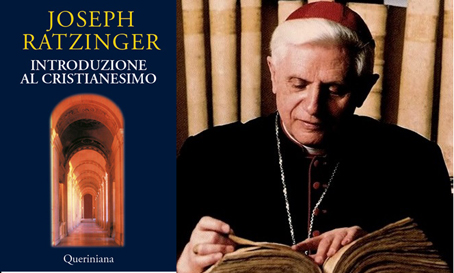
Here we want to offer at least five of the numerous examples of total irreconcilability, on the one hand, of the teachings of the Holy Scriptures and Dogmas of the Church, on the other, of the teachings expounded by Joseph Ratzinger when he was professor of Theology in Tübingen, in one of his famous books 1968, Introduction to Christianity, still today the true and only paradigm of his thought, sold for fifty years all over the world, never denied, indeed confirmed in 2000 from a new introductory essay written by its own author, at the time Prefect of the Sacred Congregation for the Doctrine of the Faith, e, in its dorsal line, reiterated by him again in an interview published in L'Osservatore Romano on 17-3-16, so only two years ago, three years after his renunciation of the Papacy. The book is therefore still very current.
It constitutes the object of my analysis
At the heart of Ratzinger. At the heart of the world, for the manuscript, Golden House, Milan November 2017, pp. 370, available in Ancora bookstores (Milan and Rome), Coletti (Roma), Hoepli (Milano), Leoniana (Roma), as well as on the Aurea Domus website.
We also want to reassure the reader of the broader contextualization, in this work of mine, of quotes from Ratzingerian thought, so as to be able to guarantee the scholar the greatest help in grasping those pages, moreover, their meaning is not always clear.
The maximum diffusion of At the Heart of Ratzinger is considered urgent. At the heart of the world so that it is clear that the undersigned, being able to start working on it only from September of 2015, he did everything to arrive in time to try - at least to try - to convince the eminent and gentle Author of Introduction to Christianity of the need to reflect on all those assumptions of his before it is too late.
In this critical study of mine I also deliberately proposed four paragraphs (dal § 76 al § 79) in which I also wanted to expose for the reader's appreciation five beautiful thoughts of the Professor whose presence, even in the ocean of the most reprehensible doctrines that are off track, allows us to understand how free my book is from any apriorism, if not dictated by the divine and above all Norma normans of the Logos.
These are the five examples.
First example.
In the 2005, recently ascended to the papacy with the name of Benedict XVI, the former Professor Joseph Ratzinger taught that God "remains the best hypothesis, although it is a hypothesis" (Joseph Ratzinger, Benedict's Europe in the crisis of cultures, Cantagalli, Siena 2005, p. 123).
But saying that God is "the best hypothesis" still means basing faith in God - credeDeum - on a hypothesis, even if it's the best, that is, on a doubt, which however means basing it on a human act: it is man who hypothesizes the existence of God, he is the man who, in his mind, “produces God”.
But faith is knowledge by testimony, and the testimony is that of Christ, what he says, proclaims and affirms: « No one has ever seen God: the only begotten Son, who is in the bosom of the Father, he revealed it » (Gv 1,18).
Note that this dramatically errant thought of the more recent Ratzinger, which confirms how we must try to correct its underlying fideism, it was possible to gather it precisely from those who believed, with the unexpected quotation of those words of his, to defend him from my words (v.
http://magister.blogautore.espresso.repubblica.it/2018/01/04/ Joseph Ratzinger theologian. Not “modernist” but modern).
In the first seventy-three pages of his book Professor Ratzinger, thirty-two years earlier, had already drawn up the founding concept of his "hypothetical" faith, and he had knocked him out with multiple and always very dramatic expressions, of which only the three most exemplary and poignant are reported here:
« …the believer can live his faith only and always hovering on the ocean of nothingness, of temptation and doubt, finding himself assigned the sea of uncertainty as the only possible place of his faith,… » (Introduction to Christianity, p. 37);
« It is the fundamental structure of human destiny to be able to find the definitive dimension of existence solely in this interminable rivalry between doubt and faith, between temptation and certainty » (Introduction to Christianity, p. 39);
« The believer will always experience the dark darkness in which the contradiction of disbelief envelops him, chaining him as if in a dark prison from which it is impossible to escape,… » (Introduction to Christianity, p. 73).
But Jesus, about the certainty and solidity of faith, he tells us: " …And you, once reformed, confirm your brothers » (Lc 22,32); « I am the way, truth and life » (Gv 14,6), e: "Blessed are those who have not seen and yet believe" (Gv 20,29).
And Saint Paul reminds us that "what can be known about God is manifest to them [it is manifest to men]; God himself showed it to them. Indeed, from the creation of the world onwards, his invisible perfections can be contemplated with the intellect in the works he has accomplished, as his eternal power and divinity; they are therefore inexcusable, Why, despite knowing God, they did not give him glory or give thanks to him as to God, but they became delusional in their reasoning and their dull minds were darkened." (Rm 1,19-22).
Conclusion: "Without faith it is impossible to please God" (Eb 11,6). The Church dogmatises on such inerrant Scriptures (with assertion to which de fide obedience is due): « Dio, beginning and end of everything, can be known with certainty through the natural light of human reason starting from created things" (Vatican I, Cost. dogma. Son of God, cap. 2, Denz 3004).
Here we must open a general parenthesis which allows us to note how Professor Ratzinger's initial postulate is very general, according to which: « …the believer can live his faith only and always hovering on the ocean of nothingness, of temptation and doubt », nullifies the entire book as well as itself, as it is circularly contradictory. If indeed, on principle, everything is uncertain, then it will be uncertain, on principle, even the postulate itself, which therefore could be false, and they will still be uncertain, Perhaps <>false, on principle, all the propositions of the book e, At that time, what's the point of not just writing it, but also read it? (v., in At the heart of Ratzinger. At the heart of the world, i §§ 11-21 on Socratic doubt, Right, and on the skeptical one, to be rejected, pp. 51-82).
Second example.
In an interview with 2016 a Jacques Servais s.j., published in the Osservatore Romano, the august Theologian, already Pope, returned cardinal despite rejecting the qualification, he reconfirmed the backbone of his book by reiterating his conviction that Redemption as 'reparation for the "infinite offense done to God"' is only a medieval doctrine: a due doctrine, according to him, solely to a bishop, otherwise holy, Bishop Anselmo of Aosta, whose "iron logic" remains "hardly acceptable to modern man", thus maintaining unchanged the thought formulated fifty years earlier in Introduction to Christianity, for whom it "appears to us as a cruel mechanism that is increasingly unacceptable to us" (Introduction to Christianity, p. 221).
But Jesus himself speaks of "God's wrath": « Whoever refuses to believe in the Son will not see life, but the wrath of God remains on him." (Gv 3,36); what anger? because anger? The Creator's wrath for sin <>of his creature; and Saint Paul clarifies: « When we were enemies, we have been reconciled to God through the death of his Son" (Rm 5,10): enemies for the sin of man, that Christ's death by bloody Holocaust redeems.
Indeed: « All of us too, ...we were by nature children of wrath" (Ef 2,3); “by nature” due to the original sin transfused into us by Adam.
And the Apostle (God through the Apostle) it gets worse: « And you, that you were already strangers and enemies in your minds and in your evil works, now God has reconciled you in His body of flesh, through His death" (Col 1,21-2); to which Giovanni is added, the beloved Apostle (that is, always God through this time the beloved Apostle): « In this the love of God towards us was manifested: that God [Padre] he sent his only begotten Son into the world, … This is love: not that we loved God, but that God loved us and sent his Son to be the expiation for our sins." (I Gv 4,9-10).
On such inerrant scriptural grounds, dogma orders (Council of Trent, Denz 1743 e 1753) that the Church professes the doctrine of Redemption as a Holocaust of Christ to the Father, and in At the heart of Ratzinger. At the heart of the world (§§ 40-3, pp. 155-72) the entire history of dogma in this regard has been covered, which demands that it be obeyed, accepted, believed and celebrated precisely what Professor Ratzinger rejects.
Third example.
Professor Ratzinger states: « God is and will always be essentially invisible to man... God is essentially invisible » (Introduction to Christianity, p. 42); and again: «in the Old Testament this statement – that “God does not appear and never will appear to man” – takes on the value of a principle: God is not only the one who is now effectively out of our field of vision...; no, he is instead the one who essentially stands outside it[Author's marking], independently of all the possible and conceivable enlargements of our field of vision » (Introduction to Christianity, pp. 42-3).
But the Christ of Himself says: « Whoever sees me sees Him who sent me » (Gv 12,45); "Whoever sees me sees the Father" (Gv 14,9); and the beloved Apostle affirms (that is, God in him): « [Dio] we will see him as He is" (I Gv 3,2).
And Saint Paul specifies: « He is the image of the invisible God » (II Cor 4,4, but also Col 1,15), and again: " They [the Christ] it is the mirror of the glory of God and the imprint of his substance" (Ebr 1,3), which means that God the Father is perfectly visible in the Son, and this is enough for the Church to affirm - contrary to what it teaches, p. es., as well as Professor Ratzinger, the notion <>Mohammedanism – the perfect visibility of God to the Blessed, so called precisely because they enjoy divine vision (see, in At the heart of Ratzinger. At the heart of the world, il
§ 18, pp. 70-4).
Fourth example.
Professor Ratzinger maintains that man, in the bliss of Paradise, « will live in the memory of God » (Introduction to Christianity, p. 343), and specifies that «Paul teaches – let us repeat it once again – not the resurrection of the body (Body), but of people, and this not in the return of the 'bodies of flesh', that is, biological structures, which he explicitly indicates as impossible" (Introduction to Christianity, p. 347).
Ma i Vangeli, talking about the meeting between the risen Jesus and the Apostles, instead they notice that: « because they found it hard to believe and were full of wonder, [Jesus] he asked them: “You have nothing to eat?” They gave him a piece of roasted fish and a honeycomb. And after eating in front of them, He took the leftovers and gave them to them." (Lc 24,41-3).
Not to mention the famous episode of Gv 20,27: « Put your finger here and look at my hands! Bring your hand closer and place it in my side! »,
da cui si evince che un corpo glorioso non è per questo meno carnale di un corpo mortale;
e san Paolo,
da qui, sign:
« E se lo Spirito di colui che ha risuscitato Gesù dai morti abita in voi,
colui che ha risuscitato Cristo dai morti darà la vita anche ai vostri corpi mortali per mezzo del suo Spirito che abita in voi » (Rm 8,10-1).
Here too,
sulla base di tali chiarissime e univoche risultanze poste dalle Sacre Scritture,
la Chiesa così dogmatizza:
« Tutti risorgeranno coi corpi di cui ora sono rivestiti » (
Concilio Laterano IV, 1215,
Definizione contro gli Albigesi e i Catari, Denz 801), (see, in At the heart of Ratzinger. At the heart of the world, i §§ 50-2, pp. 196-213,
in cui l’inconciliabile opposizione tra l’insegnamento della dottrina cattolica e quello del Professor Ratzinger è evidenziata anche da plurime altre argomentazioni e scritturali e dogmatiche).
Fifth example.
Professor Ratzinger maintains that "the doctrine of the divinity of Jesus would not be affected if Jesus had been born of a human marriage" (Introduction to Christianity, p. 265), Indeed, in his opinion, the divine sonship of Jesus "is not a process that occurred over time, but in the eternity of God" (Introduction to Christianity, pp. 265-6).
But the Evangelist (Mt 1,18-26) writes: « This is how the birth of Jesus Christ came about: his mother Maria, being betrothed to Joseph », 'betrothed', dice, not 'wife': 'wife' is the one who, with the spouse, he lost his virginity; 'bride' on the other hand is the woman who, united in marriage, he has not yet completed the wedding; "before they moved in together": the Evangelist points out that what he is about to narrate precedes the moment in which the virgin Mary will marry Joseph; "she found herself pregnant by the power of the Holy Spirit", as Saint Luke reports in his Gospel (1,26-38), « Giuseppe, her husband », 'groom', here too, and not 'husband', to confirm the not yet marital status of the two engaged couples, « that it was right and he didn't want to repudiate her, he decided to repudiate her in secret », that is, not to repudiate it publicly, that is, that he would provide for Mary and her unborn child, giving them food, the clothes, a roof, but without marrying her; « But while he was thinking about these things, behold, an angel of the Lord appeared to him in a dream and said to him: “Giuseppe, son of David, don't be afraid to take Maria with you, your wife », “to take with you”, says the angel, with a chaste expression, instead of saying "get married", to indicate to Joseph how he should conduct the union with Mary "his wife": just like he thought, a "just", who therefore reasons with justice, according to the Christian discernment of spirits, as it must be who the Lord has designated to protect the Mother of His Son and His Son himself; "because what is generated in her comes from the Holy Spirit", and not by a man, thus suspending the passage of negative influences due to original sin; « ... All this happened so that what had been said by the Lord through the Prophet might be fulfilled: “Ecco, the Virgin will conceive and give birth to a son" »: note well that Saint Matthew recognizes the remote cause in the prophecy, but no less effective for this, of what was holyly happening, thus recognizing God's power: what happens now is due to the Word of God given then; in second, remembering the prophecy, underlines the basic concept: the conception of the Son of God is due, on the mother's side, to a miraculous formation of an embryo in a virgin woman who remains a virgin, therefore the Prophet calls her "Virgin" as she is one par excellence, she is “Virgin” ontologically; e, on the father's side, it is due to the Holy Spirit, for the reason stated above; then « … Joseph did as the angel of the Lord had ordered him and took his bride with him, which, without him knowing it, gave birth to a son, whom he called Jesus".
But all this is contested by Professor Ratzinger, who instead believes that:
primo, « the doctrine of the divinity of Jesus would not be affected if Jesus had been born of a human marriage »;
second, That, regarding the Gospel now seen and that of Saint Luke reported in the text, "the formula of the 'physical' divine filiation of Jesus is extremely unfortunate and ambiguous", thus accusing the Word of God, and therefore God himself, to be, describing her as “unhappy”, an inept Word, e, qualifying it as “ambiguous”, of being a false Word, and that holds in one fell swoop; (for both points, you know, in my At Ratzinger's heart. At the heart of the world, il § 71, pp. 305-19).
Conclusions.
These five examples, especially the first, with which from 1968 al 2016 the Author of Introduction to Christianity persists in doubting the existence of God, which for him «remains the best hypothesis, although it is a hypothesis", demonstrate the skeptical mind-set, historicist and fideist who originated them and who change all the articles of the Creed one by one, as I demonstrate in my At the Heart of Ratzinger. At the heart of the world, which also identifies the causes that led the Theologian of Tübingen to that problematic approach.
It is hoped that these five examples will be useful in making my discussion known to the widest possible audience of believers, so as to warn them about the doctrines taught in the Introduction, and they urge, as can be seen in my last pages, to find you soon, and with all caution, the best way to convince the illustrious Subject to believe - at least - that his book and the doctrines contained therein are no longer proposable to the Church as his profound convictions, as in his time Cardinal Dal Poggetto managed to approach the bed of Pope John XXII, to talk to him, to convince him, so as to achieve the holy goal of eliminating any danger that the golden gates would remain forever barred to him.


 Reporting of www.unavox.it