

Of Danilo Quinto
It's not suitable, both for its length, both for his intentions, to those who are in a hurry.
"Gentleman, there you are, you are enough for me". This is what he who has faith says in the face of humiliation, to discouragements, to suffering, to injustices, to the defeats he suffers on his earthly journey.
When the man who has faith feels prostrate and experiences a struggle that is unbearable for him - even humbly turning to God to ask Him for help and support – precisely then he exercises faith. In the deepest depths of his life, man's response to this state of prostration can rend and open Heaven. Make it strong against any kind of earthly event that occurs.
Jesus expresses this reality of our life with the image of “narrow door”. Dice (Lu, 13, 24): “Strive to enter through the narrow door, because many, I tell you, they will try to enter it, but they won't succeed".
Writes Josemaría Written by Balaguer in “It is Jesus who passes”, n. 75: “The Christian's struggle never stops, because in the interior life there occurs that continuous starting and starting again which prevents pride from making us consider ourselves perfect at a given moment. It is inevitable that there will be many difficulties in our journey; if we didn't find any obstacles, we would not be creatures of flesh and blood. There will always be passions ready to drag us down, and we will always have to defend ourselves from such delusions, more or less vehement".
These are the ways God leads, in the mystery, your friends.
Saint Teresa of Avila said: “Our Lord asks for and loves courageous souls, however humble. In the spiritual life we must undertake great things". She began, amidst a thousand difficulties and sacrifices, the reform of Carmel, which provided for the foundation of new convents, male and female. As, he began to travel a lot, facing hardships and hardships, despite his poor health and ailments. For the wounds on his legs, one day he turned to God, telling him: "Gentleman, after so much trouble, this trouble was needed too!”. God answered her: “Teresa, That's how I treat my friends.". She replied: “Ah, My God, Now I understand why you have so few!”.
Those few are the levers that hold the world. They are the “humiliated and offended” as Fyodor Dostoevskji called them in his almost forgotten novel. They are those who not only love Fatima - because they understand that this is the reading of this terrible century - but also want to live its spirit, in first person, like the three shepherd children, that despite not understanding anything, they trusted and obeyed the word of the Holy Virgin Mary, because within them they lived the certainty that this had to be done.
The humiliated and offended hope. Because the theological virtue of hope also exists. Charles Péguy did not speak (1873-1914). From a peasant family, He studied at the Ecole Normale in Paris, where the philosopher Henri Bergson was his teacher. For a good part of his life, he adhered to a form of personal socialism, he then approached Catholicism, which is revealed in his latest works. At the outbreak of the First World War, he volunteered and met his death in the Battle of the Marne. In the first pages of his beautiful and intense poem, “The portico of the mystery of the second virtue”, which he wrote in one of the most difficult moments of his life, describes the mystery of the theological virtue of hope. Péguy gives the word to God:
“The faith I love most, says Dio, it is hope.
Faith, no, It doesn't surprise me.
Faith is not surprising.
I shine so brightly in my creation.
In the sun and the moon and the stars.
In all my creatures.
In the stars of the firmament and in the fish of the sea.
In the universe of my creatures.
On the face of the earth and on the face of the waters.
In the movements of the stars in the sky.
In the wind that blows on the sea and in the wind that blows in the valley.
In the calm valley.
In the quiet valley.
In plants and beasts and forest beasts.
And in man.
My creature.
In peoples and in men and in kings and peoples.
In man and in his partner woman.
And especially in children.
Mie creature.
In the gaze and voice of children. Because children are more my creatures.
That men.
They have not yet been undone by life.
Of the earth.
And among all they are my servants.
First of all.
And the voice of children is purer than the voice of the wind in the calm of the valley.
In the quiet valley.
And the gaze of children is purer than the blue of the sky, of the milky white of the sky, and a ray of star in the calm night.
Now I shine so brightly in my creation.
On the face of the mountains and on the face of the plain.
In the bread and in the wine and in the man who plows and in the man who sows and in the harvest and in the grape harvest.
In the light and in the darkness.
And in the heart of man, which is what is most profound in the world.
Created.
So deep that it is impenetrable to any gaze.
Except in my eyes.
In the storm that shakes the waves and in the storm that shakes the leaves.
Of the trees in the forest.
And on the contrary in the quiet of a beautiful evening.
In the sands of the sea and in the stars that are sand in the sky.
In the threshold stone and in the hearth stone and in the altar stone.
In prayer and the sacraments.
In the homes of men and in the church which is my home on earth.
In the eagle my creature that flies on the peaks.
The golden eagle which has at least two meters of wingspan and perhaps even three.
And in the ant my creature that crawls and piles up miserably.
In the earth.
In the ant my servant.
And right into the serpent.
In the ant my servant, my lowest servant, which is difficult to accumulate, the thrifty one.
Who works like a wretch and knows no rest and knows no rest.
If not death and the long winter sleep.
(…)
I shine so brightly in all of my creation.
In the lowest, in my lowest creature, in my lowest servant, in the lowest ant.
Which hoards miserably, like man.
Like the lowest man.
And it digs tunnels in the earth.
In the underground of the earth.
To meanly amass treasures.
Thunderstorms.
Poorly.
And right into the serpent.
Who deceived the woman and therefore crawls on his belly.
And that he is my creature and that he is my servant.
the serpent that deceived the woman.
My servant.
Who deceived the man my servant.
I shine so brightly in my creation.
In everything that happens to men and peoples, and to the poor.
And also to the rich.
Who don't want to be my creatures.
And they take cover.
So as not to be my servants.
In everything that man does and undoes for bad and for good.
(And I overlook everything, because I am the lord, and I do what he has undone and I undo what he has done).
And even in the temptation of sin.
Same.
And in everything that happened to my son.
Because of man.
My creature.
That I had created.
In incorporation, in the birth and life and death of my son.
And in the holy sacrifice of the mass.
In every birth and in every life.
And in every death.
And in eternal life that will never end.
Who will conquer every death.
I shine so brightly in my creation.
That in order not to really see me these poor people would have to be blind.
Charity, says Dio, It doesn't surprise me.
Charity, no, it's not surprising.
These poor creatures are so unhappy that, unless you have a heart of stone, how they could not have charity for each other.
How could they not have charity for their brothers.
How could they not take the bread out of their mouths, everyday bread, to give it to some unhappy children who pass by.
And my son received such charity from them.
My son their brother.
Such great charity.
But hope, says Dio, hope, Yes, which surprises me.
Myself.
This is indeed surprising.
May these poor children see how things are going and believe that tomorrow will be better.
Let them see how things are going today and believe that it will be better tomorrow morning.
This is indeed surprising and is certainly the greatest wonder of our grace.
And I myself am surprised.
And it must be because my grace truly possesses incredible strength.
And because it flows from a source it is like an inexhaustible river
Since that first time it flowed and has always flowed.
In my natural and supernatural creation.
In my spiritual and carnal and still spiritual creation.
In my eternal and temporal and still eternal creation.
Mortal and immortal.
And that time, oh that time, since that time it flowed, like a river of blood, from my son's pierced side.
What must my grace and the strength of my grace be for this little hope, wavering at the breath of sin, trembling in all winds, anxious at the slightest breath,
be so invariable, remain so faithful, so erect, so pure; and invincible, and immortal, and impossible to turn off; like this little flame in the sanctuary.
Which burns eternally in the faithful lamp.
A flickering flame crossed the depths of the worlds.
A flickering flame pierced the depths of the nights.
From that first time my grace flowed for the creation of the world.
My grace has always flowed for the preservation of the world.
Since that time my son's blood flowed for the salvation of the world.
A flame that is unreachable, a flame that cannot be extinguished by the breath of death.
What surprises me, says Dio, it is hope.
And I don't know why.
This little hope that seems like a little thing.
This little hope.
Immortal.
Because my three virtues, says Dio.
The three virtues my creatures.
My daughters my girls.
They are also like my other creatures.
Of the race of men.
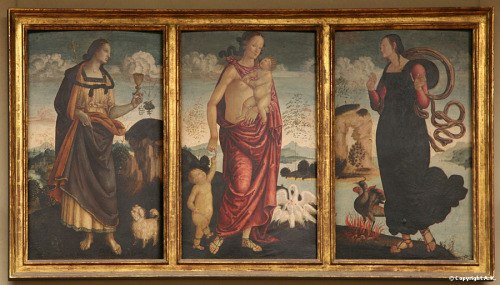
Faith is a faithful Bride.
Charity is a Mother.
An ardent mother, rich in heart.
Or an older sister who is like a mother.
Hope is an insignificant child.
Who came into the world on Christmas Day last year.
Who still plays with his father January.
With its small German fir trees covered in painted frost.
And with his ox and his donkey made of German wood. Paintings.
And with his manger full of straw that the animals don't eat.
Because they are made of wood.
But it is precisely this little girl who will cross the worlds.
This insignificant little girl.
She alone, bringing the others, that will cross the past worlds.
How the star guided the three kings from the most remote East.
Towards my son's crib.
Thus a trembling flame.
She alone will guide the Virtues and the Worlds.
A flame will pierce the eternal darkness.
(…)
Too much is forgotten, my child, that hope is a virtue, which is a theological virtue, and that of all the virtues, and of the three theological virtues, it is perhaps the one most pleasing to God.
Which is certainly the most difficult, which is perhaps the only difficult one, and which is probably the most pleasing to God.
The fed is going to be. Faith walks alone. To believe you just need to let go, just look. To not believe you would have to rape yourself, torture yourself, torment yourself, contrarsi. Get stiff. Take yourself backwards, put it backwards, go the other way around. Faith is all natural, all loose, all simple, all quiet. She comes away peacefully. And she goes away calmly. She's a good woman who knows herself, a good old woman, a good old parishioner, a good woman of the parish, an old grandmother, a good parishioner. It tells us the stories of ancient times, which happened in ancient times. Not to believe, my child, we should close our eyes and ears. So as not to see, so as not to believe.
Unfortunately, charity goes without saying. Charity walks alone. To love your neighbor you just need to let go, just look at such misery. To not love your neighbor you would have to rape yourself, torture yourself, torment yourself, contrarsi. Get stiff. Getting hurt. Get distorted, take it backwards, put it backwards. Go in reverse. Charity is all natural, all fresh, all simple, all quiet. It is the first movement of the heart. And the first movement is the good one. Charity is a mother and a sister.
For not loving your neighbor, my child, we should close our eyes and ears.
Faced with such a cry of misery.
But hope does not go without saying. Hope does not go alone. To hope, my child, you have to be very happy, you must have obtained, received a great grace.
It is faith that is easy and it is not believing that it would be impossible. It is charity that is easy and it is not loving that would be impossible. But it's hoping that's difficult
(…)
And what is easy and instinctive is to despair and that is the great temptation.
The little hope advances between the two older sisters and no one turns their gaze on her.
On the path to salvation, on the carnal path, on the bumpy road to salvation, on the endless road, on the road between her two sisters the little hope.
Keep it up.
Between the two older sisters.
The one who is married.
And the one who is a mother.
And you don't pay attention, the Christian people only pay attention to the two older sisters.
The first and the last.
Who take care of the most urgent things.
In the present time.
To the momentary moment that passes.
The Christian people only see the two older sisters, he has eyes only for his two older sisters.
The one on the right and the one on the left.
And he almost doesn't see what's in the center.
The little one, the one who still goes to school.
And he walks.
Lost between the sisters' skirts.
And she loves to believe that it is the two older ones who are carrying the little one by the hand.
To the center.
Between the two of them.
To make her travel this bumpy road to salvation.
Those who are blind do not see instead
That she is in the center pushing her two older sisters.
And that without her they would be nothing.
If not two older women.
Two women of a certain age.
Wasted by life.
It's her, this little one, that pushes everything forward.
Because Faith sees nothing but what is.
And law, she sees what will be.
Charity loves only what is.
And law, she loves what will be.
Faith sees what is.
In Time and Eternity.
Hope sees what will be.
In time and for eternity.
As it were into the future of eternity itself.
Charity loves what is.
In Time and Eternity.
God and others.
As Faith sees.
God and creation.
But Hope loves what will be.
In time and for eternity.
So to speak in the future of eternity.
Hope sees what is not yet and what will be.
Love what is not yet and what will be.
In the future of time and eternity.
On the uphill path, sandy, uncomfortable.
On the uphill road.
Dragged, clinging to the arms of her two older sisters,
Who hold her hand,
The little hope.
Keep it up.
And between the two older sisters he seems to let himself be pulled.
Like a little girl who doesn't have the strength to walk.
And be dragged down this path against her will.
While she is the one who makes the other two walk.
And to drag them,
And to make everyone walk,
And to drag them.
Because we always work only for children.
And the two big ones walk only for the little one".
Hope, the little girl walking with her older sisters, with one hand in one and one hand in the other, for Catholics it is entirely eschatological: it is the hope of eternal goods and divine reward. Because of this, the two older sisters "walk only thanks to the little one".
Hope is right. It's not vague, nor ethereal, I'm not hesitant. Catholics are men of hope. Even if they were to suffer all sorts of injustice, they have certainty – given to them by the sacrifice of Our Lord Jesus Christ – that their fate is incomparably better than that of their executioners, who can pursue and experience some fleeting and light satisfaction as long as they live in this land, but then they won't be able to experience the real one, that lasts forever. They will not be able to sit at the banquet of the Lamb. And which fate is more unhappy?
Closely related to eschatological hope is the prayer for the conversion of enemies, towards whom there is only one answer to give: the superabundance of good to the evil they can do. They, the enemies, they will be amazed by this response that Christ's friends will give him, what he said on the Cross: “Padre, forgive them, because they don't know what they're doing." (Luca, 23, 34). To the supplication to the Father – “Father, forgive them" – Jesus adds surprising words, who justify his executioners: “Because they don't know what they're doing”. Words of love, of mercy and perfect justice, which confer the maximum extenuating circumstances that we can cite for our sins. Those directly responsible were fully aware that they were condemning and crucifying an innocent person, committing murder, but they didn't know they were committing deicide. Because of this, Peter says to the Jews, inviting them to repentance, who acted “out of ignorance”, while Saint Paul adds that if they had known divine wisdom, “they would not have crucified the Lord of Glory” ( 1 Cor, 2,8). Jesus leverages this unawareness to ask His Father to exonerate His executioners. Jesus teaches us to forgive and seek justification for those who offend us. If so we will, we will open Heaven for them too. We will open the sublime door of hope, leaving the definitive judgment on men to God. This is love, this is charity and it is, above all, the heroic hope of Christians, practiced since the early years of the Church and since the first martyr, Saint Stephen, who dies invoking divine forgiveness for his executioners (At 7,60).
The Christian will never fall on this earth, because he has an extraordinary dignity, even when faced with injustice or death. It is the dignity that Christ directly conferred on him with His Sacrifice and His death on the Cross. The Holy Scripture is full of these weak characters according to the world, but strong according to God. Why get discouraged or despair, Therefore, for earthly things, so fragile, useless, non-existent, facing eternity? The Lord does not like discouragement. His friends are those who testify to His Word and who do not fear men and adversity. Because for His friends there is and will always be Him who accompanies them.
Source: http://daniloquinto.tumblr.com/post/175365832098/la-speranza-la-piccola-bambina-che-tiene-per-mano
