

di Aleksandr Gel'evich Dugin
Aleksandr Gel'evich Dugin (born in Moscow on 7 January 1962), Russian philosopher and geopolitician with a long ideological and political activity behind him. Dissident in the Soviet era, therefore harsh opponent of Yeltsin, today he supports Putin, which however does not spare criticism. With his political ideas he has become a point of reference for populists and anti-globalists of all latitudes. His works have been translated into several languages.
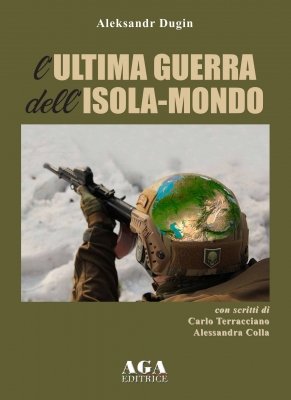
He was recently in Italy to present his book “Putin against Putin” published by AGA Editrice, in which he draws an unprecedented portrait of the Russian president. Also published by AGA Editrice is "The Last War of the Island-World", in which the Russian philosopher analyzes the geopolitical evolution of Russia as a global "tellurocratic" power, from its origins to the current presidency of Vladimir Putin.
The following interview was conducted by Paolo Becchi and Donato Mancuso.
Professor Dugin, in your latest book you identify Russian civilization with the "civilization of the Earth". We want to briefly explain the meaning of this definition?
As I tried to explain in my book, geopolitics admits two global positions. Mackinder calls them “the seaman's point of view” and “the landman's point of view”. These are two types of civilizations: the dynamic civilization of the Sea (progressist, mercantile) and the static civilization of Earth (conservative, heroic).
Historical examples? Carthage against Rome, Athens versus Sparta. Classical geopolitics is also based on the fact that the territory of contemporary Russia, before the Soviet Union (USSR) and even before the Russian Empire, constitutes the Heartland, that is, the nucleus of the entire Eurasian continent. Mackinder calls this area “the geographical pivot of history”. Therefore, from a geopolitical point of view, Russia is more than the Russian Federation in its current administrative boundaries. Russian geopolitics is by definition the geopolitics of the Heartland, that is, the geopolitics of the Earth. From the Zarathus of Moscow through the Russia of the Romanovs and the Soviet Union to today's Russian Federation, from the 15th century to the 21st century, Russia has been – and continues to be – a global hub of "Earth civilization", a continental Rome.
And what role does Putin play? In “Putin vs. Putin”, you talk about a solar Putin and a lunar Putin. Sul presidente della Federazione Russa si è detto di tutto, both positively and negatively. But who really is Vladimir Putin?
Vladimir Putin changed the history of Russia and humanity, because with his actions, with his decisive defense of Russian sovereignty, it has put the unipolar model into crisis in the geopolitical sphere, favoring the transition to a multipolar model, which, however, has not yet definitively established itself.
This is a complex historical figure. On the one hand, Putin is the projection of the Russian people as a historical entity, that is, it represents Russia itself, and wants to assert its identity and sovereignty. I call this Putin the “solar Putin”. He is the best known Putin, a figure who is admired by populists in the West, for whom it represents the possibility of geopolitically transforming the unipolar model into a multipolar one, opening up new possibilities for all peoples, and hated by globalists, for whom it constitutes the problem, the challenge to unipolar hegemony.
But there is another side of Putin that is much less known. It is the Putin that Russian society sees in domestic politics, where he achieved less success. My most important criticism is that Putin has not given an institutional dimension to his reforms. For this reason everything has unfortunately remained reversible. Putin has not gone so far as to make his reforms irreversible. This aspect represents the "lunar Putin" who does not want or perhaps cannot institutionalize his sovereignist model. For this reason his power - which is currently stable and strong - simultaneously underlies a weakness and that is, it leaves the door open to the possibility of destroying everything that Putin has managed to do once he leaves the scene.
What impression did he have of a country like Italy governed by two anti-system political forces?
I'm very enthusiastic. Two forms of populism, the “right” populism of the League and the “left” populism of the Five Star Movement, they overcame old divisions and formed the government together. It is the historical moment in which populism won over the liberal globalism of the political "centre"..
This government is the realization of the hopes I have had for many years, that is, that the people must represent themselves beyond the division between the left and the right and in opposition to the political center, which today is no longer either right or left.
The globalist liberal center, whose emblem is George Soros, it represents in itself the economic right and the cultural left. Populism represents the potentially opposing ideology, in which social justice combines with political traditionalism, to the defense of the family, of traditional European values, of sovereignty and identity. This populism that we see emerging in Italy but also in Austria, Hungary, in the United States, this populism that is growing more and more, it represents a new political form and a new political subject: the people, which is not just a group of individuals, nor the class in the communist sense, nor the nation in the bourgeois sense, but it is organic, identity, a historical-cultural subject, actor of history ignored by political modernity. With the advent of populism, we overcome modernity, on the one hand entering postmodernity and on the other returning to premodernity.
All this is the basis of a new ideological-political model corresponding to the Fourth Political Theory, that I have developed in my works. I believe that precisely this is happening today in Italy. Italy is opening a new page in European history and is showing the way to all European peoples. This is a historic moment for Europe.
He spoke of the “Fourth Political Theory”. He wants to briefly explain what it is and how he came to elaborate it?
The “Fourth Political Theory” is anti-liberal but without falling into the trap of historical fascism and communism. For us today it is necessary to archive the classic subjects of modern political ideologies – liberalism, communism and nationalism. In the context of liberalism, the central subject is the individual, in the case of communism it is classes, in the case of nationalism it is the national state. But man is deeper than the individual, of class identity or national identity understood as formal citizenship. More important than individual, class or nation is the concept of Dasein, Heidegger's Dasein, the form of returning to the roots of the human being.
The existential dimension represented by Heidegger's Dasein is precisely the aspect forgotten by current politics. This is also the reason for radical alienation and fascist totalitarianism, communists or liberals – because today we live in the context of the third totalitarianism, liberal totalitarianism. The cause of these totalitarianisms is precisely alienation, the concept of man alienated from himself. In this sense, Heidegger's existentialism takes us back to the roots of being man. This existential concept must therefore be developed, with which we can restore the organic dimension, cultural and humanistic politics. By developing this idea we can unite the ontological metaphysical concept of Dasein with the concept of people, conceived as an existential entity. Heidegger diceva “Dasein exists ethnically”, Dasein exists through the people, because the people give culture, the language, the identity. Without these, it is not possible to be a man and this positive understanding of the organic identity of the people is precisely the basis, the foundation of Dasein.
This is the most difficult level of understanding the Fourth Political Theory, but at the same time the most important because without this revision of the quality and structure of the central subject of politics, we cannot create the alternative ideological vision to the alienation of modern European politics. Without Heidegger we cannot build a truly multipolar world.
In his conception of the multipolar world, you give a lot of importance to the European Union. However, the EU is a complex of institutions increasingly in crisis, she doesn't think so?
In reality I don't talk so much about the European Union as about sovereign Europe. The European Union has become the opposite of Europe as a sovereign geopolitical entity, independent and with its own identity. The EU is the result of unification from below, driven by economics and material interests. I believe that to reach a multipolar world it is necessary to have a completely different Europe, a Europe built from above, starting from the common classical Greco-Roman and also Renaissance tradition.
The pole of the multipolar world for me is sovereign Europe, with its European identity, with its intellectual historical destiny, with his spirit, with its value axis and its metaphysical philosophical intellectual structures. Today the fight of the sovereignists is against this globalist European Union, liberal and elitist. This is the status quo. However, I believe that at a certain point this struggle will transform into the struggle for Europe as an independent pole, free and sovereign in a multipolar global geopolitical context.
What does the Eurasianist theory consist of and what is its relationship with the sovereign Europe that you have just described?
Eurasianism, since the beginning of the 1920s, advocates the idea that Russia represents a peculiar civilization, Eurasian, which combines some traditional European aspects with some specifically Asian or Eastern aspects. The difference between Western Europe and Eurasia was essential in the vision of the original Eurasianists and is also the basis of the Eurasian project, as in the context of the multipolar world Eurasia should be recognized as a pole in itself, with a particular identity, independent of European civilization, americana, Chinese or Islamic. Eurasianism has its counterparts in Europeanism or even Americanism, nell’idea ad esempio dell’unificazione dell’America del Nord voluta da alcuni circoli americani. This was Carl Schmitt's idea of large spaces. Eurasia represents the large space located east of Western Europe but which does not correspond to Chinese or Iranian civilization.
I believe that in this context Eurasianism also represents the defense of tradition. Eurasia has preserved certain aspects of the premodern spiritual tradition, religious, cultural, ecc. In the context of Christianity it represents the tradition of Orthodox Christianity, eastern, very different from Catholic or Protestant Christianity. However, it is not only this Christian heritage that defines Eurasian civilization, ma even Genghis Khan, the empires of the Scythians, of the Turks, I'm a writer. All eastern influences were important for the creation of Russia's Eurasian identity.
I believe that in the future Eurasianism could represent the ideology of the Russians' return to their origins, to its own tradition, to one's spiritual identity, cultural. But this does not exclude the possibility of a return to the roots for other civilizations - Islamic, Chinese, european, ecc. For this reason the Eurasian concept is a concept of inclusive but not universalist multipolarity, because it gives the possibility to all cultures and civilizations to preserve their identity without imposing any universalism, be it European, Western or Russian. Eurasianism is not imperialist. The Eurasian tradition is a form of pluriversal civilization. In it there is the idea that we can accept diversity without destroying it, as for example in the case of Chechnya, in the past hostile to Russia but which today is the Republic most loyal to Moscow and Putin because the Chechens have understood that in the context of this pluralist and pluriversal unity of Eurasia it is possible to preserve their identity better than in the context of the national state.
Donald Trump threatens new tariffs against Europe and China and has adopted the hard line against John Bolton's Iran. Trump's America is an opportunity or a threat?
I am not enthusiastic about Trump's America, but it is certainly better than what Clinton's America would have been. Trump's America is selfish and fights for its own interests against everyone else, in a certain sense it represents a revolt against globalism in favor of the most brutal American imperialism. However, this is better than Clinton's radical globalism and I believe that we can use the Trump moment for our purposes because Trump still constitutes a factor of instability for the globalists.
One final piece of advice for the Italian government?
Follow your own path. It will be an arduous journey. Heroic. Today the Italian government is at the forefront of Europe. The story is open and there are many challenges ahead. You need to have a strong spirit to withstand the hard blows that will come in all forms and from all sides. This is a great test for these men and for these political parties. The only possibility of success is to have deep faith in one's own culture and in the Italian people. We Russians all want this government to win and are willing to help it in every way.
SOURCE: https://www.ariannaeditrice.it/articolo.php?item_id=61169
Similar Posts
