

Of Tony Cartalucci
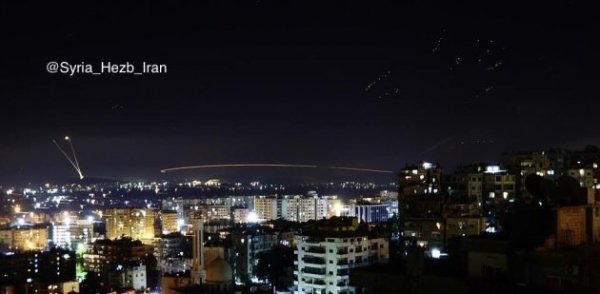
Source: Aurora site
Israel has repeatedly hit Syria with missiles and rockets, the most recent exchange took place after Israel declared that “Iranian rockets” had hit Israeli army positions in the Golan Heights which it illegally occupies. Titles, as ofIndependent, “Israel and Iran on the brink of war after the bombing of Syria in response to the alleged attack on the Golan Heights“, attempt to portray Israeli aggression as self-defense. L’Independent, However, it provided no evidence to confirm Israel's claims. For facade, with Iran inexplicably launching missiles against Israel, unprovoked and gaining no tactical advantage, strategic or political, the credibility of Israel's narrative is further eroded. But perhaps it is US public policy that designates Israel as a hostile provocateur charged with expanding Washington's proxy war against Damascus, to reveal the lethal and deceptive game that Israel and the Western media play. For years, US politicians have admitted in their newspapers that the US wants regime change in Iran and is trying to provoke a war to achieve it.
Israel takes the bait
Il Brookings Institution, financed by corporations and whose sponsors include weapons manufacturers, oil companies, banks and defense contractors, published a document in 2009 entitled “Which path to Persia? Options for a new US strategy towards Iran“, not just about the desire for regime change in Iran, but devising various options to achieve it, including sponsoring street protests in tandem with terrorist organizations known for their proxy war against Iran, as it was for Libya and Syria. Also including the provocation of Iran for a war that the politicians of Brookings they repeatedly admitted that Iran was trying to avoid. Regarding the provocation to Iran based on numerous invented cases, the document admitted: “The truth is that all of these would be difficult cases. Therefore, it would be much more preferable if the United States could cite an Iranian provocation as justification for the airstrikes before launching them. Clearly, the more outrageous, the more lethal and less provoked the Iranian intervention is, much less will the United States stay out of it. Right, It would be difficult for the United States to reproach Iran for such provocation if the rest of the world recognized the trick, undermining it. (One method that would have some chance of success would be to accelerate covert regime change efforts in the hope that Tehran would respond openly, or even partially, being able to interpret it as an unprovoked act of Iranian aggression)”. The Brookings paper even admitted that Iran may not retaliate for the most obvious provocations, such as US or Israeli air and missile attacks. Documents annotate: “…because many Iranian leaders would likely seek to emerge from the fighting in the most advantageous strategic position possible, and because they would probably calculate that playing the victim would be the best way to achieve the goal, being able to abstain from missile retaliation attacks very well”. Il Brookings he also admitted that massive air strikes against Iran would not achieve US goals, like regime change, and air strikes should be part of a broad strategy that includes US-led proxy or full-scale war. Brooking's most recent documents, come “Evaluate options for regime change" of the 2012, il Brookings Institution admitted that Israel's role, in particular the occupation of the Golan Heights, is to put constant pressure on Syria to instigate regime change. The document notes: “Israeli intelligence services have strong knowledge of Syria, as well as the Syrian regime's resources that could be used to subvert the regime and push for Assad's removal. Israel could post forces on the Golan Heights and, by doing so, divert the regime's forces from repressing the opposition. This position may raise fears in the Assad regime about a multi-front war, particularly if Turkey was willing to do the same on its border and if the Syrian opposition were fed a steady diet of weapons and training. Such a mobilization could perhaps persuade the Syrian military leadership to oust Assad to preserve itself. Supporters say this additional pressure could tip the balance against Assad in Syria, if other forces were aligned correctly”. We can assume that the objective of 2012 to take pressure off "the opposition" has failed, as Gulf-US-NATO sponsored terrorists have been defeated everywhere in Syria, except in the border regions and territory occupied by US forces in the east. Instead, Israel's role has now changed, from pressure on Syria to the attempt to provoke Iran with attacks on Syrian territory, to instigate a war with Syria and allies, like Iran, provoking Syria as described in the document 2009 from the Brookings, “Which road to Persia?” Despite continuous Israeli provocations they remained unanswered for years, every attack is presented by the Western media as defensive. At the beginning of May, when Syrian forces finally responded, Western media attempted to pass it off as an unprovoked attack, citing Israeli officials who claimed that “Iranian missiles” were fired into the Golan Heights, while according to sources on the ground, Israeli and Syrian, they said the opposite.
Syria doesn't take the bait
Syria's retaliation, However, it was proportional and reluctant. The cynical reality remains as to why. Israel's war on Lebanon in 2006, conducted with a large air force, he achieved none of Israel's objectives. The invasion failed in southern Lebanon, resulting in a humiliating defeat of the Israeli forces. While it suffered extensive damage to infrastructure, Lebanon, and in particular Hezbollah, he came out stronger than ever. Likewise in Syria, Israeli air raids and missile attacks will not be able to defeat Syria or change the West's fortunes on regime change. They only serve as a pretext to provoke a retaliation that is sufficient for the West as a casus belli for a much larger operation that would influence regime change. Attempts are underway to drive wedges into the Syrian-Russian-Iranian alliance. Arguing that Russia refuses to retaliate against US-Israeli attacks or to provide Syria with other modern air defenses, there is an attempt to represent her as weak and uninterested in the Syrian good. The fact remains that a Russian retaliation would open the door to a possible catastrophic conflict that they might not win. The delivery of more modern air defense systems to Syria will not change the fact that US-Israeli strikes will fail to achieve any tangible objectives, with or without such defenses. However, sending it would contribute to increasing tensions in the region, not to manage or eliminate them.
Because Syria has already won
Syria and its allies have eliminated the large proxy forces that the United States and its allies armed and financed to overthrow the Syrian government since 2011. Remnants of such agents cling to Syria's borders and in regions that the United States and its allies temporarily occupy. If the status quo of the conflict continues and Russia's presence remains in the region, such forces could not regroup and regain lost territory. Basically, Syria won the conflict. Effectively, parts of Syria are occupied by foreign armies. Turkey controls northern Syria and the United States controls the territory east of the Euphrates. While Syria's territorial integrity is essential, will be in the best position to reconquer these territories in the future. Maintaining the status quo and preventing the conflict from escalating is the primary concern. In the coming years, in tale status quo, the global balance of power will shift away from the US. While this will happen, Syria will have the opportunity to reclaim the occupied territory. While it is human for people to be enraged by unprovoked attacks by the United States and Israel, they are specifically aimed at provoking a response. Patience is just as important to winning a war as immediate fury. Sun Tzu stated in the strategic treatise “The Art of War”, That: “A government should not mobilize the army out of anger, military leaders should not provoke a war out of anger. Act when it is useful, give up if it isn't. Anger can become joy, anger can delight, but a destroyed nation cannot revive, and the dead cannot be resurrected”. The United States and its allies are trying to drag Syria and its allies into a war, while the United States believes it still has military primacy. Avoiding it until US military primacy is no longer there is the real key to definitively winning the war in Syria. The perfect “retaliation” will win the Syrian war, confusing and definitively defeating the United States, NATO, Persian Gulf states and Israel, without launching token missile strikes that the United States is eager to use to provoke a major, winnable war, while the current global balance of power continues to favor them.
Translation by Alessandro Lattanzio
Similar Posts
